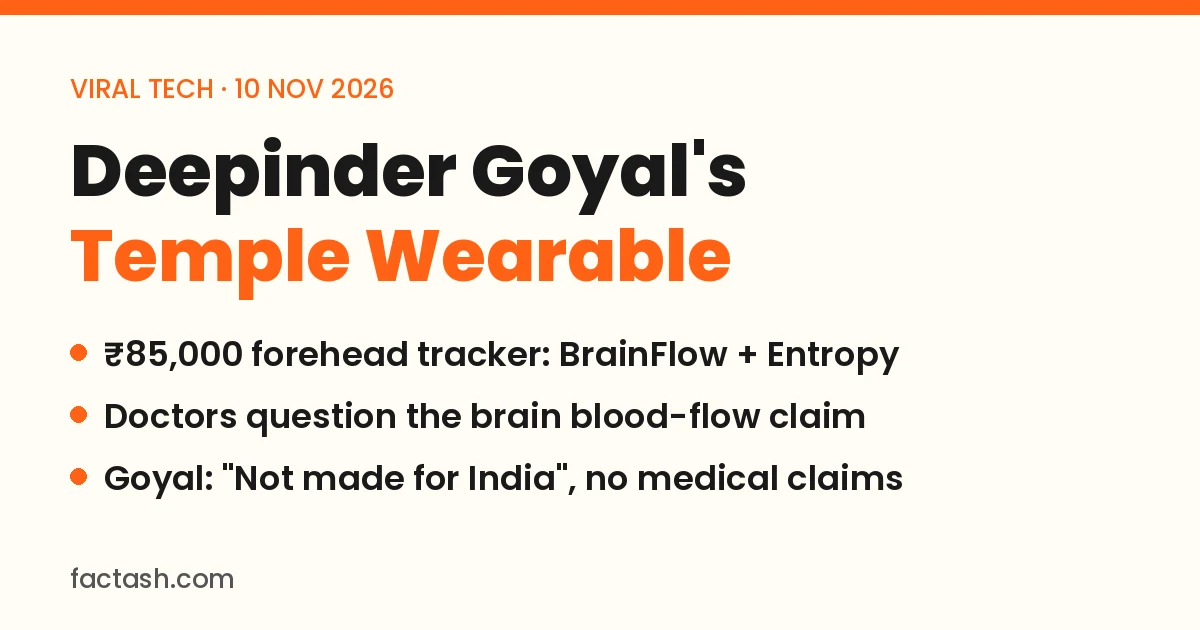
Zomato's founder built a ₹85,000 gadget you stick to your forehead, and the internet has thoughts. Deepinder Goyal's Temple wearable opened for pre-orders in India on 1 November 2026. Ten days later it's one of the loudest tech fights on Indian X: doctors say the science doesn't add up, Goyal says it was never a medical device, and his "Temple is not made for India" line poured petrol on the fire.
So what does Temple actually do, why are doctors calling it out, and is any of it worth ₹85,000? Here's the no-cap breakdown.
TL;DR
- Temple is a small, pill-shaped tracker stuck near your temple with adhesive "grips". Pre-orders opened on 1 November at ₹85,000, with deliveries expected in about three months.
- It shows two in-house scores: BrainFlow (relative changes in blood circulation linked to the brain) and Entropy (a 1 to 250 score for how hard your body is working).
- Doctors say its optical sensor reads the superficial temporal artery, which feeds the scalp and face, not the brain.
- The two BrainFlow studies so far are company-funded preprints, not peer-reviewed.
- Goyal says Temple is "strictly a fitness + AI device", has cost $30 million ($20 million of his own money) and expects under 1% of sales from India.
What is the Temple wearable?
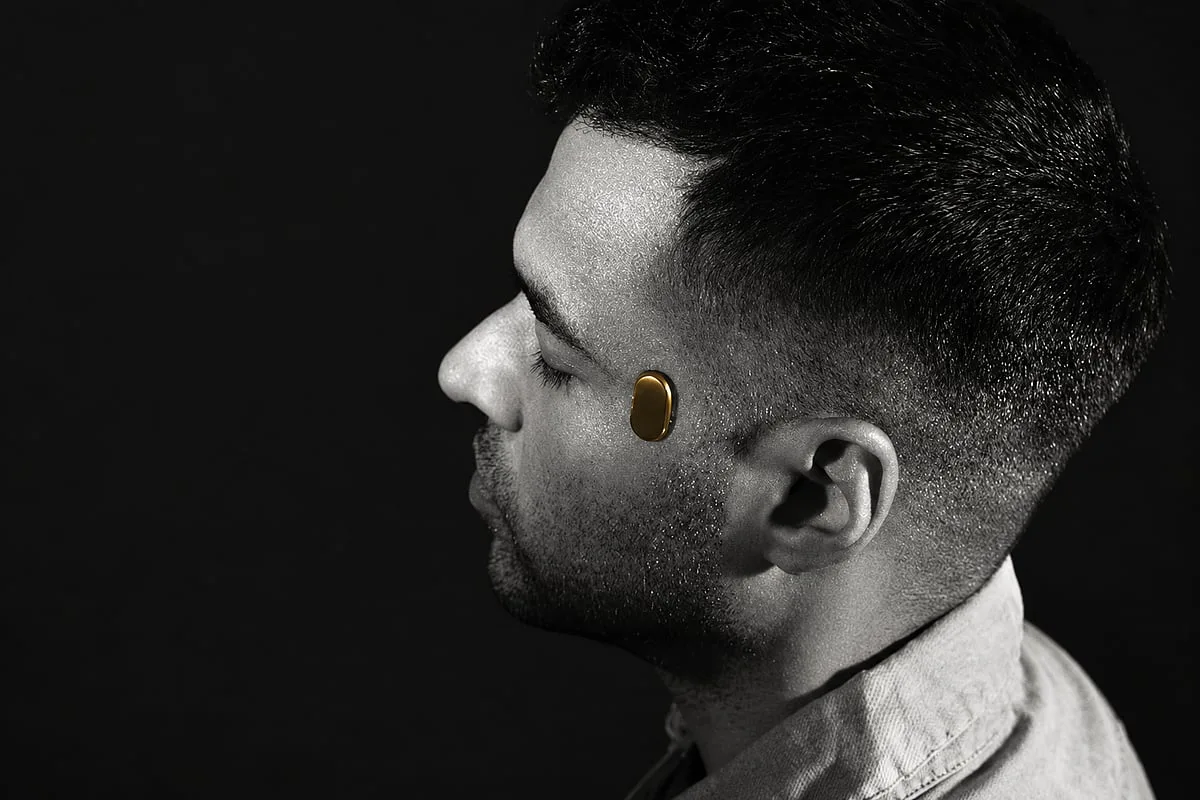
Temple comes from the wearable startup founded by Deepinder Goyal, the Zomato co-founder. It's a compact device attached to the side of the forehead with disposable adhesive bands. According to Mint, Goyal says you can wear it while running, swimming and showering, just not scuba diving.
It produces two proprietary readings, both invented by the company:
- BrainFlow: meant to track relative changes in blood circulation linked to the brain, continuously instead of in occasional clinic tests.
- Entropy: a score from 1 to 250 showing how hard your body is working to keep itself going. Lower means deeper rest; higher means more strain. Sleep, exercise, stress, food, caffeine and meditation all move it.
The device is also tied to Goyal's "Gravity Ageing Hypothesis", the idea that gravity's long-term effect on circulation could contribute to brain ageing. Fortune India points out that this is still a hypothesis, not an established explanation of ageing.
Temple wearable price in India
The first batch costs ₹85,000, which reportedly includes a lifetime app subscription. For context, that's flagship-phone money for a device with no screen. Temple isn't in general use yet: early access has gone to a small group that includes investors and people connected to Goyal, as reported by The Economic Times.
Why doctors are questioning Temple's claims
The core fight is about anatomy. Temple uses photoplethysmography (PPG), the same light-based pulse sensing that's in most smartwatches. Placed near the temple, it reads the superficial temporal artery, which supplies the scalp and face. The brain, though, gets its blood mainly through the internal carotid and vertebral arteries.
As The Federal explains, scalp blood flow can change with exercise or temperature without anything changing inside the brain, and one sensor spot may not represent the whole brain anyway.
- Dr Cyriac Abby Philips (TheLiverDoc), a hepatologist, has called the product a "scam" and said Goyal's reply was a "word salad". That "scam" allegation has not been established.
- Dr Sudhir Kumar, a neurologist, said the real questions are whether it reliably measures what it claims, whether it adds anything beyond existing metrics, and whether acting on it improves health.
- Dr Praveen Gupta of Marengo Asia International Institute of Neuro & Spine said there is no established evidence that gravity's everyday effects make the brain age faster.
Spotting overhyped claims online is a whole skill. Our guide on how to check fake news in India has a quick checklist.
What does the research actually show?
Two BrainFlow studies are out, both as preprints (shared publicly before independent peer review), according to Fortune India:
- Study 1 (medRxiv): compared Temple with transcranial Doppler ultrasound in 23 healthy adults (20 analysed per protocol) and reported correlations of about 0.8. The paper itself calls BrainFlow a relative index, not a direct measurement, and asks for more work on whether the signal is really from the brain.
- Study 2 (bioRxiv): 60 sessions with 44 healthy young men, compared against time-domain near-infrared spectroscopy. It was designed, funded and run by Temple, and its authors say superficial and systemic influences still need to be ruled out.
For Entropy, Temple claims a 0.93 correlation with metabolic-cart readings across more than 100 exercise sessions, but Goyal says the company hasn't published anything on Entropy yet.
What Deepinder Goyal said back
Goyal has been replying to critics on X. The main points:
- Money on the line: Temple has cost $30 million to develop, including $20 million of his own.
- Returns: 14-day, no-questions-asked returns. "If Temple were a scam... people would know it in just a few days," he wrote, as quoted by Daily Jagran.
- No medical claims: "Temple is strictly a fitness + AI device, and we've made no medical claims."
- Entropy first: he says the main point of Temple is Entropy, not BrainFlow.
- "Not made for India": in a note on 8 November, quoted by Times Now, he wrote: "Temple is not made for India. It's made for the world. Please check pricing. We don't expect any more than 1% of Temples being sold in India." He also said: "We don't need/want nationalist support."
- Apology: he apologised for lumping all Indian doctors together, saying his criticism was aimed at a few he called influencers.
That "not for India" line split the timeline. Some called it dismissive of the customers who built Zomato; others said a premium global product has to be priced like one.
The AI twist: a screenless voice companion
On 6 November Goyal revealed plans for a screenless, microphone-free AI companion. Motion sensors would pick up the vibrations of your voice so you can dictate messages, set reminders and save notes. He says this is an expansion, not a pivot. Temple's privacy policy allows some AI features to use third-party providers to process prompts and device metrics, while Goyal says conversations will stay end-to-end encrypted. New to AI assistants that act for you? Start with our AI agents explainer, or see how fast India is adopting AI in our story on India becoming ChatGPT's largest market.
So... should you pre-order Temple?
- Fitness nerds with spare cash: the 14-day return window lowers the risk, but you're paying ₹85,000 for scores that haven't been independently validated.
- Anyone hoping for health answers: it's not a medical device. Goyal himself says it doesn't replace seeing a doctor.
- Everyone else: wait for peer-reviewed studies and real user reviews. Goyal literally said you're "free to sit on the fence".
More viral tech, minus the hype, lives in our Technology section, and if you're shopping for smarter tools instead, check our best AI tools for 2026.
FAQ
What is Deepinder Goyal's Temple?
Temple is a small, pill-shaped wearable from Zomato co-founder Deepinder Goyal's startup. It sticks to the side of the forehead with adhesive grips and uses optical sensors to produce two proprietary scores, BrainFlow and Entropy.
What is the price of the Temple wearable in India?
Pre-orders opened in India on 1 November 2026 at ₹85,000 for the first batch, which reportedly includes a lifetime app subscription. Deliveries are expected in about three months.
Why are doctors questioning Temple?
Temple uses photoplethysmography near the superficial temporal artery, which supplies the scalp and face, while the brain is supplied mainly by the internal carotid and vertebral arteries. Doctors question whether that signal reliably reflects blood flow inside the brain, and the two BrainFlow studies are company-funded preprints that are not peer-reviewed.
Is Temple a medical device?
No. Deepinder Goyal says Temple is strictly a fitness and AI device, makes no medical claims and is not proven to diagnose or prevent any disease.
What is the Temple Entropy score?
Entropy is Temple's proprietary score from 1 to 250 that is meant to show how hard the body is working to sustain itself. Lower means deeper rest and higher means more physiological strain. Goyal says it is the product's main feature, and Temple has not yet published research on it.
Source: The Economic Times: Deepinder Goyal's Rs 85,000 Temple wearable faces scientific credibility test as doctors question claims (9 November 2026). Also referenced: Fortune India, The Federal, Times Now, Daily Jagran, Mint. Study details are as reported by these outlets; Temple's claims are the company's own.
Image credits
- Featured graphic: Factash original.
- Deepinder Goyal wearing Temple: Fortune India.