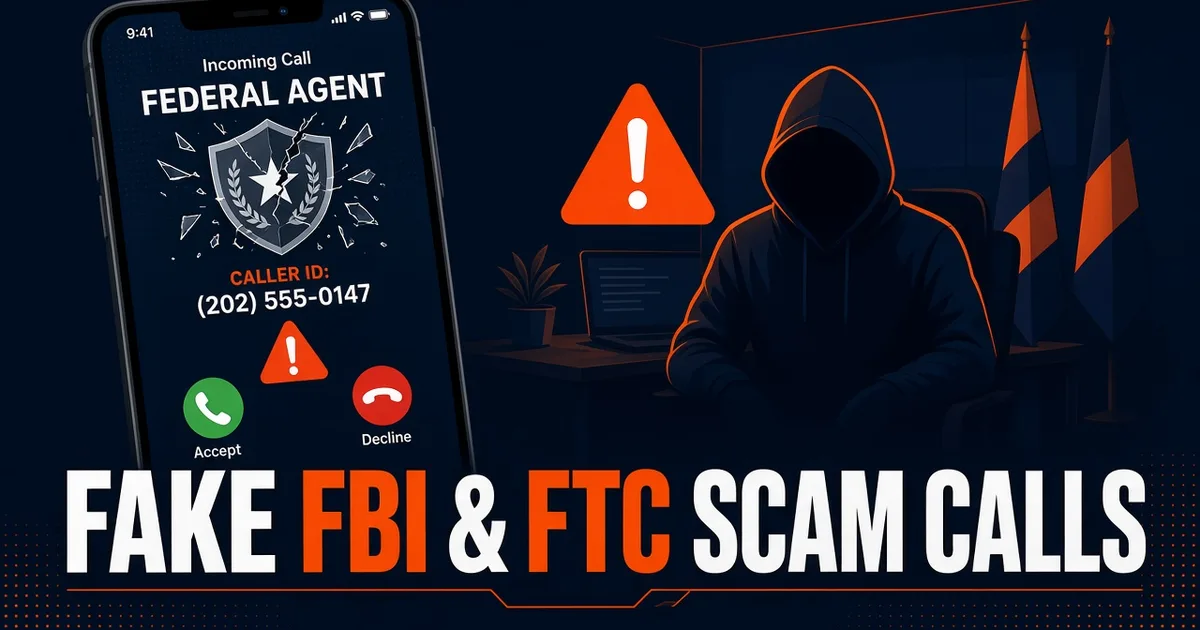
Your phone lights up with a real FBI office number. The "agent" knows your name. He says you're tied to a crime and you need to pay to fix it. Plot twist: it's a scam, and the caller ID is fake too. Bestie, this one is getting scary good, so let's break it down.
TL;DR
- The FBI says scammers are spoofing real field-office phone numbers and using real or made-up agent names.
- Some even show up on video calls with a staged "federal office" background.
- Fake FTC agents are also calling to say your number is linked to overseas fraud and will be deactivated.
- IC3 logged nearly 61,000 complaints and over $1.6 billion in losses from these scams between January 2025 and July 2026.
- Real agencies never call to demand money, gift cards, crypto or secrecy. Hang up and verify yourself.
What's happening: fake federal agents with real-looking caller ID
On 2 November 2026 the FBI's Honolulu Field Office flagged what it called a new variation of a long-running fraud. According to the FBI Honolulu warning (via Maui Now), criminals are posing as FBI, DEA and Secret Service agents and are spoofing the official phone numbers of federal field offices, including FBI Honolulu's own line.
The nasty part: when people try to double-check by calling the office back, the spoofed number can make them think they're talking to a real rep. The FBI said that in some cases people couldn't reach anyone at all and simply assumed the call was legit because the number looked like a government line.
One report described a scammer appearing on a virtual meeting platform in front of a background staged to look like a federal office, with official-looking decor and a person in business attire. Main-character energy, zero actual badge.

The numbers are wild
The FBI IC3 public service announcement I-091726-PSA, published 17 September 2026, says IC3 received nearly 61,000 complaints of law enforcement or government impersonation scams between January 2025 and July 2026, with losses of more than $1.6 billion. A few slices from that same report:
- Fake jury duty or missed court date: 6,833 complaints, losses of nearly $36 million.
- "Your license is being revoked" scams aimed at medical practitioners: 3,322 complaints, losses of more than $37 million.
- Fake foreign police or diplomats targeting immigrants, foreign nationals and international students: 1,809 complaints, losses of more than $140 million.
- "Your passport or license is expiring" scams: 496 complaints, losses of more than $348,000.
The FBI also says scammers are using AI to appear as officials on video calls. So yes, the person on your screen can look the part.
The fake FTC "we'll deactivate your number" call
Separately, the FTC warned in late October 2026 about callers who claim to be FTC officials. Per the KING 5 report on the FTC warning, the script goes like this:
- The caller says a phone registered in your name is being used to run scams in another country and reads out a fake badge number.
- They threaten to shut off your phone service if you don't cooperate.
- They transfer you to a fake police officer to "file a report". If you hesitate, they even tell you what to search online to find a police number, and their own crew answers.
- Later you're told you're under arrest and must pay a "security deposit" to avoid it.
The FTC says none of it is true. A real FTC employee will never ask you to send money or connect you to someone who does, never threaten to disconnect your phone, never tell you to keep the call secret, and never text you a photo of an ID to prove who they are.
Red flags: if you hear any of these, it's a scam
- They want payment by gift card, prepaid card, crypto, crypto ATM, wire or courier.
- They tell you not to tell your family, your bank or the police.
- They keep you on the phone the whole time and get aggressive when you push back.
- They accuse you of a crime, missed jury duty or an expiring license and threaten arrest.
- They send a link that almost matches a .gov site, like a .com version.
- They tell you which number to search for or call to "verify" them.
- They flash a badge, ID photo or official-looking video background as "proof".
What to do if a "federal agent" calls you
- Hang up. You don't owe a scammer a polite goodbye.
- Verify on your own. Look up the agency's public number yourself, call it, and say you might be the target of a scam. Don't use any number or search term the caller gave you.
- Never send money or ID photos to someone who contacted you out of nowhere.
- Screenshot everything, including any video call, and send it through tips.fbi.gov or call 1-800-CALL-FBI.
- Report it at ic3.gov (FBI) and, for FTC impersonators, at ReportFraud.ftc.gov.
- Already paid? Cut contact, call your bank right away and file a police report.
Heads-up for anyone who already lost money: a follow-up call offering to "recover" your funds for a fee is usually a second scam. Hang up, tell your bank, and file a complaint at ic3.gov yourself.
UK readers, the playbook is the same over there. Treat any unexpected call from "police" or a government body asking for money or bank details as a scam, hang up, and call back on a number you found yourself, ideally from a different phone.
Lock down the rest of your digital life
Scammers who know your name and number often got them from a breach. Check out our guide on what to do after the Amadeus data breach, switch to phishing-resistant passkeys, and secure your home Wi-Fi router. For the bigger picture, see AI cybersecurity threats to watch in 2026.
FAQ
Does the FBI call people to ask for money?
No. The FBI says law enforcement and government authorities will never contact the public by phone or text to demand payment or personal information, and never ask for prepaid cards, crypto or couriers.
Can scammers make a call look like it comes from a real FBI number?
Yes. FBI Honolulu warned in November 2026 that fraudsters are spoofing the official phone numbers of federal field offices, so caller ID alone proves nothing.
Will the FTC deactivate my phone number?
No. The FTC says its staff never threaten to disconnect your phone, never ask you to send money and never tell you to keep a call secret.
How much have government impersonation scams cost victims?
The FBI's IC3 received nearly 61,000 law enforcement or government impersonation complaints between January 2025 and July 2026, with losses of more than $1.6 billion.
Where do I report a fake FBI or FTC call?
In the US, file a complaint at ic3.gov, report FTC impersonators at ReportFraud.ftc.gov, and tell your bank right away if you sent money.
Main source: FBI IC3 public service announcement I-091726-PSA. Also referenced: FBI Honolulu warning (via Maui Now) and the KING 5 report on the FTC warning.
Image credits
- Featured graphic: Factash original.
- FBI Public Service Announcement banner: FBI / IC3.