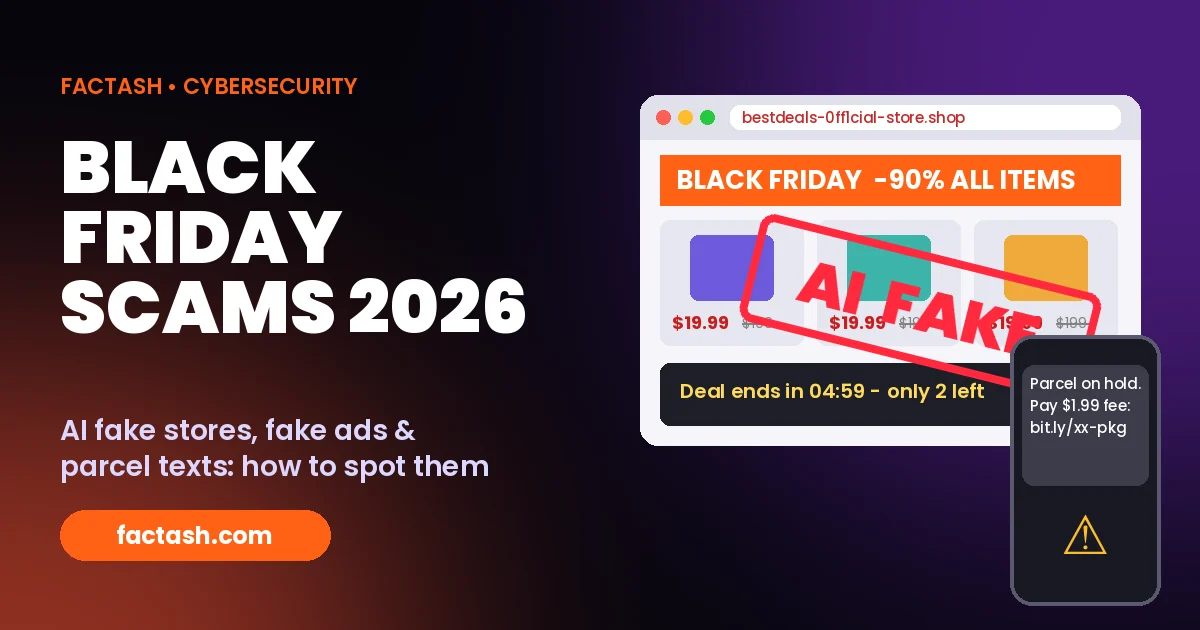
That "90% off" Black Friday deal in your feed? There's a real chance the whole store was built by AI last week and will vanish before your parcel "ships". Black Friday scams in 2026 hit different: no more typo-filled sketchy sites, just clean, professional-looking shops with paid ads behind them. Here's what's going on and how to not get played.
TL;DR
- Black Friday is 27 November 2026 and Cyber Monday is 30 November. Scammers are already live.
- Scamwise says users report a new fake store roughly every 3 minutes (about 500 a day), and fake holiday-themed stores reported to it grew 5x in 60 days.
- 85% of fake stores are gone within two weeks, so the shop that scams you on Black Friday probably doesn't exist yet.
- Switzerland's cyber agency says AI now writes flawless shop text, realistic product photos and fake reviews, and fake parcel "customs fee" texts are surging.
- Pay by credit card, never by bank transfer, gift card or crypto, and track parcels only on the carrier's own site.
What's new about Black Friday scams in 2026?
The big shift: scammers don't fake one product anymore, they fake the entire store. That's the headline finding of The 2026 Holiday Shopping Scam Report from Savi Security's Scamwise, released on 20 October 2026. It's based on more than 1 million consumer submissions to Scamwise between March and October 2026, including 250,000+ shopping sites and 100,000+ sites judged "Definitely" or "Likely a Scam".
The key numbers from the report:
- A new fake store every ~3 minutes, roughly 500 a day.
- 5x growth in fake holiday-themed stores reported in the 60 days before the report.
- At least 1 in 5 fake stores traced back to an ad on a major platform, with Meta and Google the preferred ad channels.
- Myshopify.com was the most common domain among confirmed scam cases, outranking Amazon, Etsy, eBay and Walmart combined. (That's about scammers abusing a popular store builder, not Shopify itself scamming anyone.)
- 7 in 10 fake stores are seen once and never again, nearly 40% are under 90 days old when first reported, and 85% disappear within two weeks.
- The "impossible discount" shows up in 1 in 4 scam stores, but during Cyber Week, when real shops also run 50%+ off, it blends right in.
"Scammers used to fake a product. Now they fake the whole store, with a full catalog, a return policy, and a paid ad campaign behind it," said Patrick Coughlin, co-founder and CEO of Savi Security. "Generative AI has turned scammers into big box retailers of bogus products."
Fake shops now look legit (thanks, AI)
On 10 November 2026, Switzerland's National Cyber Security Centre (NCSC, now part of the Federal Office for Cyber Security) said in its Week 45 review that it's already seeing a surge in fake online shops and parcel phishing ahead of Singles' Day, Black Friday and Cyber Monday.
Its warning applies way beyond Switzerland. Fake shops used to be easy to clock because of spelling mistakes and weird graphics. Now scammers use AI to produce natural-sounding, flawless text, realistic product images and seemingly genuine customer reviews, copy the look of well-known retailers and register lookalike domain names. Electronics, furniture, sports gear, bikes, branded clothing, watches and jewellery are popular bait.

UK bank Lloyds said in June 2026 that 68% of shopping scam reports from its customers start on Facebook, Instagram or WhatsApp. So yes, that sponsored post deserves extra side-eye.
The other Black Friday trap: fake parcel delivery texts
Everyone is expecting a parcel in November, and scammers know it. The Swiss NCSC says a new wave of fake delivery messages is expected, posing as big carriers such as DHL, DPD and Swiss Post. They claim you owe a tiny customs charge or need to confirm your address, and the link leads to a site that steals your card details or signs you up for hidden subscriptions.
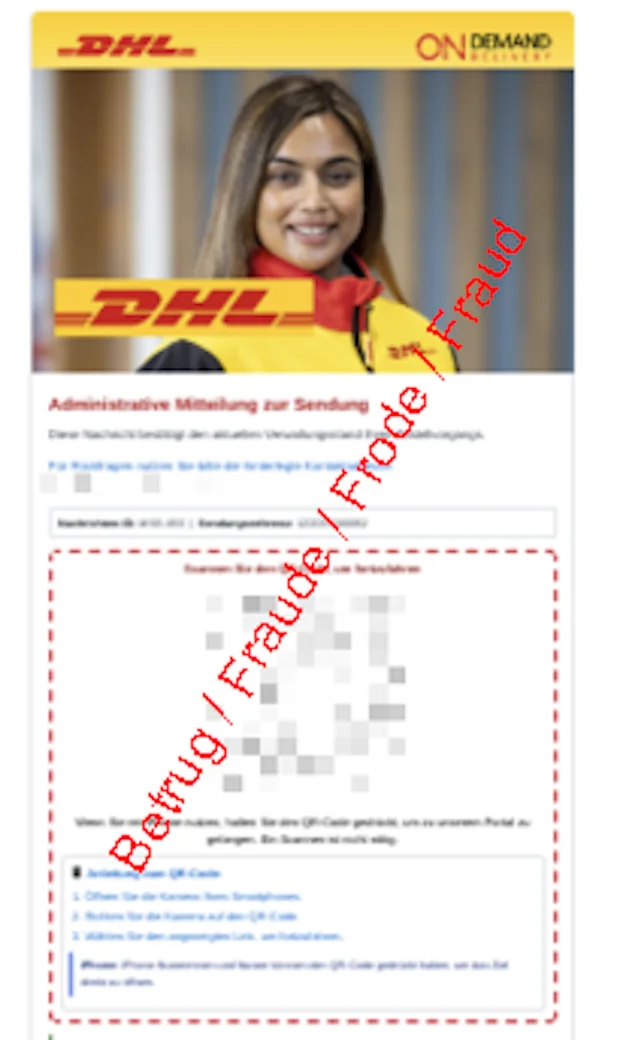
US and UK version of the same scam: a text "from" USPS, Royal Mail, Evri or DPD about a missed delivery or a small redelivery fee. The fee is never the point. Your card number is.
How much are people losing?
- UK: £11.8 million was lost to online shopping fraud over the 2024/25 festive season (1 November 2024 to 31 January 2025), according to City of London Police data shared by the UK National Cyber Security Centre.
- US: the FBI says the Internet Crime Complaint Center's 2024 report put losses from non-payment and non-delivery scams at over $785 million, with credit card fraud adding another $199 million. The FBI also notes IC3 often gets these complaints early in the year, after holiday scams play out.
Red flags: how to spot a fake online store
- The store is brand new or nobody outside its own site has heard of it.
- You found it through a social media ad, not by going to a shop you already know.
- The web address is slightly off: extra words, hyphens, misspellings or odd endings.
- Prices are wild even for Black Friday, like a whole catalog at 80-90% off.
- Countdown timers and "only 2 left" pressure you to pay right now.
- Weird payment options: bank transfer, gift cards, crypto or a payment app only.
- Reviews only live on the store's own page, or they're short and generic.
- No real contact details, postal address or clear returns policy.
Heads-up: the padlock or "https" only means the connection is encrypted. It does not prove the business is real.
How to shop safely this Black Friday and Cyber Monday
- Go to the retailer yourself. Type the address or use the official app instead of tapping ads or links in emails and texts.
- Look up the store, not just the deal. Search its name plus "review", "complaint" or "scam" on independent sites.
- Pay by credit card where you can. In the UK, Section 75 of the Consumer Credit Act makes the card provider jointly liable for single items over £100 and up to £30,000. Never pay a new seller by bank transfer.
- Check out as a guest and don't let random sites save your card, as the UK NCSC's Stop! Think Fraud advice suggests.
- Turn on 2-step verification (or better, passkeys) on your email, shopping and bank accounts.
- Track parcels only on the carrier's official site using the tracking number from the retailer. Never pay a "fee" through a text link.
- Stay alert after checkout. Scamwise says fake delivery texts, order confirmations and refund scams spike after big shopping days.
Already got scammed? Do this now
- Call your bank or card provider immediately and ask about a chargeback or Section 75 claim.
- Change passwords on any account you used, and turn on 2-step verification.
- Report it. US: ReportFraud.ftc.gov and ic3.gov. UK: Action Fraud (England, Wales, Northern Ireland) or Police Scotland. Forward scam texts to 7726 and scam emails to report@phishing.gov.uk.
- Ignore "recovery" offers. Anyone promising to get your money back for a fee is usually running scam number two.
More ways to stay scam-proof
Not sure if a website is real? See how we checked one in is ctol.digital legit?. Scammers also call pretending to be the government, so read our breakdown of fake FBI and FTC agent scam calls. If your details leaked in a breach, here's what to do after the Amadeus data breach, and don't forget to secure your home Wi-Fi router. More tech explainers live in our Technology section.
FAQ
When is Black Friday 2026?
Black Friday 2026 is on Friday 27 November, and Cyber Monday follows on 30 November. Scam stores and fake deal ads are already circulating weeks earlier.
How common are fake online stores this holiday season?
Scamwise's 2026 Holiday Shopping Scam Report says its users report a new fake store roughly every 3 minutes, about 500 a day, and that fake holiday-themed stores reported to it grew 5x in the 60 days before 20 October 2026.
How can I tell if an online store is fake?
Check how long the store has existed, search its name with words like review, complaint or scam on independent sites, look for real contact details and a returns policy, and be wary of stores found only through social media ads. A polished design and an https padlock do not prove a shop is real.
Are parcel delivery texts asking for a small fee real?
Treat them as scams. Fake DHL, DPD, USPS and Royal Mail style messages ask for a tiny customs or redelivery fee to steal your card details. Track parcels only on the carrier's official site or app using the tracking number from the retailer.
What is the safest way to pay when shopping online?
Use a credit card where you can, or a payment service with buyer protection. Never pay a new seller by bank transfer, gift card, crypto or wire. In the UK, Section 75 can make your card provider jointly liable for single items over £100 and up to £30,000.
Where do I report a Black Friday scam?
In the US, report it at ReportFraud.ftc.gov and to the FBI at ic3.gov. In the UK, report fraud to Action Fraud (or Police Scotland), forward scam texts to 7726 and scam emails to report@phishing.gov.uk. Always call your bank straight away if you paid.
Main source: Savi Security / Scamwise, The 2026 Holiday Shopping Scam Report (GlobeNewswire, 20 October 2026). Also referenced: Swiss NCSC Week 45 review (10 November 2026), UK National Cyber Security Centre Stop! Think Fraud warning, Daily Record on Lloyds shopping scam data, FBI Birmingham holiday shopping warning and Money to the Masses on Black Friday scams and Section 75.
Image credits
- Featured graphic: Factash original.
- Holiday Shopping Scam Report 2026 cover: Savi Security / Scamwise via GlobeNewswire.
- Fake online shop example and fake DHL parcel phishing message: Swiss National Cyber Security Centre (NCSC / BACS).