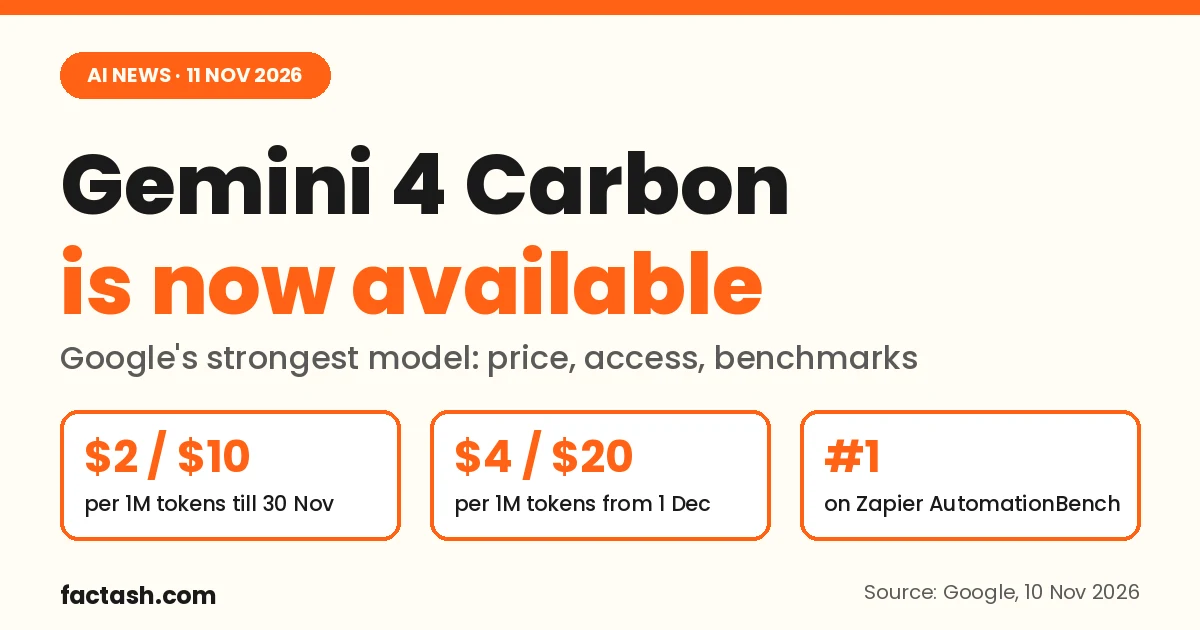
Google just dropped its biggest AI flex of the year, one day after Anthropic dropped theirs. Gemini 4 Carbon, Google's strongest model so far, became available to developers, enterprises and paying Gemini users on 10 November 2026. It's cheaper per token than Claude Fable 5.2, it tops some agent benchmarks, and it comes with a new /swarm feature that turns one prompt into a whole team of AI agents.
So is Gemini 4 Carbon actually the new king, or just the new cheap option? Here's the no-hype breakdown.
TL;DR
- Gemini 4 Carbon is Google's strongest model, built for long agent jobs, hard coding, science and cybersecurity.
- It was unveiled on 28 October for a small group of cyber defenders. The wide launch came on 10 November 2026.
- API price is $2 per million input tokens and $10 per million output tokens until 30 November, then $4 / $20.
- Consumers get it only with a Google AI Ultra subscription (Gemini app, AI Mode in Search, Antigravity).
- Google says it ranks #1 on CursorBench 4.0, Perplexity's WANDR and Zapier's AutomationBench. Independent tests still put Claude Fable 5.2 ahead overall.
What is Gemini 4 Carbon?
According to Google's launch post, Gemini 4 Carbon is "our strongest model with frontier performance in cybersecurity capabilities and long-horizon agentic workflows across complex knowledge work, software engineering, and scientific reasoning."
Think of it as Google's "big brain" tier. It sits above Gemini 4 Argon, which Google still calls the ideal choice for most coding and knowledge work. Carbon is for the stuff that breaks other models: complex multi-step coding and debugging, and open-ended research. It uses more tokens than Argon so it can explore, reason and double-check its own work. New to the whole agent thing? Our AI agents explainer has you covered.
Quick timeline
- 13 October 2026: Gemini 4 Argon opens to developers.
- 28 October 2026: Google unveils Carbon and gives early access to selected cybersecurity defenders through its Fairwind Program.
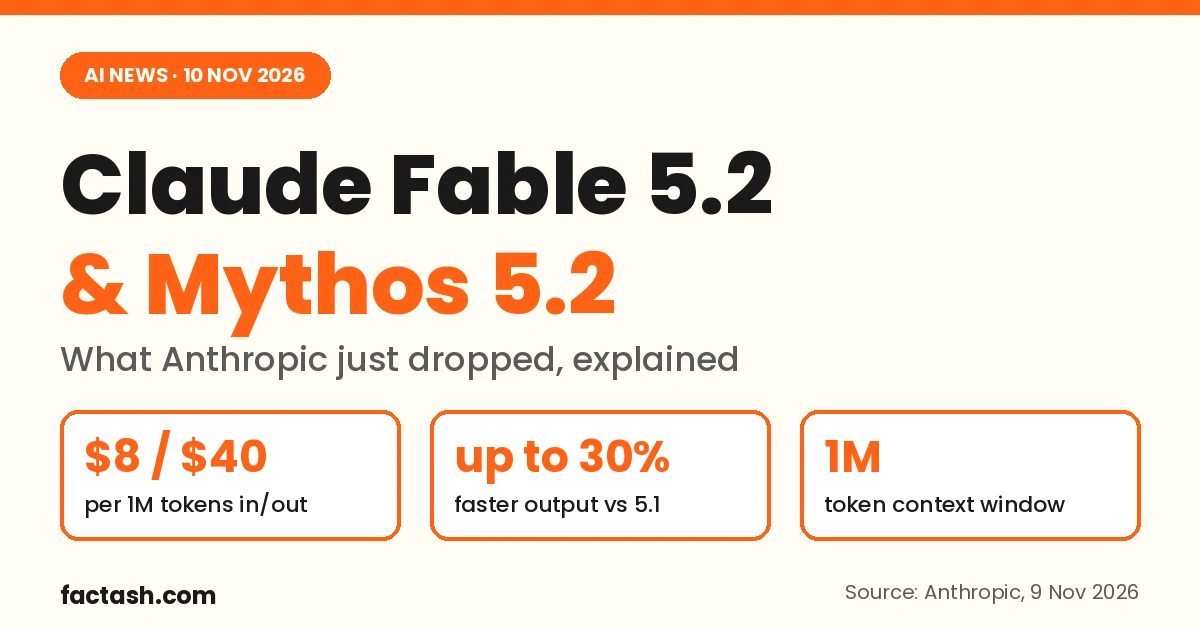
- 9 November 2026: Anthropic launches Claude Fable 5.2 and Mythos 5.2 (our breakdown).
- 10 November 2026: Carbon becomes widely available.
Dates for Argon and the Carbon unveiling are from VentureBeat.
Gemini 4 Carbon price: cheap now, less cheap in December
| Model | Input (per 1M tokens) | Output (per 1M tokens) |
|---|---|---|
| Gemini 4 Carbon (intro, until 30 Nov) | $2 | $10 |
| Gemini 4 Carbon (after 30 Nov) | $4 | $20 |
| Claude Opus 5.5 | $4 | $20 |
| Claude Fable 5.2 / Mythos 5.2 | $8 | $40 |
| OpenAI GPT-6 Astra | $10 | $50 |
Carbon prices from Google's launch post. Other list prices as reported by VentureBeat, consistent with Anthropic, OpenAI and Artificial Analysis rate cards.
So right now Carbon is one-quarter of Fable 5.2's token price, and still half once the promo ends. Artificial Analysis lists a $0.20 per million cache-hit price at Carbon's standard $4 input rate (the price after 30 November).
But token price is not job price. Artificial Analysis estimates an average cost per task on its test suite of $7.76 for Carbon (high) against $9.08 for Fable 5.2 (high) and $26.54 for Fable 5.2 (max). At medium effort, Fable was actually cheaper per task ($3.80 vs Carbon's $6.59). Cheaper per token doesn't always mean cheaper per finished job.
Who can use Gemini 4 Carbon (and where)
- Developers: paid tier of the Gemini API in Google AI Studio and Android Studio. AI Ultra subscribers can also try it in Google Antigravity and AI Studio.
- Enterprises: Gemini for business (API or model dropdown), Google Antigravity and CodeMender.
- Everyday users: the Gemini app and AI Mode in Search, but only with Google AI Ultra. Google's US Ultra plans are $99.99 a month (Ultra 5x) and $199.99 a month (Ultra 20x).
- Scientists: Google is adding Carbon to its program that gives selected scientists free access to Antigravity's highest usage tier for six months.
- Cyber defenders: a separate "Carbon for cyber" version stays behind the Fairwind Program application.
Free Gemini users don't get Carbon yet. If you just want a solid everyday chatbot, our ChatGPT vs Claude vs Gemini guide is a better place to start.
Gemini 4 Carbon benchmarks: where it wins, where it doesn't
Google says Carbon ranks #1 on CursorBench 4.0, Perplexity's WANDR and Zapier's AutomationBench, at more than 2x lower cost per task than the next best external model. Here's what independent numbers show:
| Test | Gemini 4 Carbon | Claude Fable 5.2 | Who wins |
|---|---|---|---|
| Artificial Analysis Intelligence Index | 60 (high) | 65 (max) | Fable |
| Zapier AutomationBench | 53.88% (high) | 51.45% (max) | Carbon |
| Terminal-Bench 4.0 | 65.2% (high) | 61.6% (best run) | Carbon |
| FrontierCode 2.0 (real repo changes) | 40.6% (high) | 49.1% (best run) | Fable |
| Terminal-Bench-Science 0.1 | 64.8% (high) | 73.3% (max) | Fable |
Sources: Artificial Analysis (Intelligence Index, Terminal-Bench 4.0, FrontierCode 2.0, Terminal-Bench-Science 0.1, and cost per task); Zapier's AutomationBench leaderboard.
Plot twist: VentureBeat says Google's launch materials don't publish the underlying scores for its CursorBench and WANDR claims, and the public tables it reviewed didn't include a Carbon row, so those two claims are unverified for now. The honest summary: Carbon is the value pick for business-workflow agents; Fable still leads on hard coding and science.
/swarm: one prompt, a whole squad of agents
The feature getting the most hype is /swarm in Google Antigravity (in preview). It turns a single prompt into a coordinated team of agents you can track in real time. You put Carbon on the brain jobs (architecture, coordination, auditing) and let lighter, faster models do parallel work in isolated workspaces, with "adversarial verifiers" testing every change.
Google's demos are honestly kind of unhinged in a good way:
- An interactive 3D exhibition of the Eiffel Tower's 1887–1889 construction, built from historical photos and engineering plates with one prompt.
- A 906K-triangle 3D reconstruction of a Google office from seven public city-council planning PDFs, across 10 overnight loops.
- An open-world 3D browser game where you ride a GBike as a pelican around Google's Mountain View campus.
- A playable c. 1780 fortepiano with 61-key physics, rebuilt from CAD drawings and X-rays.
These are Google's own showcase demos, so treat them as best-case examples, not average results.
Carbon and cybersecurity
Google calls this its strongest cyber model yet. A few claims from the launch post:
- In Project Fortify, Google's internal scan-triage-fix system, Carbon hit 100% recall on scanning and 95% precision on triage on Google's internal benchmark.
- Using Carbon, Wiz found zero-day vulnerabilities in two major SaaS providers in under two hours and worked with them on fixes. Google doesn't name the companies.
- Google's AlphaProof Code project used Carbon (with other models) to help formally prove security properties of the code behind the Signal encryption protocol, in weeks instead of the years such work usually takes.
The same skills that find bugs can exploit them, which is why the stronger "Carbon for cyber" stays gated. For the defender's view, see our guide to AI cybersecurity threats businesses need to watch.
Safety: what Google says it tested
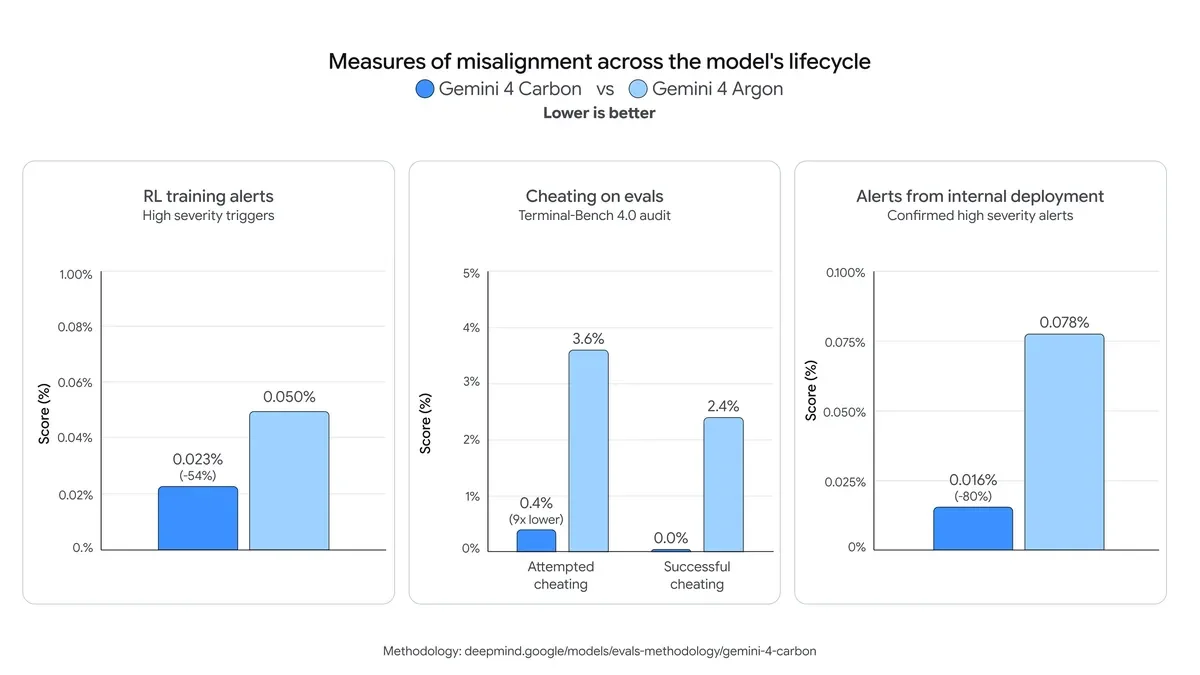
- In simulated cyberattack tests, Carbon's safeguards blocked 99% of attack trajectories from an adaptive red-teaming agent. The per-attempt breach rate fell to 0.8% (from 3.1% on Argon).
- External testing by Trajectory Labs found zero new universal jailbreaks across 132 hours and more than 13,000 requests.
- On Google's 375-task agentic honesty benchmark, Carbon passed 92% of tasks, versus 70% for Argon.
- Google says Carbon scored a 0% prompt-injection attack success rate on the Gray Swan IPI benchmark, but admits prompt-injection robustness "remains an area for continued improvement."
So… should you care?
- Casual users: unless you already pay for AI Ultra, you won't see Carbon. Our best AI tools for 2026 list is more useful for daily stuff.
- Developers: the $2 / $10 promo runs until 30 November. That's a cheap window to run your own evals against whatever you use now. Just budget for the December price.
- Businesses running agents: AutomationBench is where Carbon looks strongest, so CRM updates, support queues and multi-app workflows are worth a pilot.
- Hard coding and research: independent numbers still favour Claude Fable 5.2. Test both on your real tasks.
The AI race is now moving in days, not months. Google's AI is also landing in classrooms; see our story on Google bringing AI search to schools.
FAQ
When was Gemini 4 Carbon released?
Google unveiled Gemini 4 Carbon on 28 October 2026 for selected cybersecurity defenders and made it widely available on 10 November 2026.
How much does Gemini 4 Carbon cost?
$2 per million input tokens and $10 per million output tokens until 30 November 2026, then $4 and $20.
Is Gemini 4 Carbon free?
No. In the Gemini app and AI Mode in Search it's only for Google AI Ultra subscribers. On the API it needs the paid Gemini API tier.
Is Gemini 4 Carbon better than Claude Fable 5.2?
It depends on the job. Carbon leads on Zapier's AutomationBench and Terminal-Bench 4.0 and is cheaper per token. Claude Fable 5.2 scores higher on the Artificial Analysis Intelligence Index, FrontierCode 2.0 and science tests.
What is /swarm in Google Antigravity?
A preview feature that turns one prompt into a coordinated team of AI agents. Carbon handles the hardest roles while lighter models work in parallel, and verifier agents test every change.
What is the difference between Gemini 4 Carbon and Gemini 4 Argon?
Argon is Google's recommended model for most coding and knowledge work. Carbon is the more powerful tier for the hardest multi-step coding, research and cybersecurity tasks, and it uses more tokens to reason and verify.
Source: Google: Gemini 4 Carbon is now available (10 November 2026). Also referenced: VentureBeat, Artificial Analysis: Claude Fable 5.2 vs Gemini 4 Carbon. Benchmark claims are as reported by the companies and evaluators named.