Last updated: 16 Nov 2026, 9:10 AM IST
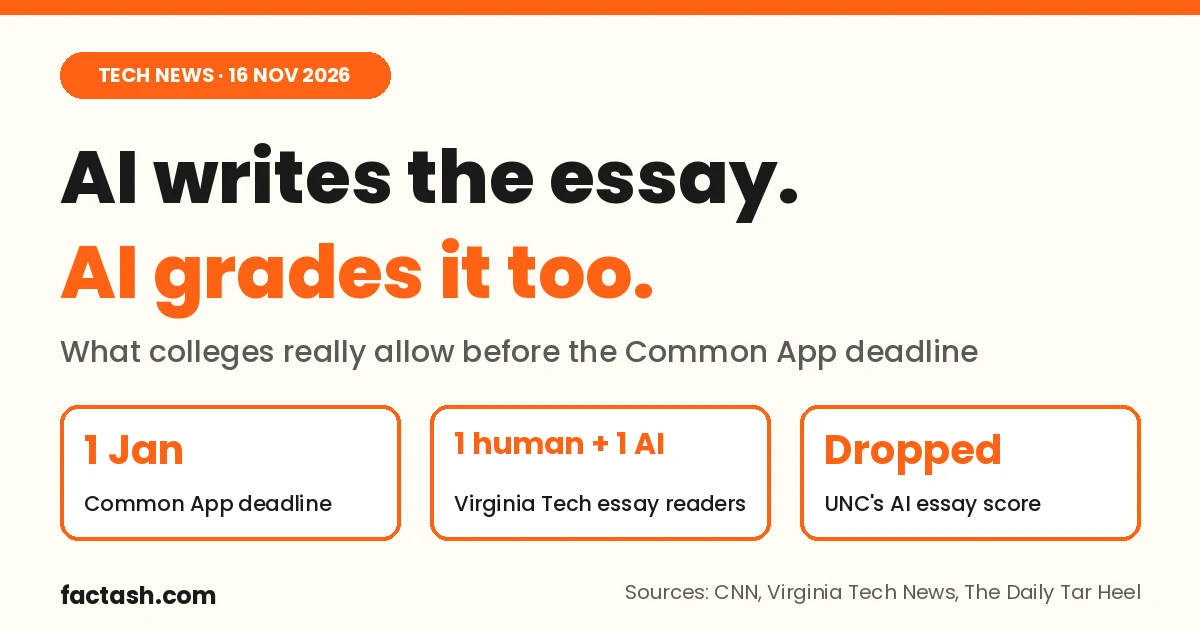
A CNN report published on 15 November 2026 says the college admissions essay "is in a very weird place". According to CNN, experts agree that many essays are now written with AI, and while colleges generally frown on that, some are using AI to evaluate essays too. With the Common App deadline on 1 January approaching, applicants in the US and abroad are asking what is allowed.
This summary is based on CNN's report by Ramishah Maruf plus the colleges' own statements.
TL;DR - Students: more and more are using AI for applications, and some are swapping paid counselors for chatbots. - Colleges: rushing to update AI rules, and each one's policy "looks a little bit different." - Colleges using AI: Virginia Tech pairs one human reader with one AI reader to score essays. UNC-Chapel Hill dropped its AI essay scoring. - Tulane cut its "Why Tulane?" essay, and says AI concerns "did play a role." - Guidance: Caltech says brainstorming help is OK, but replacing your own voice with AI content is not.
What's Actually Happening With AI and College Essays?
CNN's report says it's impossible to know exactly how many admissions essays are now written by AI, but that "experts agree that it's a lot of them."
Kate Gilbertson, a 2025 UC Berkeley grad who edits college applications full time, told CNN she's getting drafts that are missing the usual quirks of teen writing: "Those little moments of flaw tell me that this is still a 17-year-old's writing, right?"
CNN reports that students see an obvious double standard: if some universities use AI to grade essays, why can't applicants use it to write them?
Caltech's dean of undergraduate admissions, Ashley Pallie, summed it up to CNN: "students are moving faster than admissions offices."
Which Colleges Use AI to Read Essays?
The list below is based on what each school or its student paper has said publicly:
| College | What it does with AI | Source |
|---|---|---|
| Virginia Tech | One human reader + one AI reader score each essay; a second human steps in if scores differ by more than 2 points on a 12-point scale | Virginia Tech News FAQ |
| UNC-Chapel Hill | Stopped AI-assisted essay scoring for the 2026-27 cycle | The Daily Tar Heel |
| Caltech | Humans read essays; an AI reads students' scientific research and asks them questions that faculty later review | CNN |
| Dartmouth | No third-party AI detectors; an admissions officer "reads each essay" | The Dartmouth |
| Brown | Does not use third-party AI detectors (per The Brown Daily Herald, cited by The Dartmouth) | The Dartmouth |
| Tulane | Dropped the "Why Tulane?" supplemental essay; AI concerns played a role | CNN |
Photo: Virginia Tech campus, available from Virginia Tech News.
Virginia Tech: AI as a "second reader"
Virginia Tech announced the change for its 2025-26 cycle. Before, two human reviewers scored each essay. Now it's one human plus one AI model built and tested by Virginia Tech researchers on internal university resources. The school says the AI is "designed to confirm, not replace, the human reader's score" and that final decisions are made "exclusively by human admissions professionals." Its stated reason: faster, more consistent reviews and earlier decisions, without raising application fees. Virginia Tech says it received a record 57,622 first-year applications for fall 2025.
UNC-Chapel Hill: tried it, then dropped it
UNC used the Reader AI tool in the Slate admissions platform to give essays an AI score for things like grammar, vocabulary and sentence structure. For 2026-27 it stopped. A university spokesperson told The Daily Tar Heel that the widespread use of AI writing tools was diminishing the usefulness of the AI ratings: scores increasingly skewed higher, so the rating was "no longer providing a meaningful distinction" in decisions.
Can Colleges Tell If You Used AI?
There is no reliable AI detector for essays. Here is what the sources say:
- Many top schools aren't using AI detectors. Dartmouth and Brown both say they don't use third-party AI detectors on essays.
- Counselors call detectors unreliable. One counselor quoted by The Dartmouth said many AI detection tools can produce false positives.
- Human readers notice the style. Editors such as Gilbertson told CNN that many recent drafts lack the small flaws typical of teenage writing.
- The Common App has rules. Its policy, quoted by The Dartmouth, bars submitting "substantive content or output of an artificial intelligence platform" as your own work.
Photo: Caltech campus (Getty Images via CNN), viewable in the syndicated CNN report on KSL.com.
What's Allowed? The Safe Way to Use AI on Your Application
Policies differ by school, so always check each college's own AI policy. Based on what schools told CNN, the general guidance is:
- Brainstorming is usually fine. Caltech says using AI for "generating questions or exercises to help kick-start the brainstorming process" is OK.
- Ghostwriting is not. Caltech calls "replacing your unique voice and tone with AI-generated content" unethical, and the Common App bans submitting AI output as your own.
- Research help is widely used. OpenAI launched a ChatGPT college planner for teens this year, and an EAB survey cited by CNN found 82% of students who named AI tools in their college search said they used ChatGPT. "For a lot of students, AI is the college counselor they can't afford," EAB's Michael Koppenheffer told CNN.
- Recommendation letters: the University of Pennsylvania warned against AI use in letters written by counselors and teachers.
- Keep your own voice. Editors quoted by CNN say the small imperfections of real teenage writing show that the essay is genuine.
One consultant told CNN the essay exists "to show a moment of growth." Caltech's Pallie even says that in an ideal world everyone would do an interview, and the style of that interview would be "Human."
Why This Matters Beyond the US
The Common App is used by over 1,000 colleges and universities, according to The Dartmouth, so its rules also apply to applicants from India, the UK and elsewhere who apply to American colleges. The wider question of AI on both sides of a high-stakes decision is also being debated for jobs and schools, including Google's AI search push in classrooms.
FAQ
Do colleges use AI to read admissions essays?
Some do. Virginia Tech pairs one human reader with one AI reader to score each essay, with humans making all final decisions. UNC-Chapel Hill used AI essay scoring but stopped for the 2026-27 cycle. Others, such as Dartmouth, say a human admissions officer reads every essay.
Can colleges detect AI-written essays?
There is no reliable detector. Dartmouth and Brown say they do not use third-party AI detectors, and counselors warn detection tools can give false positives. Admissions readers and editors say AI essays often lack the personal quirks of real teen writing.
Is it allowed to use ChatGPT for my college essay?
It depends on the college, so check each school's policy. Caltech says using AI for brainstorming is OK but replacing your own voice with AI-generated content is unethical, and the Common App prohibits submitting substantive AI output as your own work.
When is the Common App deadline?
CNN reports the Common App deadline many students are working toward is 1 January. Individual colleges set their own deadlines; for example, Virginia Tech listed 15 January as its regular decision deadline for the 2025-26 cycle.
Why did Tulane drop its supplemental essay?
Tulane no longer requires the "Why Tulane?" essay. Its spokesperson told CNN the essay had not been very important in selection in recent years and confirmed that concerns about AI played a role.
Why did UNC stop using AI to score essays?
A UNC spokesperson told The Daily Tar Heel that widespread use of AI writing tools made the AI essay ratings skew higher, so the rating no longer gave a meaningful distinction between applicants.
Keep Reading on Factash
- ChatGPT vs Claude vs Gemini in 2026
- Best AI tools to use in 2026
- AI agents explained
- India is now ChatGPT's largest market
- How to check fake news before you share
- More Technology news
Source: main source is CNN, "As students rely on AI in college applications, admissions offices scramble to keep up" by Ramishah Maruf, 15 November 2026 (read via CNN syndication on KESQ; CNN en Español version). Also: Virginia Tech News admissions FAQ, The Daily Tar Heel and The Dartmouth. Last checked 16 November 2026, 9:20 AM IST.
Image credits
- Featured graphic: original Factash design (facts from CNN and Virginia Tech News).