Last updated: 3 Nov 2026, 3:15 AM IST
A storm named after a drum. Not a random drum, either. A warning drum.
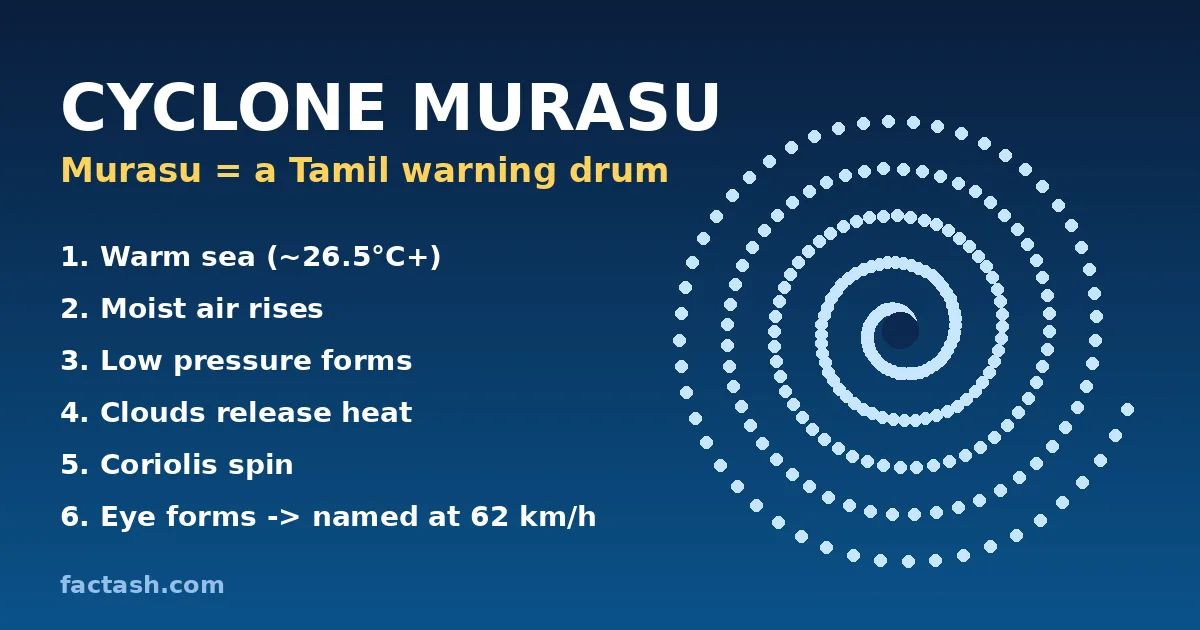
If you've been wondering about the cyclone murasu meaning, here's the short version. "Murasu" is a Tamil word for a traditional drum. In ancient South India, kings had it beaten to announce news and warn people about disasters. In 2026 it's the name of a severe cyclonic storm over the Bay of Bengal. Honestly, that's a pretty good name for a warning.
But there's more to it. Who picked the name? Why did it come right after Arnab? And how does a calm patch of ocean turn into a spinning storm? Let's get into it.
TL;DR - Murasu = a traditional Tamil drum, once used for public announcements and disaster warnings. - India proposed the name in 2020. It's the first Tamil name ever given to a tropical cyclone. - Cyclone names come from a fixed list of 169 names from 13 countries. - The next name on the list is Akvan, from Iran.
Cyclone Murasu Meaning: The Drum Behind the Name
Murasu (முரசு) is a traditional Tamil percussion instrument. According to reporting by News18 and The Hindu, it was played across ancient kingdoms to share royal announcements and public notices, and to warn people during natural disasters. People heard the drum and gathered to listen. Then came the message.
Sound familiar? That's basically what a cyclone alert does today.
The Hindu reports that the Regional Meteorological Centre in Chennai suggested names linked to the ocean, fish, coastal life and communication. Murasu made the cut because it stood for warning people, and because it suggested a thunderous sound.
Fun fact: Murasu is the first Tamil name given to a tropical cyclone since the north Indian Ocean started naming cyclones in September 2004.
Who Named Cyclone Murasu?
India did. India submitted it to the regional list in 2020.
News18 credits P. Puviarasan for the idea. He was then Director of the Weather Forecasting Division at the Chennai Meteorological Centre. Other Tamil names were considered too, like Neer (water) and Navai (boat). Only Murasu and Neer made it onto India's list.
Cyclone Murasu named by which country? (The quick answer)
India. Bangladesh, the country before India on the list, named the storm before Murasu: Cyclone Arnab, which hit the Andhra Pradesh coast in late October 2026.
How Cyclones Are Named in India
Here's a plot twist: nobody picks a name when a storm shows up. The names were all decided years ago.
The >World Meteorological Organization (WMO) and ESCAP run a panel of 13 countries: Bangladesh, India, Iran, Maldives, Myanmar, Oman, Pakistan, Qatar, Saudi Arabia, Sri Lanka, Thailand, the UAE and Yemen. Each country gave 13 names, so the list has 169 names in total.
The rules, per WMO and the >IMD's official name list:
- Countries are listed alphabetically.
- Names are used in order, column by column.
- A name is used only once. After that it's retired.
- Names should be short (max 8 letters), easy to say, and avoid politics, religion, gender and cultural sensitivities.
- The IMD's RSMC New Delhi gives the name, but only once a system becomes a cyclonic storm, with winds of about 62 km/h.
So Murasu didn't get its name because it was heading to India. It got it because India's name came after Bangladesh's Arnab in column 3. That's all there is to it.
Why cyclones are given names at all
Names are easier to remember than coordinates. They help authorities warn people clearly and avoid confusion when more than one storm is active. Before a system gets a name, IMD bulletins use labels like "BOB/09/2026". Not exactly memorable.
How Is a Cyclone Formed? Step by Step
Okay, science time. Keep it simple.
- Warm sea water. The ocean surface needs to be really warm, usually around 26.5°C or more. This is the fuel.
- Evaporation. Warm water heats the air above it. That moist air rises.
- Low pressure forms. Rising air leaves a low-pressure zone near the surface. Surrounding air rushes in to fill it.
- Clouds and heat. The rising moist air cools and forms clouds. This releases heat, which makes the air rise even faster. It's a feedback loop.
- The spin. Earth's rotation (the Coriolis effect) makes the inflowing air curve. Now it's rotating.
- The eye. As the system organises, a calm centre called the eye forms, with a wall of intense storms around it.
- It gets a name. Once sustained winds hit about 62 km/h, the IMD calls it a cyclonic storm and gives it the next name on the list.
Then it hits land, loses its warm-water fuel, and weakens. That's why cyclones fade after landfall.
Why are cyclones anticlockwise in the northern hemisphere?
That's the Coriolis effect again. In the northern hemisphere, air moving towards a low-pressure centre gets deflected to the right, so the storm spins anticlockwise. In the southern hemisphere it's flipped, and they spin clockwise.
Why Are Cyclones Formed in the Bay of Bengal So Often?
The Bay of Bengal gets more cyclones than the Arabian Sea, and it's not bad luck. Its surface water stays very warm, which is exactly the fuel cyclones need. It also gets leftover storm systems from the Pacific side. WMO rules even say that a storm forming in the South China Sea that crosses Thailand into the Bay keeps its original name.
The result? States like Andhra Pradesh, Odisha and Tamil Nadu see cyclone after cyclone. Murasu arrived only about a week after Arnab.
Cyclone vs Super Cyclone: What's the Difference?
It's all about wind speed. Here's the IMD scale (sustained winds):
| Category | Wind speed |
|---|---|
| Depression | 31–49 km/h |
| Deep Depression | 50–61 km/h |
| Cyclonic Storm | 62–88 km/h |
| Severe Cyclonic Storm | 89–117 km/h |
| Very Severe Cyclonic Storm | 118–166 km/h |
| Extremely Severe Cyclonic Storm | 167–221 km/h |
| Super Cyclonic Storm | 222 km/h and above |
Murasu was a severe cyclonic storm. The IMD forecast winds of 100–110 km/h with gusts up to 120 km/h as it neared the south Andhra coast near Ongole. A super cyclone is on another level. And a name tells you nothing about strength: the next name goes to the next storm that reaches 62 km/h, whether it fizzles or goes full super cyclone.
The Next Name After Murasu
Akvan, from Iran. After that, the list continues with Kaani (Maldives), Ngamann (Myanmar), Sail (Oman), Sahab (Pakistan) and Lulu (Qatar).
That doesn't mean another storm is coming soon. It just means that whenever the next one reaches cyclone strength, it gets that name.
Myth Check: Are Cyclones Named After Women?
Nope. Not here, anyway. This one goes around every cyclone season.
North Indian Ocean names are chosen to avoid gender, politics and religion. The list is full of words for nature, objects and culture: Murasu is a drum, Arnab refers to the ocean, and Neer means water. According to WMO-based reporting in The Hindu, no tropical cyclone is named after an individual.
Stay Safe, Stay Smart
A cool name doesn't make a cyclone any less dangerous. Follow official IMD bulletins at >mausam.imd.gov.in and your state disaster authority. Ignore forwards from random sources. Disasters also bring a wave of scams and fake "relief" links, so check our cybersecurity guides before you click on anything.
Want more explainers like this? Check out the latest on our news page, browse tech explainers, or dive into the full Factash blog.
Fake Cyclone Forwards to Ignore
During every cyclone, old videos and made-up "alerts" spread quickly on WhatsApp and social media. Before you share anything:
- Trust only official sources for the track, landfall time and warnings: IMD, RSMC New Delhi, NDMA and your state disaster management authority.
- Be wary of forwards with no date, no source, or a "forward to everyone" request. Old storm videos are often reshared as new.
- Check images with a reverse image search before sharing them.
- Never share personal or bank details in reply to a "relief" or "compensation" message.
Related: How to check fake news in India: a practical 2026 guide.
FAQ
What is the meaning of Murasu?
Murasu is a Tamil word for a traditional drum. It was used in ancient South India to make public announcements and warn people about disasters.
Who named Cyclone Murasu?
India proposed the name in 2020. News18 reports that it was suggested by P. Puviarasan of the Chennai Meteorological Centre.
How are cyclones named in India?
The IMD's RSMC New Delhi takes names in order from a fixed list of 169 names contributed by 13 WMO/ESCAP panel countries. A name is used only once.
What is the next cyclone name after Murasu?
Akvan, contributed by Iran.
What is the difference between a cyclone and a super cyclone?
Wind speed. A cyclonic storm has sustained winds of 62–88 km/h. A super cyclonic storm has winds of 222 km/h or more.
Are cyclones named after women?
No. North Indian Ocean cyclone names avoid gender, and no tropical cyclone is named after an individual.
Why do cyclones weaken after landfall?
They lose their energy source, which is warm, moist ocean air. Friction with land also slows them down.
Sources: WMO, IMD (RSMC New Delhi), The Hindu, News18, India Today, Indian Express. Facts as reported on 1–2 November 2026.
Which numbers should I call during a cyclone emergency in India?
Dial 112, the national emergency number, for police, fire and ambulance. The NDMA disaster helpline is 011-1078. Follow your state and district authorities for local control-room numbers.