Ever been stuck in an IVR loop at 11 PM, pressing 9 for "more options" until your soul left your body? TRAI just noticed.
The TRAI new rules 2026 are here. On 2 November 2026, the Telecom Regulatory Authority of India notified the Telecom Consumers Complaint Redressal (Fourth Amendment) Regulations, 2026. In plain English: complaint support around the clock, a real human for at least 16 hours a day, a heads-up when you're chatting with an AI bot, and fines for telcos that close your complaint without fixing it.
Here's what actually changes for you, minus the legal jargon.
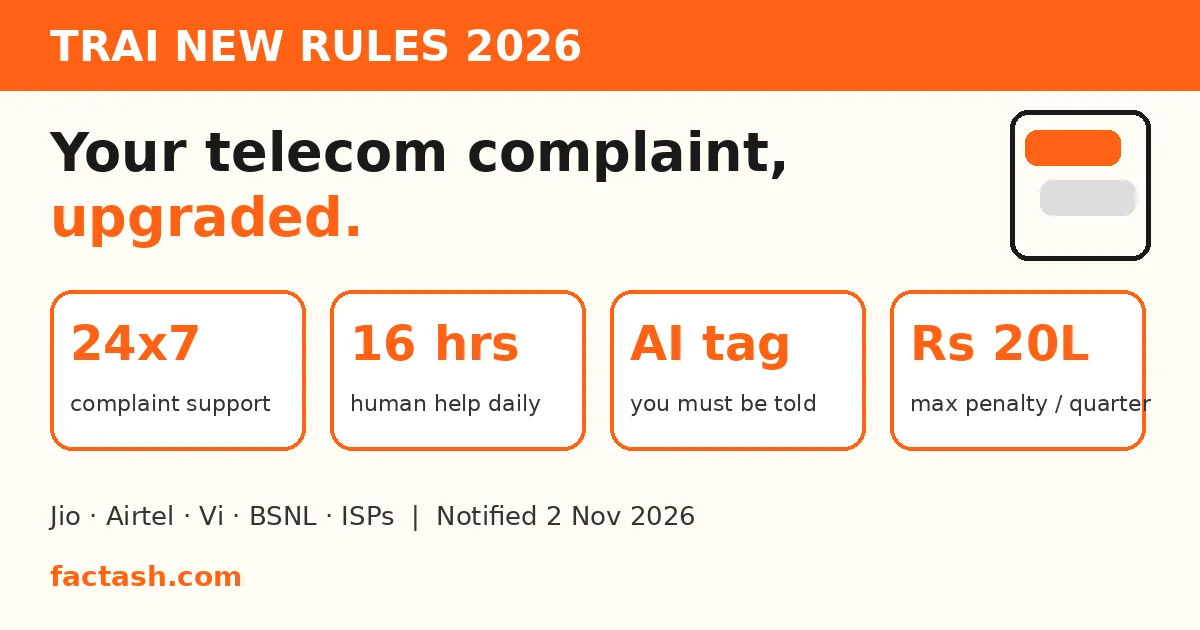
TL;DR - Complaint centres go 24x7 (earlier: 16 hours). - AI agents are allowed, but human help must be available at least 16 hours a day. - You must be told when you're talking to an AI agent. - Telcos pay ₹1,000 per wrongly closed complaint and ₹5,000 per wrongly closed appeal, capped at ₹20 lakh per quarter per service area. - You get 15 days to appeal (down from 30), and the telco must decide within 15 days.
What Are the TRAI New Rules 2026?
They're an update to TRAI's 2012 complaint redressal regulations, and they cover how Jio, Airtel, Vi, BSNL and internet providers must handle your complaints. Hindustan Times reports this is the first big rewrite in over a decade; the rules were last revised on 1 July 2014.
TRAI first floated the draft in a consultation paper in May 2026, took stakeholder comments, and then issued the final version on 2 November.
24x7 Support, But Humans Can't Ghost You
The headline change: complaint centres must work round the clock, every day of the week, instead of the old 16-hour setup.
Telcos can run this with human reps, automated systems, AI agents, or a mix. But there's a catch, and it's a good one:
- Human assistance must be available for at least 16 hours daily.
- Tech-based solutions must work with appropriate human oversight.
So yes, a bot might pick up at 3 AM. But during the day you can still reach an actual person. Telcos objected to 24x7 on cost grounds, per HT, and TRAI's answer was that 24x7 "does not necessarily imply deployment of the same level of resources" all day.
The AI Agent Rule: You Have to Be Told
This is the part that's very 2026. According to HT and Mint, telcos must notify you when you're interacting with an AI agent or chatbot. That's the first time TRAI has put AI customer care into a binding rule.
No more wondering if "Priya from customer care" is a person or a large language model. You'll know.
How the Complaint Process Changes
More ways to complain
You can now register complaints and appeals, raise service requests and ask queries through your operator's mobile app, on top of the complaint centre, website and web portal.
A cleaner IVR (finally)
TRAI has set a standard three-level structure for IVRS, apps and web portals, with separate options for complaints, appeals and queries. You also get an option to reach a human and a call-back facility. Menus must be available in English, Hindi and at least one other official language of the state, as Mint reports.
Status updates that actually update
The notified text requires updates on your complaint: an acknowledgement with a docket number, the expected resolution time, a delay notice with reasons if it's running late, and a closing message with a feedback link.
Appeals got faster
- You now get 15 days to appeal a complaint decision (earlier: 30). Don't sleep on it.
- The telco's appellate authority must give its final decision within 15 days of getting your appeal.
- The old advisory committee route is gone. Telcos must set up Consumer Grievance Redressal Oversight Committees to review their systems.
The Money Part: Penalties for Telcos
TRAI calls these "financial disincentives". Here's the breakdown:
| Violation | Penalty |
|---|---|
| Complaint improperly disposed of | ₹1,000 per complaint |
| Appeal improperly disposed of | ₹5,000 per appeal |
| Cap for the above | ₹20 lakh per quarter, per licensed service area |
| Late quarterly report (first 15 days) | Up to ₹5,000 per day |
| Late quarterly report (after 15 days) | ₹20,000 per day |
| Cap for late reports | ₹10 lakh per instance, per service area |
Note: this money goes to the regulator side, not into your wallet. But it gives telcos a reason to stop marking your complaint "resolved" when it isn't.
Does It Apply to My Wi-Fi Provider?
Probably. The rules apply to internet service providers with more than 10,000 subscribers as of the last day of the previous financial year. TRAI dropped the old alternative test based on ₹5 crore turnover.
When Do the TRAI New Rules Kick In?
Not overnight. As reported by HT, it's staggered after publication in the Gazette:
- 30 days: the rules take effect.
- 60 days: the oversight committee, survey and reporting rules.
- 90 days: 24x7 centres, the new IVRS and app-based complaints.
Bonus: TRAI's Separate AI Guidelines Draft
Different document, same vibe. On 30 October 2026, TRAI released draft guidelines on the responsible use of AI in telecom networks and services, per CNBC-TV18. Comments are open until 27 November 2026. That's a draft, not a final rule, so watch this space.
What You Should Do Now
- Always note your docket number. It's your receipt.
- If a complaint is closed without a fix, appeal within 15 days.
- If a bot is going in circles, use the human option or call-back.
- Watch out for scam "customer care" numbers and fake KYC calls. Our guide on how to check fake news in India and our cybersecurity section can help you spot them.
Want more explainers like this? Check out the news page, AI explainers, tech explainers, or the full Factash blog.
FAQ
What are the TRAI new rules 2026 for telecom complaints?
The Telecom Consumers Complaint Redressal (Fourth Amendment) Regulations, 2026, notified on 2 November 2026. They require 24x7 complaint support, at least 16 hours of human help daily, AI disclosure, faster appeals and penalties for mishandled complaints.
Can telecom companies use AI agents for customer care?
Yes. AI agents and automated systems are allowed, but they must work with human oversight, human help must be available at least 16 hours a day, and you must be told when you're talking to an AI agent.
What is the penalty for telecom companies under the new TRAI rules?
₹1,000 per improperly disposed complaint and ₹5,000 per improperly disposed appeal, capped at ₹20 lakh per quarter per licensed service area.
How many days do I get to appeal a telecom complaint now?
15 days, down from 30. The telco must give its final decision within 15 days of receiving your appeal.
When will the new TRAI complaint rules come into effect?
They take effect 30 days after Gazette publication. Some parts apply after 60 days, and 24x7 centres, IVRS and app rules apply after 90 days.
Do the rules apply to broadband and Wi-Fi providers?
Yes, to internet service providers with more than 10,000 subscribers.
Sources: TRAI press release No. 146/2026, TRAI notification of 2 November 2026, Hindustan Times, Mint, CNBC-TV18. Facts as reported on 2–3 November 2026. This is an explainer, not legal advice.