Google really said "one big model this week wasn't enough." Two days after making Gemini 4 Carbon widely available, Google launched Gemini 4 Hydrogen on 12 November 2026. It's the fast, everyday model that replaces Gemini 3.8 Flash, and unlike Carbon, it isn't locked behind a pricey subscription. It's rolling out in Google Search for everyone, and Google says free Gemini app users will get it too.
So what is Hydrogen, what does it cost, and is it actually good? Here's the no-hype breakdown.
TL;DR
- Gemini 4 Hydrogen is Google's new fast model for coding, AI agents and everyday tasks. It drops the old "Flash" name.
- It launched globally on 12 November 2026 in the Gemini API, AI Studio, Gemini for business, the Gemini app and Google Search.
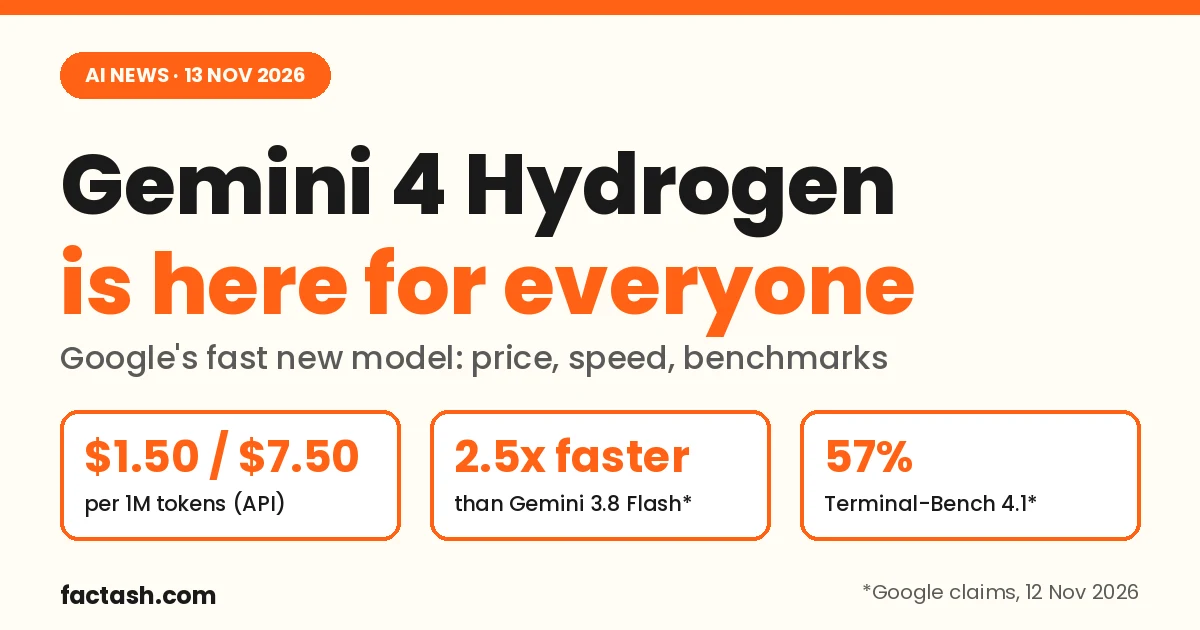
- API price: $1.50 per million input tokens and $7.50 per million output tokens, flat across its 1 million-token context window.
- Google says it's 2.5x faster than Gemini 3.8 Flash and more than triples Flash's Terminal-Bench 4.1 score (57% vs 18.2%).
- Search gets it for all users. Google says free Gemini app users get it through auto model selection, but Ars Technica reports the app version is live for AI Pro and Ultra subscribers first.
What is Gemini 4 Hydrogen?
According to Google's launch post by DeepMind's Koray Kavukcuoglu, Hydrogen brings "cutting-edge intelligence to everyone — with speed and efficiency for everyday coding and agentic workflows."
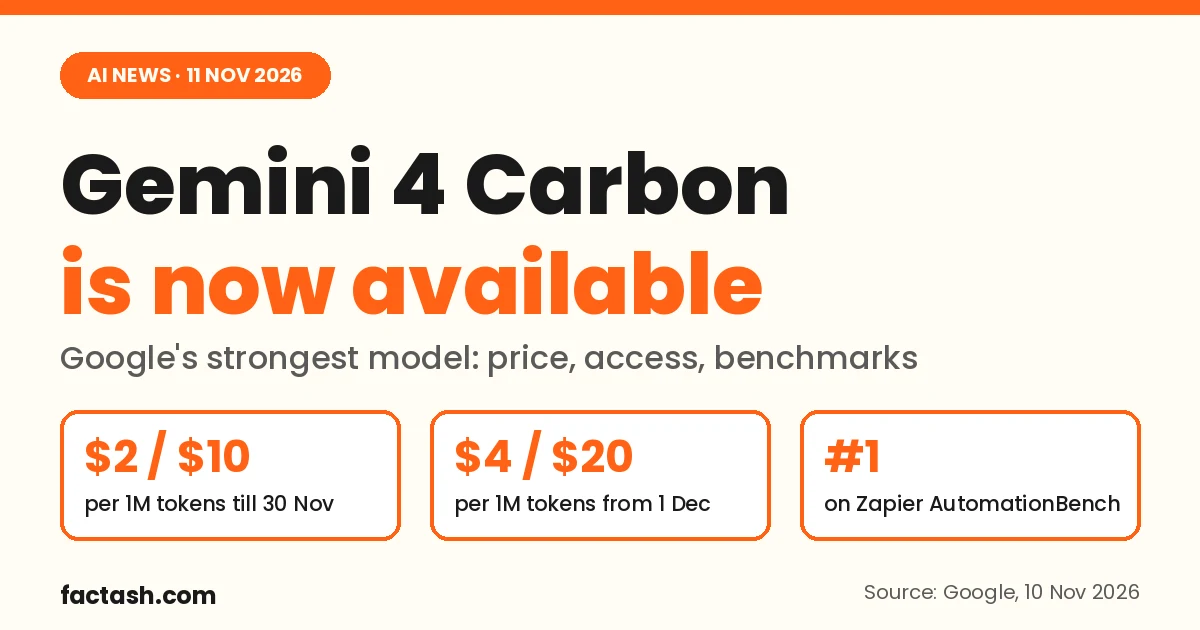
Think of Google's lineup like this. Carbon and Argon are the big brains for deep, long reasoning on your hardest problems. Hydrogen is the speedrunner: it's built to execute quickly, write code, run tests and handle everyday asks without making you wait. You can use it on its own or as the fast "worker" next to Carbon. New to agents? Our AI agents explainer has you covered, and our Gemini 4 Carbon breakdown covers the big sibling.
Quick timeline
- September 2026: Gemini 3.8 Flash launches (9to5Google).
- 10 November 2026: Gemini 4 Carbon becomes widely available.
- 12 November 2026: Google launches Gemini 4 Hydrogen and starts rolling it out globally.
- 12 November 2026 (US time): Ars Technica reports Hydrogen has replaced Gemini 3.8 Flash across Google's products.
Gemini 4 Hydrogen price
| Model | Input (per 1M tokens) | Output (per 1M tokens) |
|---|---|---|
| Gemini 4 Hydrogen | $1.50 | $7.50 |
| Gemini 4 Hydrogen, cached input | $0.075 | – |
| Gemini 3.8 Flash (intro, until 31 Dec) | $0.75 | $3.75 |
| Gemini 4 Carbon (from 1 Dec) | $4 | $20 |
Hydrogen prices from Google's Gemini API pricing page. Flash and Carbon prices as reported by VentureBeat and Google.
So yes, per token Hydrogen costs twice Flash's current intro rate. VentureBeat notes it matches Flash's scheduled standard price from 1 January 2027, and Google hasn't listed a shutdown date for Flash. Ars Technica frames the same price as unchanged from 3.8 Flash, so it depends on whether you compare against the promo or the standard rate. There's also a free tier in AI Studio.
But per-token price isn't per-job price. Artificial Analysis, quoted by VentureBeat, estimates about $1.87 per benchmark task for Hydrogen (high) versus $7.77 for Gemini 3.8 Flash (high), because Hydrogen finishes with fewer tokens. Cheaper-looking models can still cost more per finished job.
Who can use Gemini 4 Hydrogen (and where)
- Everyone: Google Search for all users, plus the Gemini app model dropdown. Google says free app users get Hydrogen through auto model selection when it fits the prompt, but Ars Technica reports that at launch it was live in the app for AI Pro and Ultra subscribers, while AI Plus and free users were still on the older 3.5 Flash-Lite.
- Developers: the Gemini API in Google AI Studio and Android Studio (all tiers). Paid Google AI Pro and Ultra subscribers can also try it in Google Antigravity.
- Enterprises: Gemini for business (API or model dropdown), Antigravity, and Gemini in Google Sheets for eligible business plans.
- Sheets fans: Gemini in Google Sheets gets Hydrogen first for Google AI Pro and Ultra subscribers.
Compared with Carbon, which needs Google AI Ultra in the Gemini app, this is a much bigger reach. If you're still picking an everyday chatbot, our ChatGPT vs Claude vs Gemini guide helps.
Gemini 4 Hydrogen benchmarks: the receipts
Google's headline claims versus Gemini 3.8 Flash: tasks finished 2.5x faster at the default "high" setting, Terminal-Bench 4.1 up from 18.2% to 57%, and more than 5x fewer fabricated claims. Here's how it stacks up against rivals on Google DeepMind's own published table:
| Test | Gemini 4 Hydrogen | Claude Sonnet 5.5 | GPT-6.1 Terra |
|---|---|---|---|
| Terminal-Bench 4.1 (agentic coding) | 57.0% | 63.9% | – |
| Agents' Last Exam v1.1 (knowledge work) | 71.6% | 60.4% | 69.8% |
| OSWorld-2.1 (computer use) | 77.6% | 83.9% | 74.2% |
| HLE-Diamond (reasoning) | 58.8% | 53.3% | 47.3% |
| Terminal-Bench-Science 0.1 | 51.4% | 59.9% | 58.3% |
Source: Google DeepMind Gemini model page. These are Google's numbers.
Independent check: on the Artificial Analysis Intelligence Index, Hydrogen scores 51 at high and 54 at xhigh, a point above Gemini 4 Argon (50) and way up from Flash's 31, per VentureBeat. The honest read: Hydrogen wins on reasoning and knowledge work, while Claude Sonnet 5.5 still leads on coding-in-a-terminal, computer use and science tests in Google's own table.
Four thinking levels (and a new "xhigh")
Hydrogen has four thinking levels: low, medium, high (the default) and a new xhigh. More thinking means better answers but more time and tokens. Artificial Analysis's figures show the spread: an index score of 27 at low (about $0.29 per task) up to 54 at xhigh (about $3.16 per task). Pick the lowest level that gets the job done.
Orchestrator: Carbon plans, Hydrogen does the work
Google also announced Orchestrator in Google Antigravity, which switches between models like Carbon and Hydrogen inside one session. Google says that on Terminal-Bench 4.0, Orchestrator hit near-Carbon success rates while using 24% less quota and finishing 19% faster on average. For parallel agent setups, Carbon can coordinate while Hydrogen powers the worker and verifier agents.
What changes in Google Search and the Gemini app
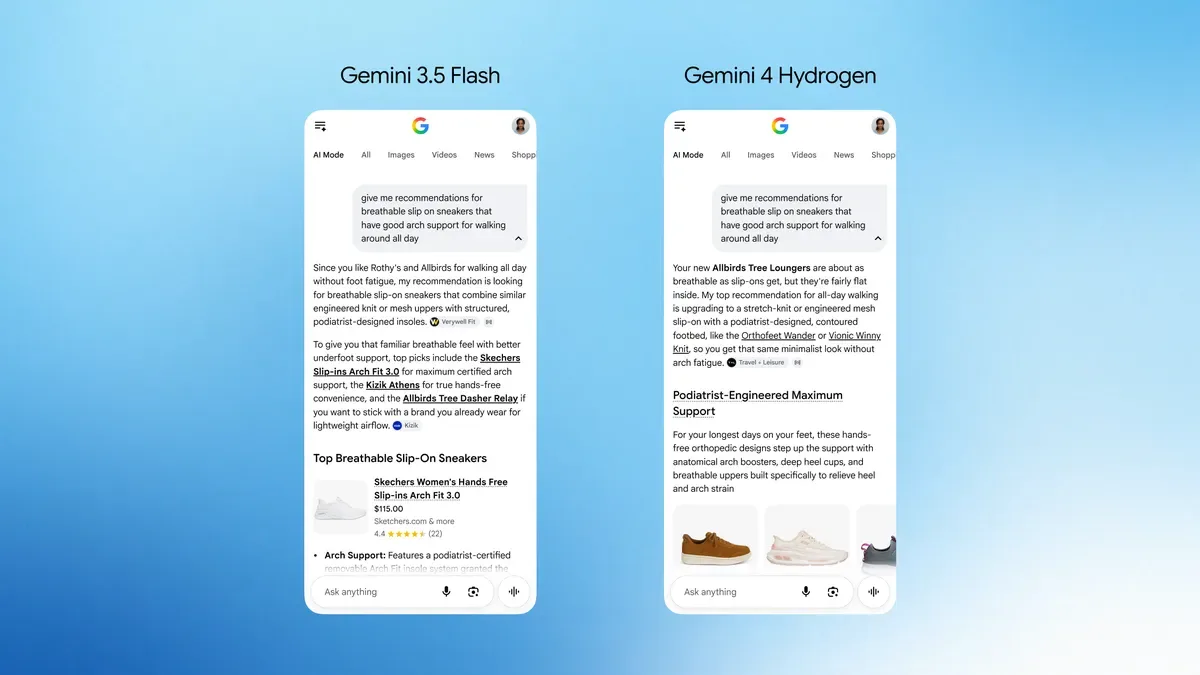
For normal people, this is the part that matters. Google says Hydrogen in Search:
- Gets your real intent, even with multi-part questions, typos or super specific requests.
- Gives more visual answers that are easier to scan.
- Shows a wider range of links, thanks to an upgraded "query fan-out" technique that searches more angles of your question.
In the Gemini app, Google says Hydrogen follows your tone and formatting rules more closely, pulls context from Gmail, Drive and connected apps like Airtable and Dropbox, and calls the right tools more often. Google's AI is also showing up in classrooms, and not without pushback; see our story on Google bringing AI search to schools.
Safety: what Google claims
- Up to 81% less overreach and 79% less under-service in agent tasks versus 3.8 Flash.
- 12x fewer misaligned actions and task shortcuts in tool-use and coding evaluations.
- A 96.7% honesty rate on Google's internal agent honesty test.
- More than 2.3x more resilient to indirect prompt injection on the Gray Swan IPI benchmark.
- False refusals on HealthBench Pro kept under 0.4%.
These are Google's internal numbers, so treat them as claims until outside testers weigh in. Ars Technica pointed out that Hydrogen isn't getting the slow, security-first rollout Carbon and Argon got; it's going straight to everyone.
So… should you care?
- Casual users: yes, a little. You'll probably meet Hydrogen in Search and the Gemini app without changing a thing. Our best AI tools for 2026 list covers what else is worth trying.
- Developers on 3.8 Flash: run your own evals. Hydrogen costs more per token than Flash's intro price but may cost less per finished job.
- Teams running agents: the Carbon-plus-Hydrogen combo via Orchestrator is the thing to pilot.
- Hard coding and computer-use work: Google's own table still shows Claude Sonnet 5.5 ahead on several tests, so compare on your real tasks. Our Claude Fable 5.2 and Mythos 5.2 breakdown covers Anthropic's latest.
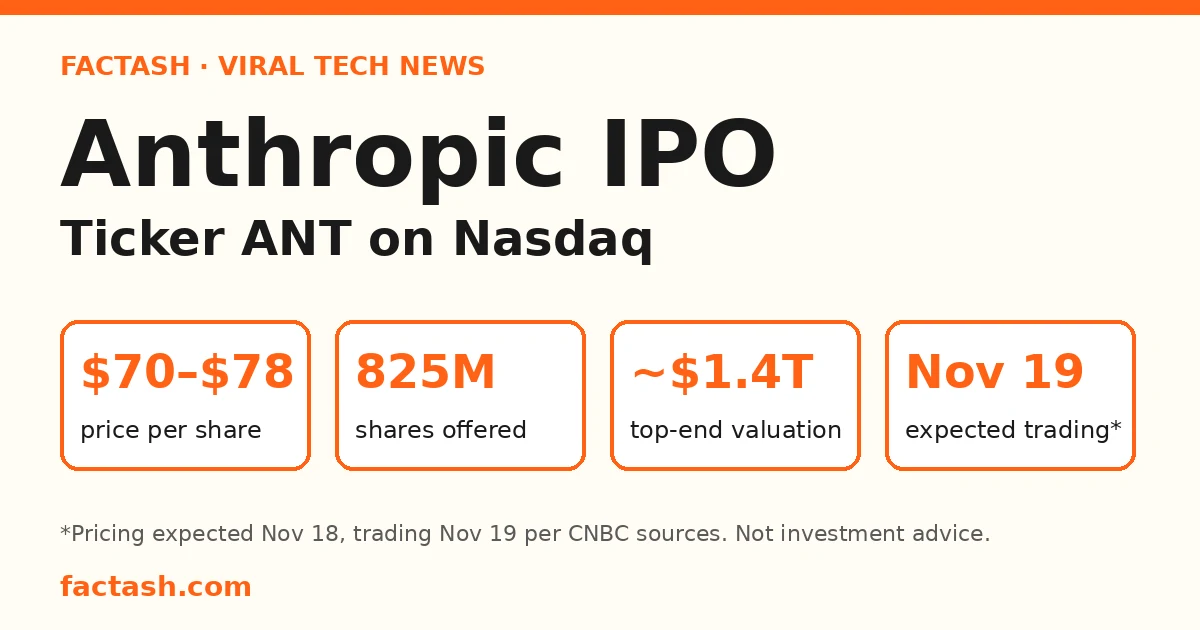
The AI race is moving in days now. Anthropic is busy with its IPO too; catch up with our Anthropic IPO explainer.
FAQ
When was Gemini 4 Hydrogen released?
Google announced Gemini 4 Hydrogen on 12 November 2026 and began rolling it out globally the same day across the Gemini API, AI Studio, Gemini for business, the Gemini app and Google Search.
How much does Gemini 4 Hydrogen cost?
On the paid Gemini API tier it costs $1.50 per million input tokens and $7.50 per million output tokens, flat across its 1 million-token context window. Cached input is $0.075 per million tokens, and there is a free tier in Google AI Studio.
Is Gemini 4 Hydrogen free?
Partly. It is in Google Search for all users. Google says free Gemini app users get it through auto model selection, though Ars Technica reports AI Pro and Ultra subscribers get it in the app first. Antigravity access needs a paid Google AI Pro or Ultra plan.
Does Gemini 4 Hydrogen replace Gemini 3.8 Flash?
Yes. Google positions Hydrogen as the upgrade for teams moving from Gemini 3.8 Flash, and it is replacing Flash in products like Search. Google has not listed a shutdown date for Flash in the API.
Is Gemini 4 Hydrogen better than Claude Sonnet 5.5?
It depends on the task. In Google's published table, Hydrogen leads on HLE-Diamond and Agents' Last Exam, while Claude Sonnet 5.5 scores higher on Terminal-Bench 4.1, OSWorld-2.1 and Terminal-Bench-Science.
What is the difference between Gemini 4 Hydrogen and Gemini 4 Carbon?
Carbon is Google's strongest model for deep, long-horizon reasoning and needs Google AI Ultra in the Gemini app. Hydrogen is the faster, cheaper everyday model available far more widely, and it can work as Carbon's worker in multi-model setups.
Source: Google: Introducing Gemini 4 Hydrogen (12 November 2026). Also referenced: Google Gemini API pricing, Google DeepMind Gemini model page, VentureBeat, 9to5Google, Ars Technica. Benchmark claims are as reported by the companies and evaluators named.