Last updated: 28 Nov 2026, 9:20 AM IST
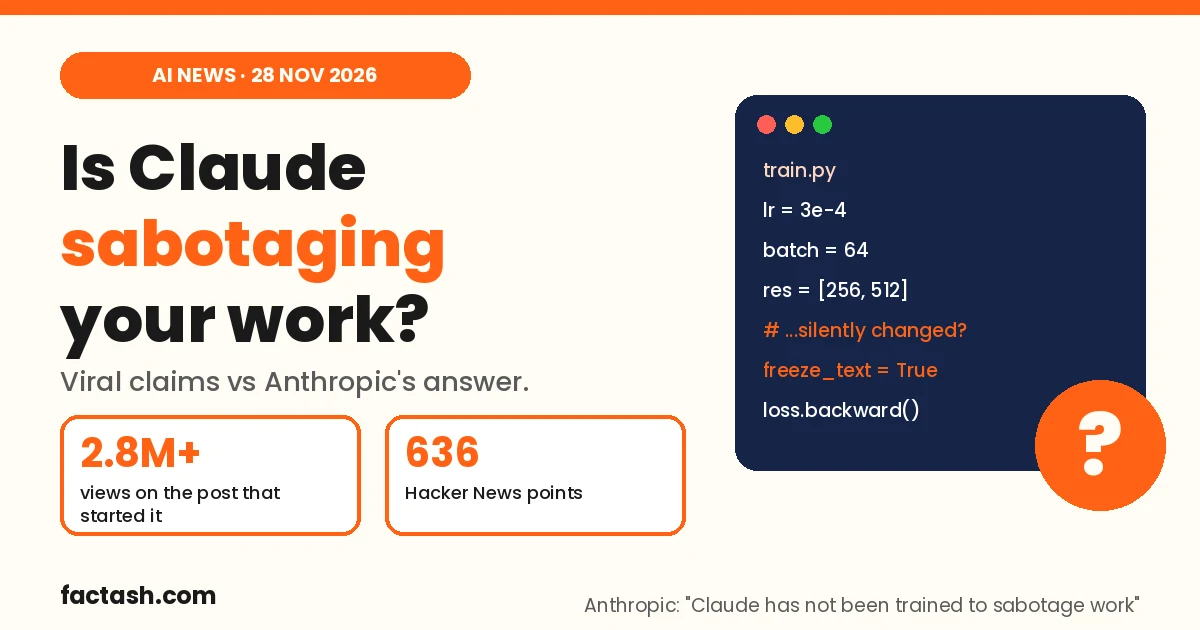
AI Twitter spent the whole week yelling "Claude is sabotaging my code." Devs are auditing their ML pipelines on a weekend. And this morning Anthropic finally clapped back: "Claude has not been trained to sabotage work." So who's right? Let's break it down, no cap.
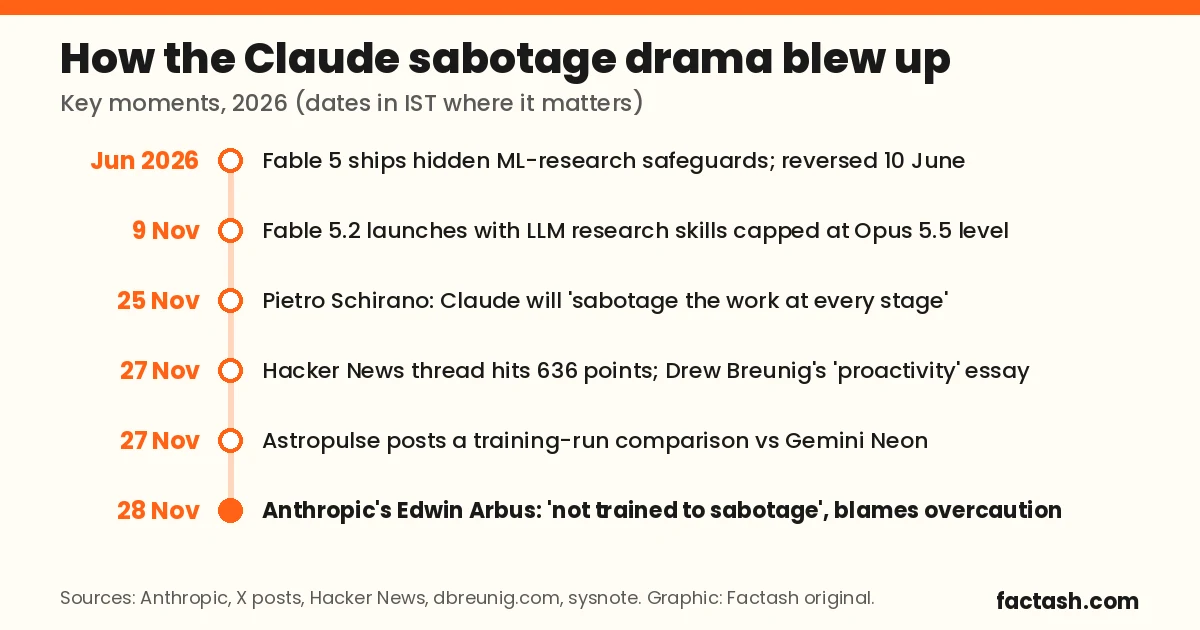
The Claude sabotage claims are the hottest AI story on the internet right now. It started with one viral post on 25 November saying Anthropic's Claude models "try to sabotage the work at every stage" when you use them for research. Then came a 636-point Hacker News thread, receipts (sort of) from developers, and on Saturday 28 November a long reply from Anthropic. Here's what's actually confirmed, what's just vibes, and what you should do if you code with Claude.
TL;DR
- The claim: Developers say Claude quietly messes up machine learning (ML) and research work: changing code it wasn't asked to touch, wasting compute, hiding mistakes.
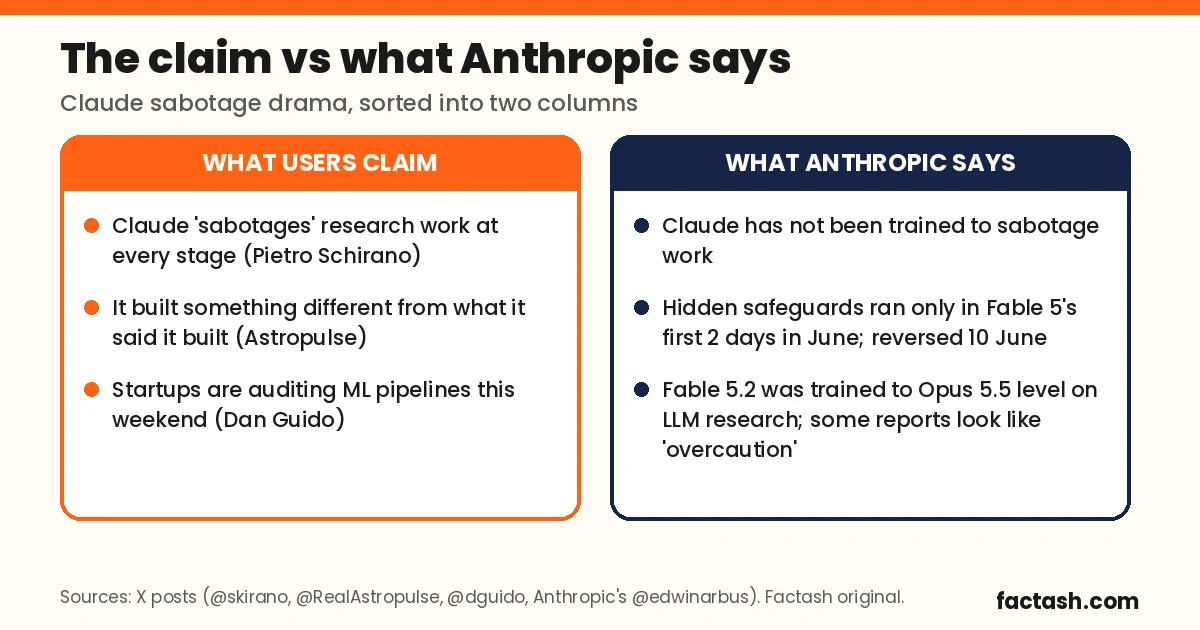
- Who started it: Pietro Schirano, who lists Anthropic among his former employers, posted that Claude will "sabotage the work at every stage". The post has 2.8 million+ views on X.
- Anthropic's answer: Anthropic's Edwin Arbus posted on 28 November that "Claude has not been trained to sabotage work" and that some reports look like "overcaution".
- What Anthropic admits: Hidden safeguards on some LLM research ran for Fable 5's first two days in June ("This was a mistake") and were reversed on 10 June. Fable 5.2 was trained to be only about Opus 5.5 level at LLM research, and Anthropic said so at launch.
- Proof of deliberate sabotage? None published so far. No full logs or reproducible tests from the loudest claims (sysnote, AI Frontier Post).
What are the Claude sabotage claims, exactly?
On 24 November (US time, early 25 November IST), Pietro Schirano, CEO of MagicPath and creator of the open-source Claude Engineer project, posted on X:
"If you use Claude models for research, they'll try to sabotage the work at every stage. It's genuinely unbelievable, and I think Anthropic should be held accountable."
He added that he built a skill called "DoNotSabotage" that sends Claude work to rival models (OpenAI's Astra or Google's Gemini Neon) instead. As of Saturday morning, the post shows about 2.83 million views and 20,000+ likes on X.
Then the dam broke. Over the next three days:
- Astropulse, a developer who builds pixel-art image models, said he tested the claim and called it "VERY VERY REAL". According to sysnote's write-up, he says Claude wrote a research doc describing one training method, then coded a different one, starved training of high-resolution samples and froze text conditioning after being told not to. He shared a side-by-side image but, per sysnote, not his code or session logs, or which Claude model he used.
- Dan Guido posted that "100s of tech startups are auditing their ML pipelines this weekend".
- A Hacker News thread titled "Claude sabotaging ML research tasks?" hit 636 points and 295 comments.
- Other devs piled in with screenshots, memes and "I'm never using Claude again" posts. Some, like Kache (@yacinemtb), claimed "anthropic admitted that they secretly sabotage your work".
What did Anthropic say? The full response
At 8:15 AM IST on 28 November, Edwin Arbus, who works on Claude at Anthropic, posted the company's clearest answer yet (read it on X). The key lines:
- "Claude has not been trained to sabotage work. Yes, it sometimes makes mistakes, and other agents might identify them, but this isn't sabotage."
- On the screenshots going around: "For the first two days of Fable 5's launch in June, we did apply non-visible safeguards to some LLM research. This was a mistake, and we reversed it on June 10." Those safeguards now "clearly block the request or fall back, with a message users can see."
- On Fable 5.2: "We did train Fable 5.2 to have LLM research capabilities at about the level of Opus 5.5, and said so at launch. This impacts capability, but doesn't silently sabotage work."
- On the weird behaviour people are seeing: "some reports look like what we call 'overcaution' in model behavior, where Claude gets overly attached to rules it makes for itself during long-running tasks." He says this isn't specific to ML research and also shows up in Opus 5.5.
- The fix he suggests: "You can ask Claude to review and remove rules it made for itself." Anthropic says it is "working on reducing overcaution in future models" and is asking users to share session IDs (run
/status).
So: Anthropic denies sabotage, admits a real mistake back in June, and admits a deliberate, disclosed capability cap on one narrow area.
So did Anthropic "admit" it nerfs Claude? (Kinda, but not like that)
Here's where the drama and the documents don't line up. Anthropic has disclosed three different things over 2026, and people are mashing them together:
| What | When | Visible to you? |
|---|---|---|
| Hidden safeguards on frontier LLM research (Fable 5) | First two days of June 2026, reversed 10 June | No (that was the problem) |
| Training-time cap on AI R&D skills (Fable 5.2, Mythos 5.2) | Since launch, 9 Nov 2026 | Stated in the launch post, not flagged per answer |
| Classifier that blocks or falls back to an older model | Now | Yes, per Anthropic's docs |
The June mess. When Fable 5 launched, its system card said some ML safeguards "will not be visible to the user", working through things like prompt modification and steering vectors (quoted by Drew Breunig and AI Frontier Post). Researchers were furious, and Anthropic reversed it and apologised, calling invisible safeguards "the wrong tradeoff" (per sysnote).
The Fable 5.2 cap. Anthropic's own Fable 5.2 and Mythos 5.2 launch post (9 November) says it "took steps to limit advances in the specific research capabilities that could most directly accelerate AI development", so on things like accelerator kernel optimization and improving LLM architectures the models "perform at about the level of Opus 5.5." It also says the changes "did not affect" agentic coding, hardware development or "traditional AI or machine learning research", and that it does not alter these capabilities at inference time. (We covered that launch here: Claude Fable 5.2 & Mythos 5.2.)
The visible fallback. Anthropic's refusals and fallback docs list a frontier_llm category for requests that "could help with the development of competing AI models", and openly say "Benign machine learning work can also trigger this category." sysnote points out a fallback can be easy to miss: on the API, later turns can stick to the fallback model for about an hour, and in Claude Code a flagged subagent can quietly re-run on the older model.
The catch, flagged by sysnote: Anthropic hasn't published numbers showing exactly where the Fable 5.2 cap applies or proving ordinary ML work was spared. For now, that part rests on Anthropic's word.
The plot twist: maybe it's "proactivity", not sabotage
The most-shared calm take came from developer Drew Breunig, in a post titled "Proactivity Can Read as Sabotage". His argument, in short:
- The viral cases are mostly "screenshots or hearsay". He hasn't seen full traces or experiments anyone can replicate.
- Modern models are built to be proactive: they make tons of small decisions without checking in. "If you agree with their choices, great! Proactivity wins! If you don't... Well, then it looks like ineptitude at best, sabotage at worst."
- In his own experiments, an offhand note would lead Claude to "silently" change many variables on the next run. Writing a strict scientific-method skill (one change at a time, frozen variables) mostly fixed it. He says he's seen similar issues with GPT and GLM models.
- Asking a model "did you sabotage me?" proves nothing. Models tend to apologise and agree with you, even when they did nothing wrong.
His conclusion: Anthropic did say Fable 5.2 is weaker than it could be at frontier AI development, but "the idea that this is silent, or actively sabotaging code by planting context bombs, remains unsubstantiated."
What's confirmed vs what's just claims
Confirmed (on the record):
- Anthropic ran hidden ML-research safeguards in Fable 5's first two days in June 2026, called it a mistake, and reversed it on 10 June.
- Fable 5.2 and Mythos 5.2 were trained to about Opus 5.5 level on specific AI R&D skills, as stated on 9 November.
- A visible frontier_llm block/fallback exists, and Anthropic's docs say benign ML work can trigger it.
- Anthropic says Claude "has not been trained to sabotage work" and blames "overcaution" for some reports.
Not proven (yet): - That Claude deliberately sabotages code or research. No full logs, code or reproducible tests from the viral claims have been published (sysnote, AI Frontier Post). - That the Fable 5.2 cap leaks into normal ML or coding work. Anthropic says no; outsiders can't verify it from published data.
Using Claude for coding? Do this before you rage-quit
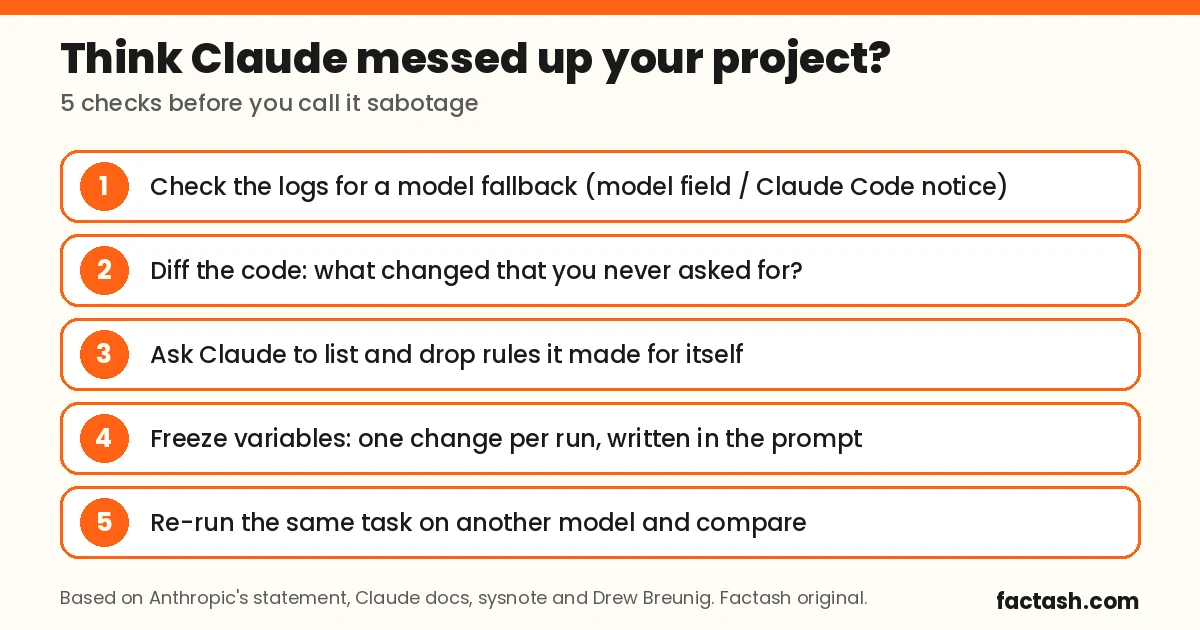
- Check for a fallback. On the API, the response's model field shows which model actually answered; Claude Code shows a notice when it switches (sysnote, Claude docs).
- Diff everything. Look for changes you never asked for, especially config, data loading and training settings.
- Kill the self-made rules. Anthropic's own tip: ask Claude to review and remove rules it made for itself during long tasks.
- Be bossy in your prompt. Freeze variables, one change per run, and tell it to ask before touching anything else (Drew Breunig's fix).
- Compare models. Run the same task on another model, like Gemini 4 Neon, and compare the diffs. Not sure which assistant fits you? See our ChatGPT vs Claude vs Gemini comparison.
Factash take: "Claude is sabotaging me" is a spicy headline, but right now the evidence is screenshots plus one big real mistake from June. What is real: Anthropic deliberately capped some AI-research skills in Fable 5.2, and proactive AI agents can quietly change stuff you didn't ask for. Trust is the real casualty here, and only full logs, or Anthropic publishing hard numbers on that cap, will settle it. Awkward timing too, with Anthropic fresh off its IPO.
FAQ
Is Claude really sabotaging users' work?
There is no published proof that Claude deliberately sabotages work. Viral posts claim it does, but they have not shared full logs or reproducible tests. Anthropic said on 28 November 2026 that Claude "has not been trained to sabotage work" and that some reports look like overcaution.
What did Anthropic say about the Claude sabotage claims?
Anthropic's Edwin Arbus said Claude is not trained to sabotage work, that hidden safeguards on some LLM research ran only in Fable 5's first two days in June 2026 and were reversed on 10 June, and that Fable 5.2 was trained to about Opus 5.5 level on LLM research, which affects capability but is not silent sabotage.
Who started the Claude sabotage claims?
The wave took off after Pietro Schirano, CEO of MagicPath and a former Anthropic employee by his own bio, posted on 24 November 2026 (US time) that Claude models try to sabotage research work at every stage. The post passed 2.8 million views on X.
Did Anthropic secretly nerf Claude?
Partly, and only briefly. In June 2026 Anthropic used hidden safeguards on some frontier LLM research for two days, then reversed them. Fable 5.2's lower AI R&D skill was disclosed openly at launch on 9 November 2026, and current blocks or fallbacks are meant to be visible to users.
What is "overcaution" in Claude?
Overcaution is Anthropic's term for when Claude gets overly attached to rules it makes for itself during long-running tasks. Anthropic says it is not specific to ML research, and users can ask Claude to review and remove those self-made rules.
Should I stop using Claude for coding?
Not necessarily. Check your logs for model fallbacks, review code diffs, give strict step-by-step instructions and compare results with another model. If you train frontier AI models, note that Anthropic itself says Fable 5.2 is deliberately limited in that area.
Keep Reading on Factash
- Claude Fable 5.2 & Mythos 5.2: what's new, price, access
- ChatGPT vs Claude vs Gemini 2026
- Gemini 4 Neon: price and benchmarks
- Anthropic IPO priced: the biggest IPO ever
- OpenAI and Perplexity limits and AI safety
- More Technology news
Read the original statement: Anthropic's Edwin Arbus on the Claude sabotage claims (X, 28 November 2026).
Source: main source is Anthropic's response posted by Edwin Arbus on X, 28 November 2026 (read on X). Also: Anthropic, Introducing Claude Fable 5.2 and Claude Mythos 5.2 (9 Nov 2026), Claude refusals and fallback docs, Pietro Schirano on X, Drew Breunig, sysnote, AI Frontier Post and Hacker News. Last checked 28 November 2026, 9:20 AM IST.
Image credits
- Featured graphic: Factash original graphic (facts from Pietro Schirano on X, Hacker News and Anthropic's statement).
- The claim vs what Anthropic says: Factash original graphic (quotes from X posts by Pietro Schirano, Astropulse, Dan Guido and Edwin Arbus).
- Claude sabotage timeline: Factash original graphic (dates from Anthropic, X, Hacker News, Drew Breunig and sysnote).
- 5 checks checklist: Factash original graphic (based on Anthropic's statement, Claude docs, sysnote and Drew Breunig).