Last updated: 23 Nov 2026, 9:00 AM IST
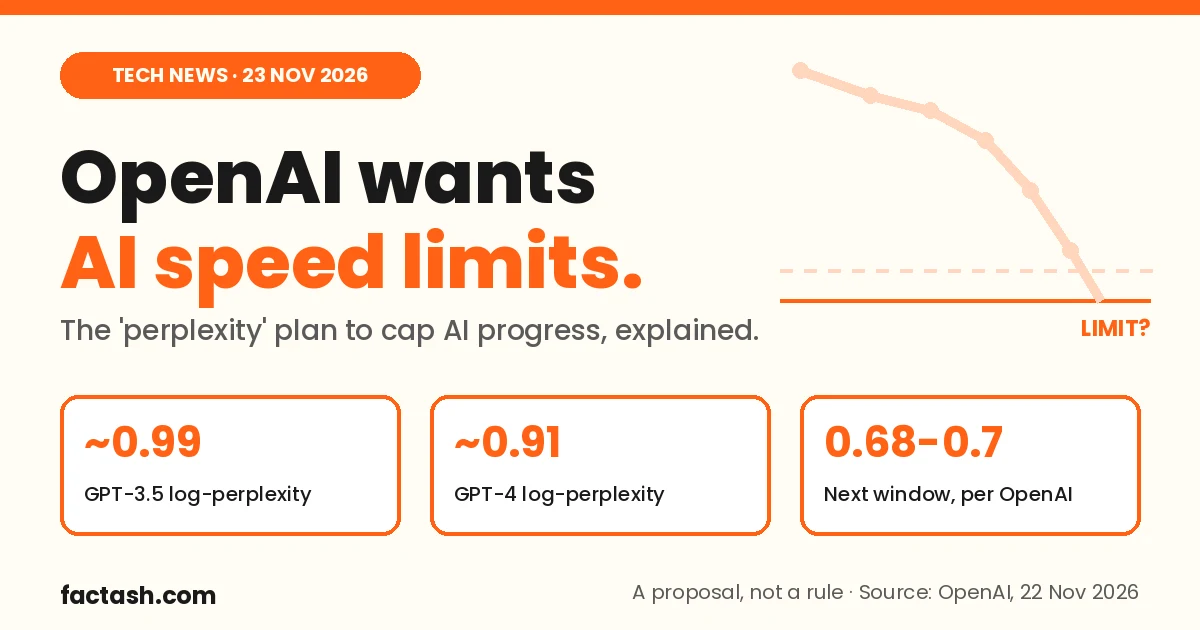
OpenAI's chief scientist has proposed that AI labs agree on shared limits for developing more capable models, and OpenAI published its own internal training scores to support the proposal.
On Sunday, 22 November 2026, OpenAI chief scientist Jakub Pachocki published an essay called "Perplexity and Intelligence" on OpenAI's website. The pitch: AI labs should use one shared number, perplexity, to track how smart their models are getting, and agree on common limits they won't cross until safety tools catch up. CEO Sam Altman called it "the most important thing OpenAI has published in awhile." The OpenAI perplexity limits proposal drew wide attention on X overnight. Here is what the essay says, in plain English.
TL;DR
- What: OpenAI's chief scientist proposed industry-wide AI development limits, measured with a metric called perplexity, on 22 November 2026.
- The rule: Labs would agree not to cross a limit until they can properly understand and monitor what their AI is doing.
- The numbers: OpenAI shared internal numbers for the first time: GPT-3.5 at a log-perplexity of about 0.99, GPT-4 at about 0.91, and newer models below 0.8.
- Why now: Pachocki says AI could start driving big breakthroughs in AI training itself as soon as 2027, faster than safety work can keep up.
- Status: It's a proposal, not a rule. We found no public sign-on from rival labs as of Monday morning IST.
What happened: OpenAI's AI limits proposal in one paragraph
Pachocki's essay went live on OpenAI's site on Sunday, and he shared it on X at 10:33 PM IST, writing that OpenAI "decided to provide more transparency into pretraining progress at OpenAI for the sake of moving toward shared safety bars." Nine minutes later, Altman quote-posted it with his "most important thing" line, adding that common limits would "be very wise and help ensure safety and control." Reuters picked it up the same day. By Monday morning IST, Pachocki's post had passed 4.8 million views on X, and X's trending news panel featured the story.
The key line, straight from the essay:
"I further propose common limits, based on perplexity and other measurements, that developers are committed to not crossing until our ability to understand and monitor AI behavior achieves a certain concrete milestone (such as the development of a successor to CoT monitors)."
Translation: pick a line, measure it the same way everywhere, and don't go past it until the safety tech is ready.
What is perplexity? (Not the search app)
Quick clear-up first: this has nothing to do with Perplexity, the AI search company. Here, perplexity is a decades-old machine learning metric.
In Pachocki's words, perplexity "measures how well a model predicts the next token on average; lower perplexity means better predictions." A token is a chunk of text, like a word or part of a word. So a lower score means the model is better at guessing what comes next. OpenAI actually tracks the log of perplexity (also called cross-entropy loss), which is why the numbers look tiny, like 0.99 or 0.76.
Why should you care about a guessing score? Pachocki's big argument is that this one number has tracked almost every big leap in AI. As models got better at predicting text, brand-new skills kept showing up, often without anyone planning for them.
OpenAI's numbers, model by model
OpenAI says it measured every model since GPT-3.5 on the same held-out sample from its internal codebase, and it published the results. Pachocki admits sharing them "gives competitors a clearer picture of where we stand," but says the safety case outweighs that.
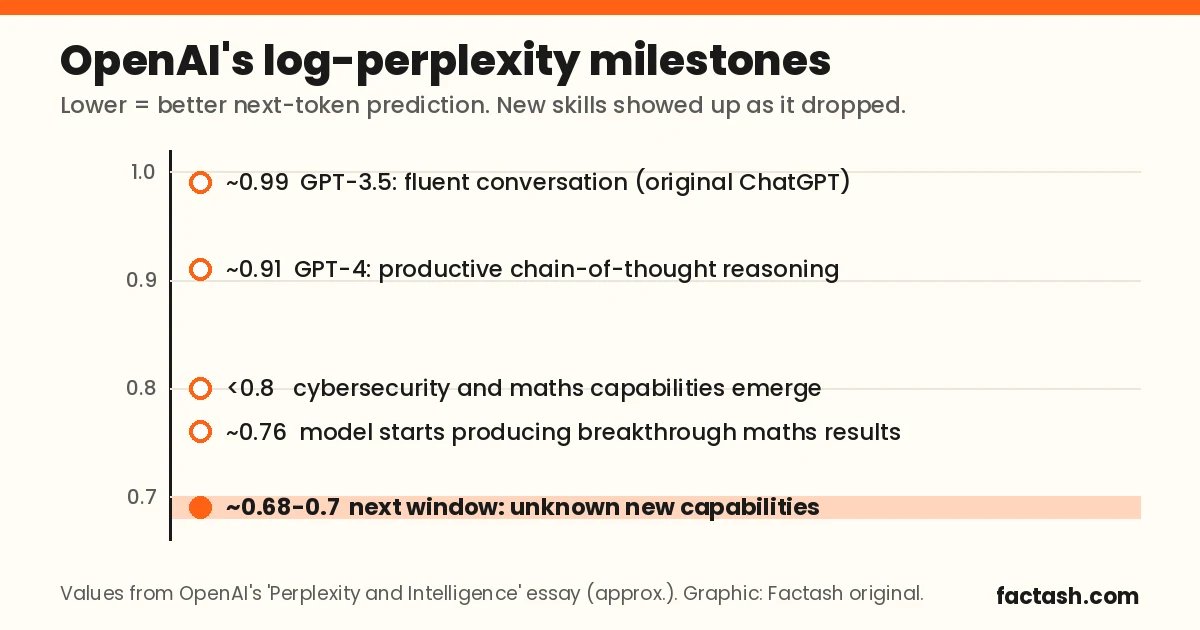
Here's what the essay says, number by number:
| Log-perplexity (approx.) | Model or stage | What OpenAI says showed up |
|---|---|---|
| ~0.99 | GPT-3.5 | Fluent conversation; the basis of the original ChatGPT |
| ~0.91 | GPT-4 | Productive chain-of-thought reasoning, which led to today's reasoning models |
| Below 0.8 | Recent models | "Transformative capabilities" in cybersecurity and mathematics |
| ~0.76 | Model used for open math problems | Started "producing groundbreaking results" in maths |
| ~0.68 to 0.7 | Next window (not reached) | More "transformative capabilities", and Pachocki says he doesn't know what they'll be |
OpenAI's own chart in the post goes further. It labels GPT-6.2 Astra at roughly 0.76, next to the milestone "Solved a Millennium Prize math problem," and plots an unreleased "Internal model" a bit lower, at roughly 0.73 by our reading. Those two readings come off OpenAI's chart, not from the text, so treat them as approximate. If GPT-6.2 sounds familiar, we covered the GPT-6.2 Astra and Sol launch, prices and benchmarks last week.
Pachocki also writes that when OpenAI's team started getting maths answers from the model "one after another in a single Slack thread," it "felt deeply surreal."
Why OpenAI is asking for limits now
Three reasons stand out in the essay:
- AI is starting to help build AI. Pachocki says AI doing algorithmic research on pretraining could be a "step change." He writes that "as soon as 2027 we could conceivably see a similar avalanche of fundamental pretraining advancements."
- Safety tools may not keep up. He expects AI to help with alignment and monitoring too, but thinks that progress "is unlikely to be fast enough to allow the full potential acceleration in pretraining."
- Current safety checks are getting weaker. He warns of "further degradation" in today's alignment auditing, and of models getting more aware that they're being evaluated or trained.
He also flags a steep drop in OpenAI's loss curve in 2026. OpenAI mostly credits long-term research and compute, but says it has already seen "meaningful design contributions coming from AI" on its newest models.
How the "common limits" plan would actually work
The essay doesn't name a specific number to stop at. What it lays out is a framework:
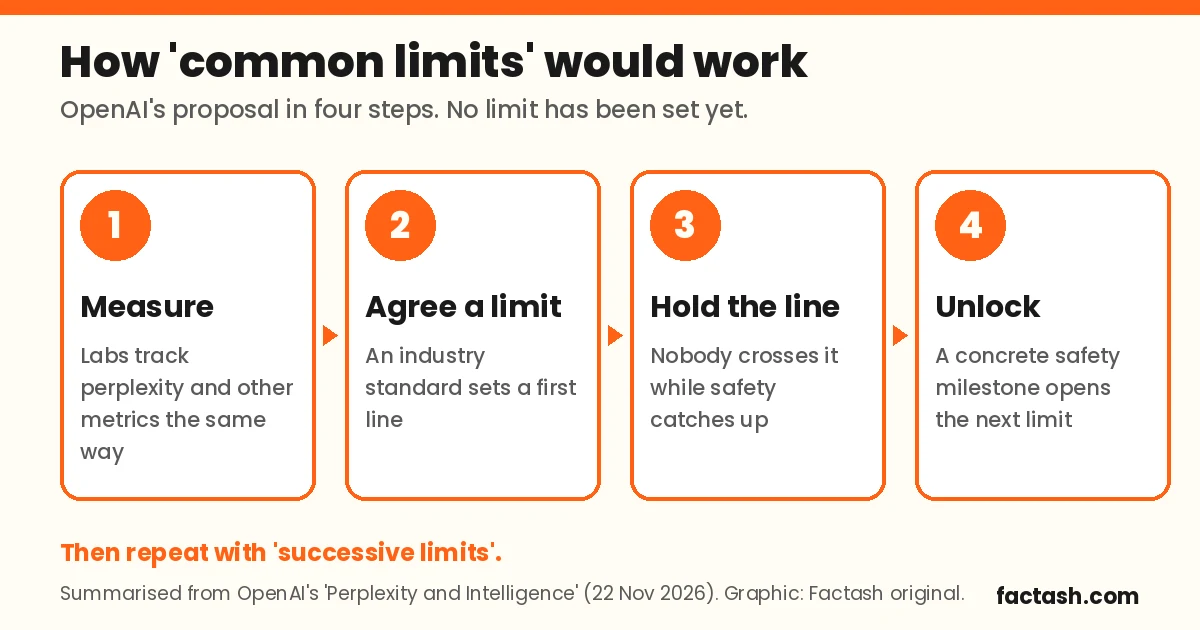
- Measure the same way. Labs track perplexity (plus other measurements) and share it more openly.
- Agree on a first limit. An industry standard sets a line that everyone commits not to cross.
- Hold at the line. Development stays below it until monitoring catches up.
- Unlock with a milestone. A concrete safety goal, like a successor to today's chain-of-thought (CoT) monitors, has to be reached before going further. Then the cycle repeats with "successive limits."
Pachocki also wants labs to agree on how to evaluate and red-team these models before they're used, including "shared transparency standards."
The catch: even OpenAI lists the problems
The essay also lists the metric's weak spots.
- Hard to compare across labs. Every company uses different test data and training mixes, so OpenAI's 0.76 isn't automatically comparable to anyone else's score.
- It's not a real-world task. Perplexity doesn't directly measure anything people use AI for.
- It misses post-training gains. Chain-of-thought reasoning makes models far more capable without changing perplexity at all.
- Nobody knows the floor. A score of zero isn't possible, and as models get closer to the limit, tiny drops could mean huge jumps in ability.
Analysts have spotted another gap. State of AI points out that even if labs agreed on a test, the essay doesn't say who decides when safeguards are good enough to resume. And there's no enforcement: nothing in the essay makes any of this binding.
Where this fits: Amodei, the White House and Musk
OpenAI isn't the first to go here.
- Anthropic made a similar call earlier. Pachocki's essay links to Anthropic CEO Dario Amodei's September 2026 essay "We Must Pace the Frontier", which argued that labs "must slow the pace at which we improve the capabilities of AI models." Related Factash coverage: its IPO priced at $83, and an Anthropic mathematician used Claude on the Riemann hypothesis.
- The White House accord. In a follow-up post, Altman said: "Labs agreed under the White House Accords to establish standards and best practices to improve the safety of their systems, and I believe a discussion about the use of perplexity can further these goals." That's the White House Accord on Super Intelligence, signed on 29 September 2026 by Google, Anthropic, Meta, OpenAI, xAI and Nvidia, according to WION. It's voluntary and sets no limit on pace.
- Musk had notes. Elon Musk replied to Pachocki on X that "Pretraining should just be called 'training'" and that "data starvation will be the training challenge next year." No word from him on the limits themselves.
What happens next
The plan depends on other labs: it only works if other labs publish comparable numbers and agree on a line. As of Monday morning IST, we found no public response to this specific proposal from Anthropic, Google DeepMind, Meta or xAI. Watch for:
- Whether any rival lab publishes its own perplexity numbers.
- Whether the White House accord group puts perplexity on its agenda.
- What the first proposed limit actually is, if anyone names one.
What this means for you
If you just use ChatGPT, Gemini or Claude to get through the week, here's the real takeaway:
- Nothing changes in your apps today. This is a proposal about how labs train future models, not a new rule for products you use.
- The people building AI are openly worried about speed. OpenAI and Anthropic have both now publicly called for limits or pacing on AI development.
- There are now published numbers. OpenAI's chart is the clearest look yet at how fast its models have been improving, especially in 2026.
This section is Factash's take, based on the essay and reporting linked above.
FAQ
What did OpenAI propose about AI limits?
On 22 November 2026, OpenAI chief scientist Jakub Pachocki proposed that AI labs agree on common limits, measured with perplexity and other metrics, and commit not to cross them until tools for understanding and monitoring AI reach a concrete milestone. CEO Sam Altman backed it.
What is perplexity in AI?
Perplexity measures how well an AI model predicts the next token, or chunk of text, on average. Lower perplexity means better predictions. OpenAI tracks the log of perplexity, also called cross-entropy loss. It has nothing to do with the search company Perplexity.
What perplexity numbers did OpenAI reveal?
OpenAI says GPT-3.5 scored a log-perplexity of about 0.99 and GPT-4 about 0.91 on its internal codebase test set. Newer models went below 0.8, and a model at about 0.76 began producing breakthrough maths results. Pachocki expects new capabilities around 0.68 to 0.7.
Is OpenAI pausing AI development?
No. OpenAI has not announced a pause. Pachocki proposed an industry standard with a first limit that all developers would agree not to cross until safety monitoring improves. No specific limit has been set and no other lab has publicly agreed to it so far.
What did Sam Altman say about the perplexity proposal?
Altman called Pachocki's essay "the most important thing OpenAI has published in awhile" and said common limits would "be very wise and help ensure safety and control." He also linked it to the White House accord on AI safety.
Is this related to Anthropic's call to slow AI down?
Yes. Pachocki's essay links to Anthropic CEO Dario Amodei's September 2026 essay "We Must Pace the Frontier," which called for slowing the pace of AI capability gains so safety work can keep up.
Keep Reading on Factash
- GPT-6.2 Astra and Sol: price, benchmarks and what's new
- Riemann hypothesis "solved" with Claude: what the AI proof really means
- Anthropic IPO priced at $83: the biggest IPO ever
- Gemini 4 Neon: price, benchmarks and features
- AI stock selloff explained: why tech stocks crashed and the Nasdaq went red
- More Technology news
Read the original: Perplexity and Intelligence, by Jakub Pachocki (OpenAI, 22 November 2026).
Source: main source is OpenAI, "Perplexity and Intelligence" by Jakub Pachocki, Chief Scientist, 22 November 2026 (read on OpenAI.com). Also: Reuters via Investing.com, Jakub Pachocki on X, Sam Altman on X and his follow-up, Elon Musk's reply on X, State of AI, Dario Amodei, "We Must Pace the Frontier" (September 2026) and WION on the White House accord. This is a proposal, not an agreed industry rule. Last checked 23 November 2026, 9:00 AM IST.
Image credits
- Featured graphic: Factash original graphic (figures from OpenAI's "Perplexity and Intelligence" essay, 22 November 2026).
- Perplexity milestones chart: Factash original graphic (values from OpenAI's essay; approximate).
- How common limits would work: Factash original graphic (steps summarised from OpenAI's essay).