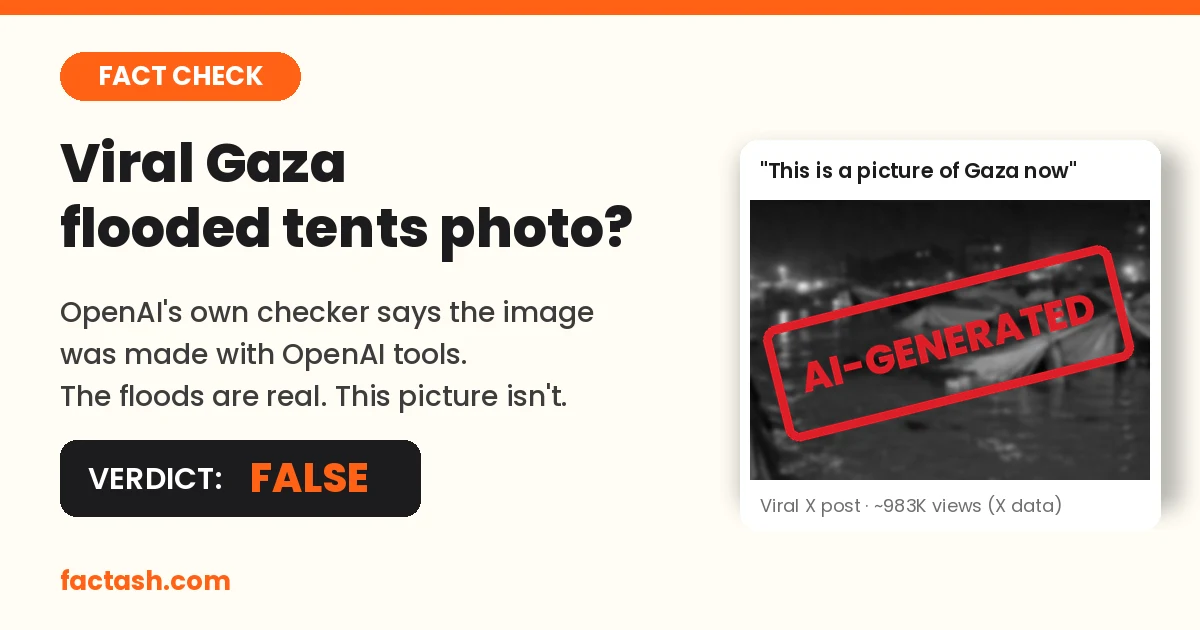
The floods are real. The kids in soaked tents are real. That one cinematic night shot everyone shared? Not real. And that's exactly why it's a problem.
Heavy rain hit Gaza from Friday night, 6 November 2026, and flooded thousands of tents where displaced families are living. Within hours, one image took over X: blue and white tents half underwater at night, city lights glowing across the flood. "This is a picture of Gaza now," the caption said. It racked up close to a million views, and even UK MP Jeremy Corbyn shared it before deleting it. We checked the Gaza flooded tents photo against Snopes, OpenAI's own verification tool and real reporting from the UN, the BBC and The Guardian. Here's the deal.
VERDICT: FALSE. The viral night-time image of flooded tents is not a real photo of Gaza. Snopes found it was AI-generated: OpenAI's verification tool detected that it was made with OpenAI tools, and the pixels show a star-like grid pattern that forensics expert Hany Farid has called a tell-tale sign of AI. But the flooding itself is real. The UN says thousands of families lost their shelters, and at least five people, including three children, were killed when a sand dune collapsed on tents. Claims that the Gaza floods are "fake" are also false.
The Claim
"For anyone who cares, this is a picture of Gaza now. We are drowning in our tents💔"
That's the caption on a post by X user @ahmed_nashwan1, published late on 6 November 2026 (UTC). When we checked X's public data on 12 November, the post had about 983,000 views, 34,500 likes and 16,600 reposts. Snopes used images from that account in its fact-check and says posts of the image "collectively gained millions of views" across social media. Snopes also says it is unclear exactly where the image first came from, so we're not saying who made it, only what it is.
Snopes reports that prominent accounts shared it too, including British MP Jeremy Corbyn, who posted the image and then deleted it.
The topic is huge on X right now. Using X's public post counts, we found roughly 78,000 posts mentioning flooded tents in Gaza between 6 and 12 November, peaking at about 26,000 on 8 November alone.
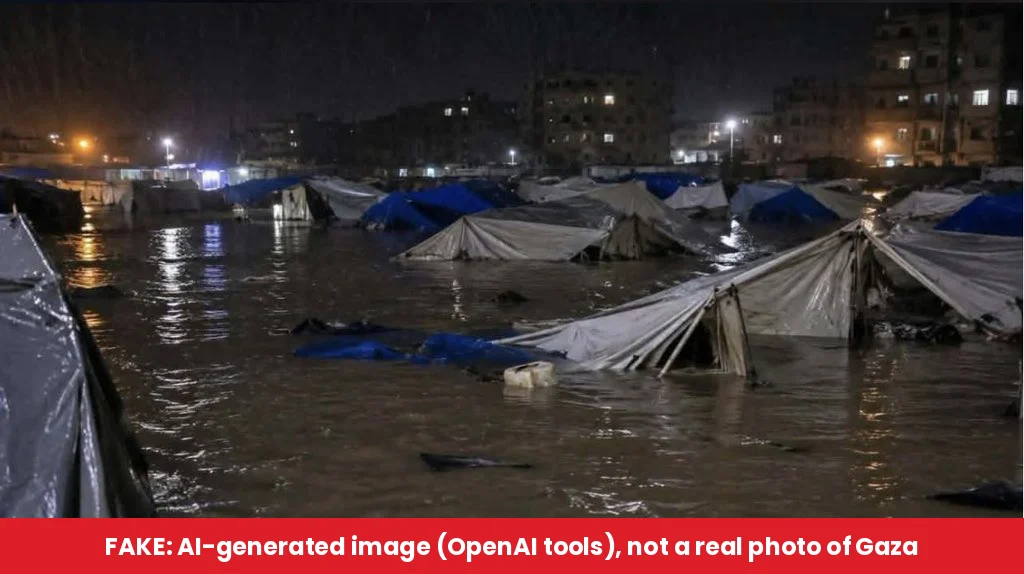
What We Found
1. OpenAI's own tool says OpenAI made it. Snopes ran the image through OpenAI's "Verify OpenAI-generated content" tool and got the result "Generated with OpenAI tools". OpenAI says the tool looks for two signals: C2PA Content Credentials (metadata) and SynthID, an invisible watermark built into the pixels that is designed to survive cropping, filters and compression. OpenAI says detected signals are reliable and "false positives are rare".
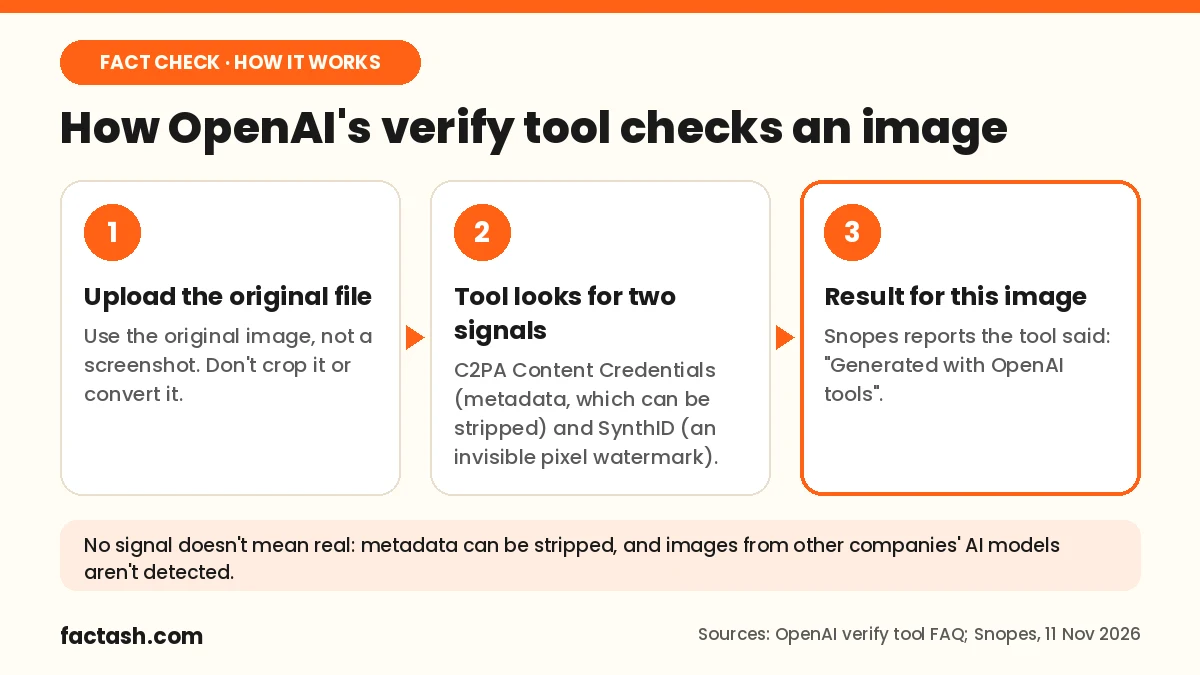
See Snopes's screenshot of the OpenAI result.
2. The pixels have an AI fingerprint. Zoom in close and the image shows a star-like grid pattern. Snopes explains that OpenAI's image model builds pictures in a systematic grid (an autoregressive approach), and digital forensics expert Hany Farid has described this kind of pattern as a tell-tale sign of AI generation.
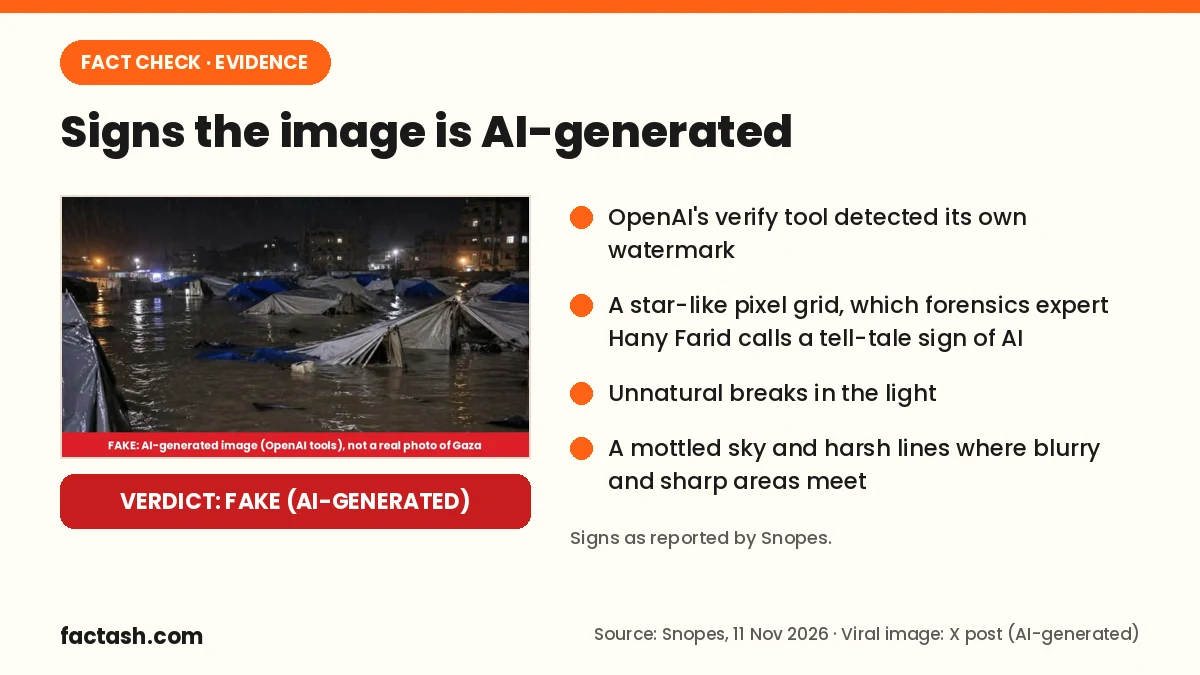
See Snopes's zoomed-in illustration of the pixel grid.
3. The lighting and textures don't add up. Snopes also flagged unnatural breaks in the light, a mottled sky texture and harsh lines where blurry pixels meet sharp ones.
What's Actually Happening in Gaza
Here's where people get it twisted: a fake picture doesn't mean a fake disaster. According to UN News (9 November 2026), citing the UN aid office OCHA:
- Heavy rain and strong winds started lashing Gaza on Friday night, 6 November, flooding displacement sites across all five governorates.
- An infant reportedly drowned, and five people, including three children, were killed when a sand dune collapsed onto tents at Al Berka Reservoir, west of Deir al-Balah.
- By 8 November, aid partners had received appeals from more than 26,000 households. More than 6,000 family shelters were reportedly destroyed and 17,400 damaged.
- Water rose to 1.5 metres in some places. Civil defence received 2,166 distress calls but could respond to only 218.
- About 65% of Gaza's population, around 1.4 million people, live in tents or makeshift shelters, and more than 150,000 tents are waiting outside Gaza to be sent in.
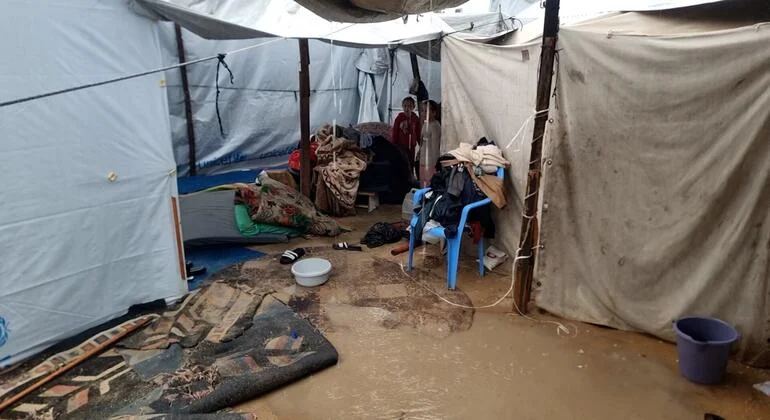
The Guardian published a gallery of real photos from Gaza City, Khan Younis, Bureij and Jabaliya, and noted reports that about 70,000 tents were flooded within 12 hours. The BBC reports that Trump's Board of Peace called Israel's aid response "insufficient", while Israel's aid agency Cogat said it had let in more than 91,000 tents and blamed Hamas for delays. Hamas rejected that account and blamed Israeli restrictions.
So the real images exist. Nobody needed an AI one.
Why a Fake Like This Does Double Damage
AI fakes of a real tragedy cause harm in two directions, and France's public broadcaster franceinfo (11 November 2026) explains both:
- They exaggerate. Some fakes are made to shock and drive sympathy. franceinfo found an AI video of children crammed in a flooded tent, viewed hundreds of thousands of times, that had already been used for Gaza floods in December 2025, according to Lead Stories.
- They get used to deny the real thing. Other users point to the fakes as "proof" that the floods aren't happening and that the media got fooled.
This isn't new either. In December 2025, AFP Fact Check debunked an AI video of Gaza children wading through floods, which Hive Moderation rated 99.9% likely AI-generated, while AFP's own photos showed the real, muddier scene.
Why This Is a Technology Story
Here, an AI company's own detector helped settle a viral debate. OpenAI's tool reads C2PA metadata and SynthID watermarks, and that's what nailed this image. But OpenAI is upfront about the limits: if no signal is found, the content could still be AI, because metadata can be stripped, watermarks can degrade, and images from other companies' models won't show up. And even a positive result says nothing about whether the content is "accurate or presented in the correct context".
Translation: detectors are a clue, not a verdict. We saw the same lesson in the Krakow shooter "Ukraine flag" photo, the Florida Learjet crash photo, the Trump 90-day blackout video and the Jeff Bezos hair transplant photos.
How to Check Viral Disaster Photos Yourself
- Run it through a provenance checker. Upload the original file (not a screenshot, and don't crop it) to OpenAI's verify tool. Google's SynthID Detector and Hive Moderation are other options. Treat the result as one piece of evidence.
- Reverse image search it. Google Lens or TinEye can show whether a picture appeared earlier, on an AI art page or during an older disaster.
- Compare it with real photo agencies. Look at galleries from AP, AFP, Reuters, Getty or The Guardian for the same event. If the viral shot looks nothing like any of them, slow down.
- Zoom in. Weird light, smeared textures, garbled text and too-perfect "cinematic" framing are common AI tells.
- Check the numbers with official sources. For Gaza, UN OCHA, UNICEF and UN News post regular, dated updates.
- Don't flip to "it's all fake". One AI image doesn't cancel thousands of real ones. Check before you deny, too.
- Share the fact-check, not the fake. Even a "debunk" repost can spread the image further.
Want the full toolkit? Read our guide on how to check fake news in India (and anywhere).
FAQ
Is the viral photo of flooded tents in Gaza real? No. Snopes found the night-time image of flooded blue and white tents was AI-generated. OpenAI's verification tool detected that it was made with OpenAI tools.
Is the flooding in Gaza real? Yes. The UN says heavy rain from 6 November 2026 flooded displacement sites across Gaza, destroyed more than 6,000 family shelters and damaged 17,400, and that at least five people, including three children, died when a sand dune collapsed on tents.
How did fact-checkers know the image was AI-generated? OpenAI's verify tool detected its provenance signals (C2PA metadata or a SynthID watermark), and the pixels showed a star-like grid pattern that forensics expert Hany Farid has described as a sign of AI generation. Snopes also noted unnatural lighting and textures.
Did Jeremy Corbyn share the fake Gaza flood image? According to Snopes, Corbyn posted the image and later deleted it.
Can OpenAI's tool tell if any image is AI-generated? No. It only detects content made with OpenAI tools. OpenAI says a "no signal" result doesn't prove an image is real, because metadata can be stripped and other companies' AI images won't be flagged.
Sources
- Main source: Snopes, "Is this image of flooded tents in Gaza real?" (Taija PerryCook, 11 Nov 2026)
- UN News, "Children among the dead as heavy rains flood tents and shelters in Gaza" (9 Nov 2026)
- OpenAI, "Verify OpenAI-generated content"
- The Guardian, "Heavy rain floods displaced families' tents in Gaza – in pictures" (8 Nov 2026)
- BBC News, "Board of Peace says Israel's aid response after Gaza floods 'insufficent'" (Mallory Moench, 10 Nov 2026)
- franceinfo, "Pluies et inondations à Gaza : de fausses images générées par IA trompent les internautes et décrédibilisent les vraies images" (11 Nov 2026)
- Lead Stories, "Fact Check: AI Videos Of Flooded Tents In Gaza Are NOT Real" (Dec 2025)
- AFP Fact Check, "Video of Gaza children wading through floods is AI-generated" (17 Dec 2025)
- Original viral post on X by @ahmed_nashwan1 (6 Nov 2026, UTC)
Image credits
- Featured image: original Factash graphic.
- Viral flooded tents image (AI-generated; "FAKE" label added by Factash): X post by @ahmed_nashwan1, as cited by Snopes
- Diagram of how OpenAI's verify tool works: original Factash graphic.
- Evidence card of AI signs: original Factash graphic (includes the labelled viral image credited above).
- Real photo of a rain-soaked tent in Deir al-Balah: UN News