Last updated: 26 Nov 2026, 9:05 AM IST
One million satellites. Each one basically a server rack with solar wings. And the US government just said yes. Welcome to the "data centers in space" era.
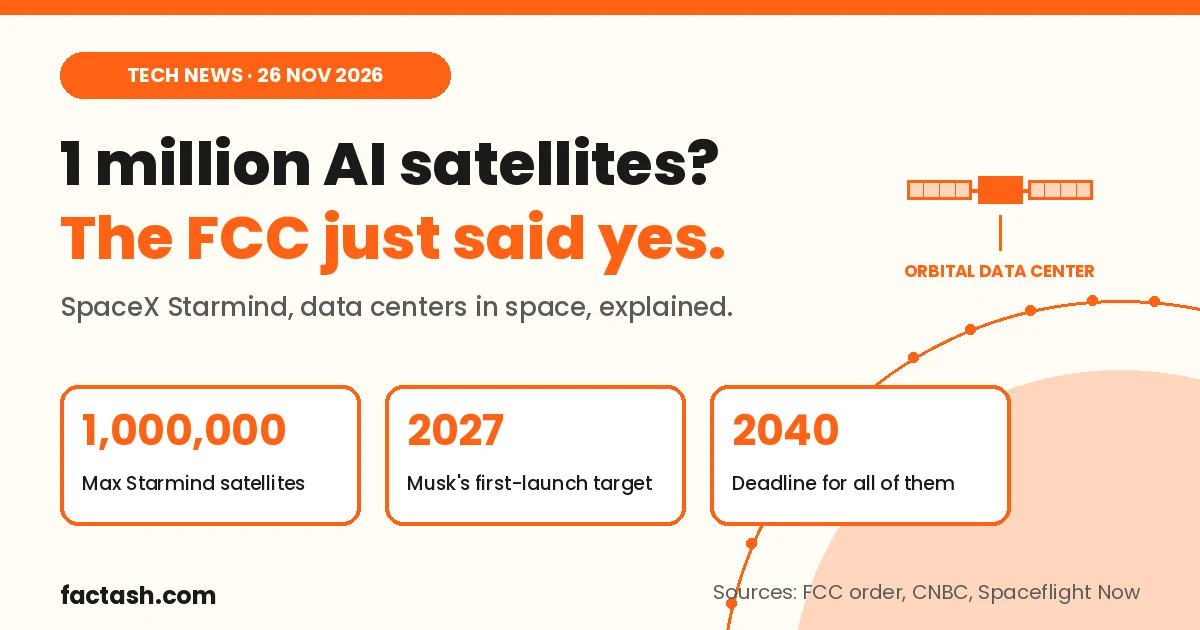
The SpaceX Starmind approval is the tech story everyone is arguing about this Thanksgiving week. On Wednesday 25 November, the US Federal Communications Commission (FCC) authorised Elon Musk's SpaceX to deploy up to 1,000,000 satellites that work as orbital AI data centers. It's the first approval of its kind in US history. Musk loves it, Amazon and astronomers hate it, and the big question is whether any of this is actually buildable. Here's the whole thing, minus the hype.
TL;DR
- What happened: The FCC approved SpaceX's Starmind constellation, up to 1 million satellites acting as AI data centers in low-Earth orbit, on 25 November 2026 (FCC, CNBC).
- First of its kind: The FCC calls it "the first authorization in U.S. history for a constellation of data centers in space."
- Deadlines: 1 satellite by 25 Nov 2033, 10% by 2035, 50% by 2038, all of them by 25 Nov 2040, or the licence becomes void (FCC order).
- Musk's timeline: first launches in Q3 2027, "very large volume in '29" (Spaceflight Now).
- Who objected: Amazon (Kuiper/Amazon Leo), Viasat and the American Astronomical Society all filed petitions to deny. The FCC rejected them.
- Not settled yet: The FCC deferred SpaceX's plan to retire satellites above 600 km into orbits around the sun.
What is SpaceX Starmind? The 60-second version
Starmind is SpaceX's plan to move AI computing off the ground and into orbit. Instead of giant warehouses full of chips that drink power and water, each Starmind satellite carries a computing payload, runs on solar power, and sends results back to Earth by laser through SpaceX's Starlink network.
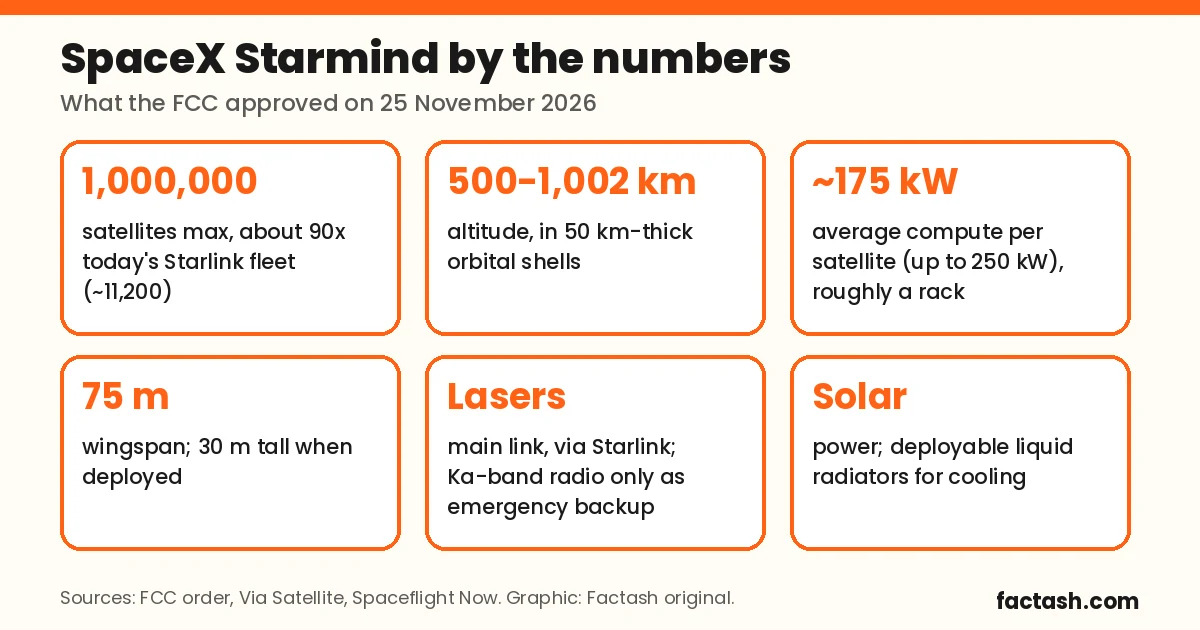
The key specs, from the FCC order and SpaceX's own descriptions:
| Spec | Starmind | Source |
|---|---|---|
| Max satellites | 1,000,000 | FCC order |
| Altitude | 500 to 1,002 km, in 50 km-thick shells | FCC order |
| Compute per satellite | about 175 kW on average, up to 250 kW | SpaceX via Via Satellite |
| Size | 75 m (246 ft) wingspan, 30 m (98 ft) tall | SpaceX via Spaceflight Now |
| Main comms | Laser (optical) links to Starlink | FCC order |
| Backup comms | Ka-band radio, 18.8-19.3 GHz down / 28.6-29.1 GHz up, emergencies only | FCC order |
| Built with | Nvidia, at SpaceX's Bastrop, Texas facilities | Spaceflight Now |
| Launched on | Starship | Spaceflight Now |
How big is a "server in space"? SpaceX's Michael Nicholls (SVP of Starlink and AI) said at the International Astronautical Congress in October that each satellite "might be something like a 250 kilowatt satellite, or roughly a rack of compute in space," and that clusters of about 10 satellites would fly in tight formation, linked with around 10 terabits of bandwidth (Spaceflight Now).
For scale: SpaceX's whole Starlink fleet is nearly 11,200 satellites today, per astronomer Jonathan McDowell's tracking (Spaceflight Now). Starmind's licence is for roughly 90 times that.
What exactly did the FCC approve?
Read the fine print and it's narrower than the headlines. Technically, the FCC granted SpaceX radio spectrum authority for backup and emergency telemetry, tracking and command (TT&C) for a 1-million-satellite constellation operating as data centers. The radio bands can only be used "in the event its optical links experience a failure," and on an "unprotected and non-interference basis", meaning SpaceX can't interfere with anyone else and can't complain if others interfere with it (FCC order, DA 26-1273).
SpaceX also got waivers, including of the FCC's surety bond rules and its old milestone rules, swapped for the newer milestone schedule the FCC adopted this year. The FCC chairman went big in the official press release:
"Compute campuses or data centers are essential to sustaining America's leadership in SI. By moving compute capacity beyond Earth, SpaceX and the many competitors working on their own orbital data centers are meeting the moment." — FCC Chairman Brendan Carr
The same release says the system "promises to bring the human race closer to a Kardashev II civilization", a sci-fi-sounding term from the 1960s for a civilisation that can harness the full energy of its star. Yes, a government press release said that.
Musk's reply on X: "Much appreciated. This will be a great asset to America and the world" (CNBC).
When will Starmind launch? The deadlines
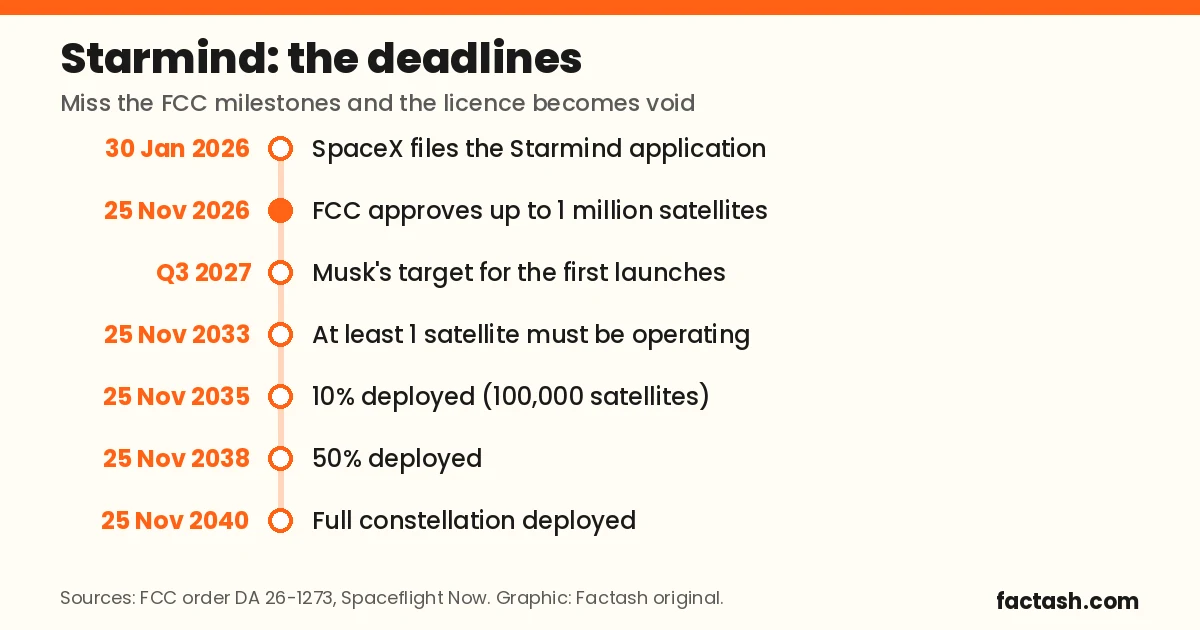
The FCC order says the authorisation "will become null and void" if SpaceX misses these:
- 25 November 2033: at least one Starmind satellite deployed and operating.
- 25 November 2035: 10% of the authorised maximum, which works out to 100,000 satellites.
- 25 November 2038: 50%.
- 25 November 2040: the rest.
The 15-year licence term only starts once SpaceX certifies its first Starmind satellite is in orbit and working.
SpaceX wants to move way faster than the legal minimum. Musk said in a Baron Capital talk that he expects the first spacecraft to launch in the third quarter of 2027: "We'll start off slow, but then it will ramp to significant volume probably in '28 and then very large volume in '29" (Spaceflight Now). President and COO Gwynne Shotwell told investors in October the launches would begin in 2027 (Via Satellite).
Context: SpaceX filed the application on 30 January 2026, around the time it acquired Musk's AI company xAI (Via Satellite). Ten months from filing to approval is fast for a filing this huge. Starship, which would carry the satellites, is still in its test-flight era (catch up on our Starship Flight 15 ship-catch explainer).
Who opposed Starmind, and why?
| Who | Their argument | What the FCC said |
|---|---|---|
| Amazon (Kuiper / Amazon Leo) | Called it a "lofty ambition rather than a real plan" and said it would take SpaceX "centuries" to build | Petition rejected; Amazon declined to comment on the approval |
| Viasat | Radio interference worries | Backup-only, non-interference radio use addresses it |
| American Astronomical Society | Night-sky and astronomy damage | Outside the scope of this radio licence |
| Earthjustice | No environmental review under NEPA, decided in a holiday week | FCC dismissed environmental concerns as outside its authority |
| Secure World Foundation | Wants phased, demo-first approval for mega-constellations | Not adopted |
Sources: CNBC, Spaceflight Now, Via Satellite, FCC order.
The astronomers were blunt. The AAS said it was "disheartened and dismayed," and is "gravely concerned about the future of federally funded astronomical research under such a fundamentally altered night sky" (Spaceflight Now). Astrophysicist and author Adam Becker told CNBC any serious attempt "is going to further pollute the night sky and runs a serious risk of a cascading chain reaction of space junk collisions."
The FCC's position, quoted by Via Satellite: "In many cases, the comments seek to substitute the government's judgment regarding the viability of business endeavors for that of the applicant and private enterprise. We decline to do so." It also called worries about the atmosphere from burning-up satellites "speculative and not supported in the record."
The one big thing still unresolved: space junk
The FCC approved SpaceX's debris plan only for satellites below 600 km. Above that, SpaceX wants to retire dead satellites into graveyard orbits or orbits around the sun instead of burning them up in the atmosphere. The FCC deferred that waiver, saying SpaceX "has not provided sufficient information," and requires a new application before any satellite that won't re-enter is launched (FCC order, Spaceflight Now).
That matters because most of the planned altitude range, up to 1,002 km, is above 600 km. TechCrunch notes current FCC rules require satellites ending missions below 2,000 km to re-enter within five years (TechCrunch).
Why put data centers in space at all?
The pitch is simple: free sunlight, no land fights, no water for cooling. On the ground, data centers are getting harder to build. The BBC notes communities across the US have pushed back, and data centers were a big issue in the November midterms (BBC). (Remember the viral "data center noise" clip? We fact-checked it here.)
The catch, per TechCrunch: nobody has done this at scale. SpaceX still has to slash the cost of building and launching satellites, figure out how to cool chips in a vacuum (Starmind uses deployable liquid radiators, per Via Satellite), and line up financing for chips headed to orbit. Analysts quoted by Via Satellite call orbital data centers "technically and economically unproven." The BBC adds it's unclear whether SpaceX will ever launch a full million or simply asked for more than it needs.
SpaceX isn't alone, which is why this approval matters beyond Musk:
- Google has Project Suncatcher and sent its first chips to space in October on a SpaceX rocket and a Planet Labs satellite (CNBC).
- Blue Origin filed for a 51,600-satellite constellation called Project Sunrise (CNBC, Via Satellite).
- Starcloud filed for an 88,000-satellite constellation (Via Satellite).
The FCC says it is reviewing other orbital data center applications and "intends to issue decisions on each expeditiously." Starmind just set the template.
Why should you care?
- It's where your AI might run. The chatbots and image tools you use run on data centers. If orbit becomes a real option, AI's power-and-water problem moves off the planet, at least partly.
- It's an AI money story. Investors are already nervous about how much the AI build-out costs (our AI stock selloff breakdown covers that). A million satellites is the most extreme version of that spending bet.
- It's a night-sky story. Starlink already changed what astronomers see. Starmind's licence is for about 90 times more satellites than Starlink has now.
Factash take: the approval is real, but it's a licence, not a launch. Watch three things: whether the first Starmind satellite actually flies in 2027, how SpaceX answers the FCC's deferred junk-disposal question, and whether Blue Origin and Starcloud get the same quick yes.
FAQ
What is SpaceX Starmind?
Starmind is SpaceX's planned constellation of up to 1 million satellites that act as AI data centers in low-Earth orbit, between 500 and 1,002 km up. They are solar-powered and send data back to Earth mainly through laser links to Starlink.
Did the FCC approve SpaceX's 1 million satellites?
Yes. On 25 November 2026 the FCC authorised SpaceX's Starmind constellation of up to 1,000,000 orbital data center satellites, calling it the first authorisation in US history for data centers in space. Some parts, like disposal above 600 km, were deferred.
When will SpaceX launch Starmind satellites?
Elon Musk says the first launches should happen in the third quarter of 2027, ramping up in 2028 and 2029. Under the FCC order, SpaceX must have at least one satellite operating by 25 November 2033 and the full constellation by 25 November 2040.
Who opposed the SpaceX Starmind approval?
Amazon's Kuiper Systems (Amazon Leo), Viasat and the American Astronomical Society filed petitions to deny the application. Earthjustice and the Secure World Foundation also criticised it. The FCC rejected the petitions.
Why does SpaceX want data centers in space?
SpaceX says orbital data centers are the most cost- and energy-efficient way to meet AI computing demand, using constant solar power and avoiding the land, power and water fights that ground data centers face. Critics say the idea is technically and economically unproven.
Will Starmind affect astronomy and space junk?
Astronomers fear a "fundamentally altered night sky," and critics warn of collision risks. The FCC said astronomy and environmental issues were outside its authority for this licence and deferred SpaceX's plan to dispose of satellites above 600 km.
Keep Reading on Factash
- SpaceX Starship Flight 15: the first ship catch explained
- Fact check: is the viral data center noise video real?
- AI stock selloff: why tech stocks crashed and the Nasdaq went red
- Anthropic IPO priced at $83: the biggest IPO ever
- More Technology news
Read the original report: SpaceX wins FCC approval to deploy 1 million orbital data center satellites (CNBC, Lora Kolodny and Annie Palmer, 25 November 2026).
Source: main source is CNBC, "SpaceX wins FCC approval to deploy 1 million orbital data center satellites" by Lora Kolodny and Annie Palmer, 25 November 2026 (read on CNBC). Also: the FCC Memorandum Opinion and Order, DA 26-1273, the FCC press release, Spaceflight Now (Will Robinson-Smith), Via Satellite (Rachel Jewett), TechCrunch and the BBC (Max Matza). Last checked 26 November 2026, 9:05 AM IST.
Image credits
- Featured graphic: Factash original graphic (facts from the FCC order and CNBC).
- Starmind by the numbers: Factash original graphic (specs from the FCC order, Via Satellite and Spaceflight Now).
- Starmind deadlines timeline: Factash original graphic (dates from the FCC order and Spaceflight Now).