Last updated: 28 Nov 2026, 9:05 AM IST
The US Air Force's flagship cloud, the one that holds radar feeds, munitions tracking and personnel data, just got breached. Nobody knows who did it. And it's not even the first federal hack this week.
The Air Force Cloud One breach is the tech story everyone is searching right now. On Friday 27 November, Reuters reported that hackers broke into Cloud One, one of the US military's biggest cloud computing platforms. The Air Force won't confirm or deny it, but a US official confirmed the hack to NBC News. Here's what's actually known, what isn't, and why it matters way beyond the Pentagon.
TL;DR
- What happened: Hackers breached the US Air Force's Cloud One platform, three people familiar with the matter told Reuters.
- When: The intrusion was discovered "within the past month or so" during work to upgrade the system (Reuters).
- How: One source said the attackers exploited a software vulnerability to reach the platform's control plane. The exact bug is unknown.
- Who: Unknown. Reuters couldn't establish who did it, the full scope, or whether any data was stolen.
- Fallout: Cyber Command was called in, app migrations were paused, updates were blocked and some admin rights were revoked (Reuters).
- Official line: The Air Force "does not comment" on specific networks; the Pentagon told CBS News its systems "are safe, secure, and managed 24-7."
Air Force hacked: what exactly did Reuters report?
The scoop comes from Reuters reporters Mike Stone and Raphael Satter, published on Friday 27 November 2026 (evening IST). The key points, all from people who spoke on condition of anonymity:
- Hackers breached Cloud One, the Air Force's flagship cloud platform. Reuters spoke to five sources in total.
- The intrusion was found during an upgrade within roughly the past month, and the discovery caused disruption across the platform.
- One source said the intruders used a software vulnerability to reach the control plane, and compared it to a "universal remote." In theory, that access could be used to check the operational status of military aircraft or the movement of spare parts, though it's unclear whether the hackers actually did that.
- Investigators called in US Cyber Command to assess the damage. Cyber Command did not respond to Reuters.
- "A breach here is a big deal," one source told Reuters.
A few hours later, NBC News reported that a US official confirmed the hack, but couldn't share details on timing or impact (NBC News). That official wasn't named, so there's still no on-the-record confirmation from the Air Force.
What is Cloud One, and why is this a big deal?
Think of Cloud One as the Air Force's all-in-one IT backbone. Reuters describes it like this:
- Launched in 2017 as a "one-stop shop" for the Air Force's IT needs.
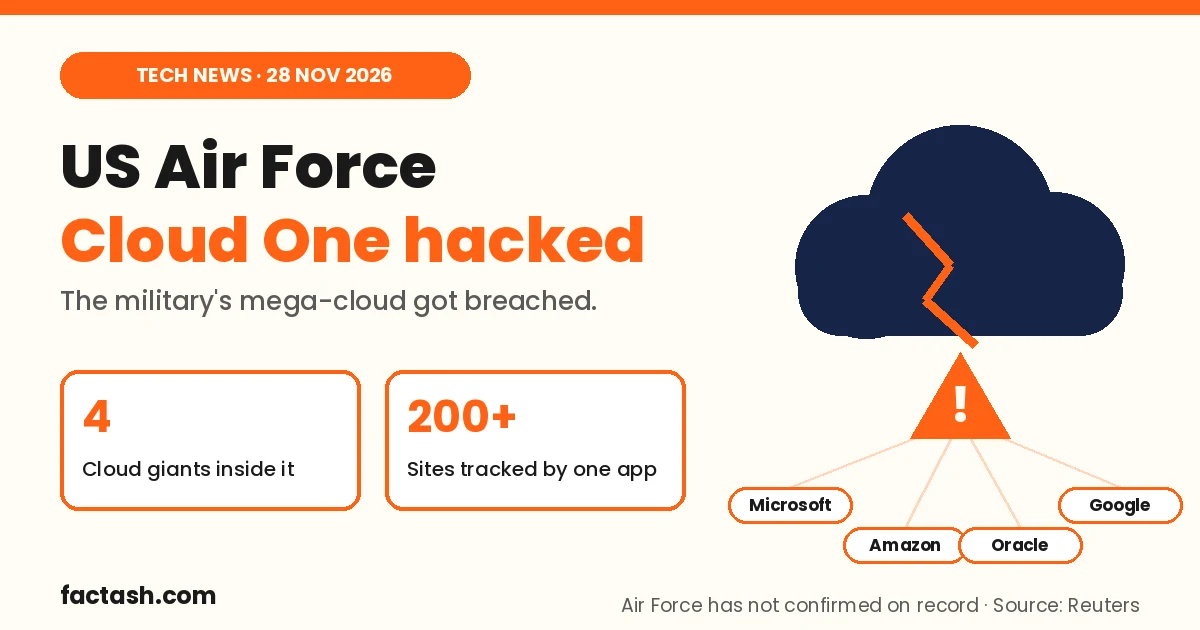
- It combines the clouds of four giants: Microsoft, Amazon, Oracle and Alphabet (Google).
- It powers "scores of applications," including ones that handle personnel data and pay, plus logistics and maintenance.
- It also runs the Cloud-Based Command and Control system, which pulls together air defense radar and other data feeds from across North America.
- And the Theater Integrated Combat Munitions System (TICMS), which tracks bombs and missiles across more than 200 US Air Force locations worldwide.
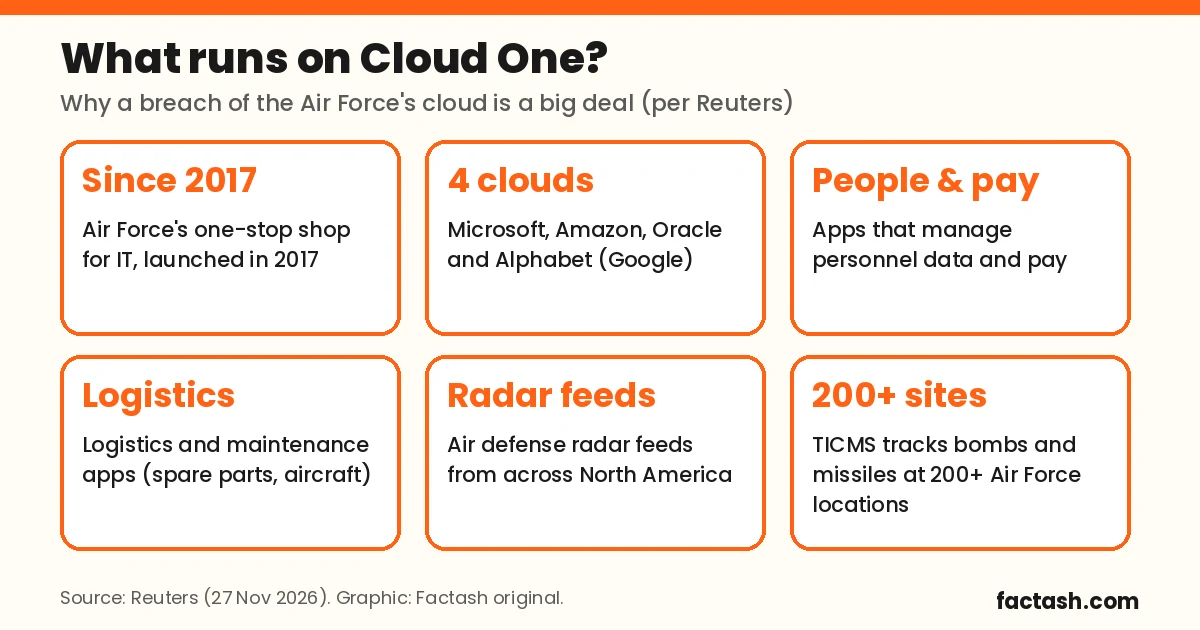
So yeah, this isn't some random intranet. It's the place where a lot of the Air Force's sensitive tactical, personnel and logistics data lives, which is exactly why Reuters said the breach "could jeopardize a vast swathe" of it.
| What | Detail | Source |
|---|---|---|
| Platform | Cloud One, Air Force enterprise cloud | Reuters |
| Started | 2017 | Reuters |
| Cloud providers | Microsoft, Amazon, Oracle, Alphabet | Reuters |
| Discovered | Within the past month or so, during an upgrade | Reuters |
| Entry point | A software vulnerability, used to reach the control plane (one source) | Reuters |
| Attacker | Unknown | Reuters |
| Data stolen? | Unknown | Reuters |
| Investigating | US Cyber Command called in (one source) | Reuters |
| Prime contractor | Leidos (took over from SAIC in 2026) | Reuters, CBS News |
What's been disrupted?
This is the part that hits day-to-day operations. According to Reuters:
- Migrations paused: Efforts to move back-office apps onto Cloud One, a longstanding military priority, have been paused.
- Updates blocked: Updates to apps already running on Cloud One were blocked, leaving personnel unable to apply fixes "just as a new batch of serious software vulnerabilities has been disclosed across the technology industry." Not ideal timing, to put it mildly.
- Admin rights pulled: A fifth source said some users had their administrator rights revoked.
What did the Air Force, the Pentagon and the contractors say?
- Air Force (to Reuters): It "does not comment on the security posture, vulnerabilities or operational status of specific networks and systems. We continuously take prudent measures to protect Department (of the Air Force) information, systems and mission capabilities."
- Air Force (to NBC News): "Ensuring the security, resilience, and availability of our most critical war fighting assets remains a top priority."
- Pentagon (to CBS News): The Defense Department said its systems "are safe, secure, and managed 24-7 by the best experts and teams in the world" and that it "will continue to maintain all mission-critical operations and applications" (CBS News).
- Leidos: The current prime contractor referred questions to the Air Force. CBS News says Leidos has run Cloud One since May and pointed to a $454.9 million contract it announced earlier this year to modernize and secure the Air Force's cloud operations.
- SAIC: The previous prime contractor did not respond to Reuters.
Plot twist from the archives: in a 2023 commentary on FedScoop, Cloud One's own leadership bragged about a "100% success rate" in beating back a "staggering" number of hacking attempts, adding: "There is no room for error when it comes to security" (via Reuters). Oof.
Is this connected to the FBI, CIA and Treasury hacks?
Honestly? Nobody knows yet. But the timing is wild. Reuters says the US government is already dealing with at least six other recently disclosed cyber incidents, including two at the FBI, a previous hack of Pentagon data, a leak of Department of Homeland Security personnel information, a breach affecting at least two spy agencies, and a hack at the Treasury Department.
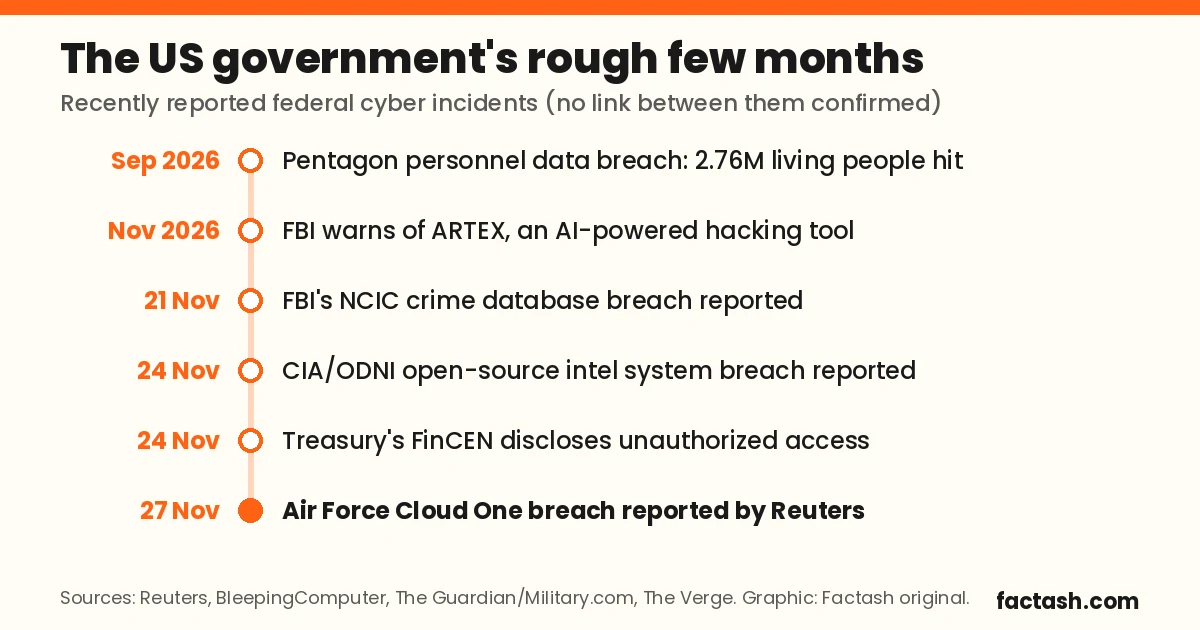
- 21 Nov: Reports said hackers breached the FBI's NCIC crime database (BleepingComputer; our explainer: FBI hacked again: NCIC breach).
- 24 Nov: The CIA and ODNI found a breach of an open-source intelligence system that exposed some unclassified information; ODNI said there were "no disruptions to critical capabilities or classified systems" (The Guardian).
- 24 Nov: Treasury's FinCEN disclosed "unauthorized access to a limited subset of its systems" and took some systems offline (The Verge).
- Earlier: A Pentagon personnel system breach affected 2.76 million living people and 294,000 deceased individuals, a US defense official told Military.com (via The Guardian).
BleepingComputer notes it's unclear whether any of these breaches are connected, and it's also unknown whether AI-powered hacking tools like ARTEX, which the FBI recently warned about, were used against the Air Force (our ARTEX explainer). Reuters adds that the breach lands amid "heightened anxiety over AI-powered intrusions," which are a particular headache for cloud networks because AI can scan huge attack surfaces for weak spots fast.
What we still don't know
- Who did it. No attribution to any country or group has been reported.
- What was taken. Reuters couldn't confirm whether any data was stolen.
- Which bug. The specific software vulnerability hasn't been identified.
- When it started. We know when it was found (roughly the past month), not how long the hackers were inside.
- Whether it's linked to the other federal breaches.
Why this matters (even if you're not in the military)
Cloud One is built on the same commercial clouds that run your favourite apps: Microsoft, Amazon, Oracle and Google. Nothing reported so far says those providers' own systems were hacked, and Reuters points to a vulnerability used to reach Cloud One's control plane. But the lesson is the same for every company running a multi-cloud setup: the more glued-together your systems are, the more one weak spot can matter. If the "universal remote" for the US military's cloud can get grabbed, your company's admin console is worth locking down too. (We've got a starter list in our guide to AI cybersecurity threats businesses need to watch.)
Factash take: This is a reported breach, not an officially confirmed one, and the details come from anonymous sources. But a US official confirmed it to NBC, Reuters spoke to five people, and the disruption (paused migrations, blocked updates, revoked admin rights) is very real. Watch for three things next: an attribution, word on whether data left the building, and whether Congress starts asking questions about the string of federal hacks.
FAQ
Was the US Air Force really hacked?
Reuters reported on 27 November 2026, citing three people familiar with the matter, that hackers breached the Air Force's Cloud One cloud platform, and a US official confirmed the hack to NBC News. The Air Force itself has not confirmed or denied it on the record.
What is Air Force Cloud One?
Cloud One is the US Air Force's enterprise cloud platform, launched in 2017. It combines Microsoft, Amazon, Oracle and Alphabet clouds to run apps for personnel and pay, logistics and maintenance, air defense radar feeds and munitions tracking, according to Reuters.
Who hacked Cloud One?
Nobody knows yet. Reuters could not establish the identity of the hackers, and no country or group has been publicly blamed.
Was any military data stolen?
It is not known. Reuters said it could not establish the full scope of the intrusion or whether any data was stolen. One source said the access could in theory be used to check aircraft status or spare-parts movements, but it is unclear if that happened.
How did the hackers get in?
One source told Reuters the intruders exploited a software vulnerability to reach Cloud One's control plane. The specific vulnerability has not been identified.
Is the Air Force breach linked to the FBI and CIA hacks?
There is no confirmed link. Reuters and BleepingComputer note a string of recent federal incidents at the FBI, CIA and ODNI, Treasury's FinCEN and the Pentagon, but say it is unclear whether any of them are connected.
Keep Reading on Factash
- FBI hacked again: NCIC crime database breach explained
- ARTEX AI hacking tool: FBI warns of 3-hour breaches
- 1Password breach: hacked via GitHub. Is 1Password safe?
- AI cybersecurity threats businesses need to watch in 2026
- More Technology news
Read the original report: Hackers breach US Air Force flagship Cloud One computing platform (Reuters, Mike Stone and Raphael Satter, 27 November 2026).
Source: main source is Reuters, "Hackers breach US Air Force flagship Cloud One computing platform" by Mike Stone and Raphael Satter, 27 November 2026 (read on Reuters). Also: NBC News, CBS News, The Guardian, BleepingComputer, CNBC (Reuters text, with correction), The Verge and Military.com. Last checked 28 November 2026, 9:05 AM IST.
 Context photo: the Air Force has invited ethical hackers to test its systems before, as at the "Hack the Air Force 2.0" event in December 2017 (not related to the Cloud One breach).
Image credits
- Featured graphic: Factash original graphic (facts from Reuters).
- What runs on Cloud One: Factash original graphic (details from Reuters).
- US government cyber incidents timeline: Factash original graphic (dates from Reuters, BleepingComputer, The Guardian, Military.com and The Verge).
- Hack the Air Force 2.0 photo: Trevor Tiernan / U.S. Air Force (ID 171208-F-YN705-002), public domain, via Wikimedia Commons.