Last updated: 26 Nov 2026, 9:25 AM IST
The app whose whole job is keeping your passwords safe just announced it got hacked. Before you panic-delete it, read this.
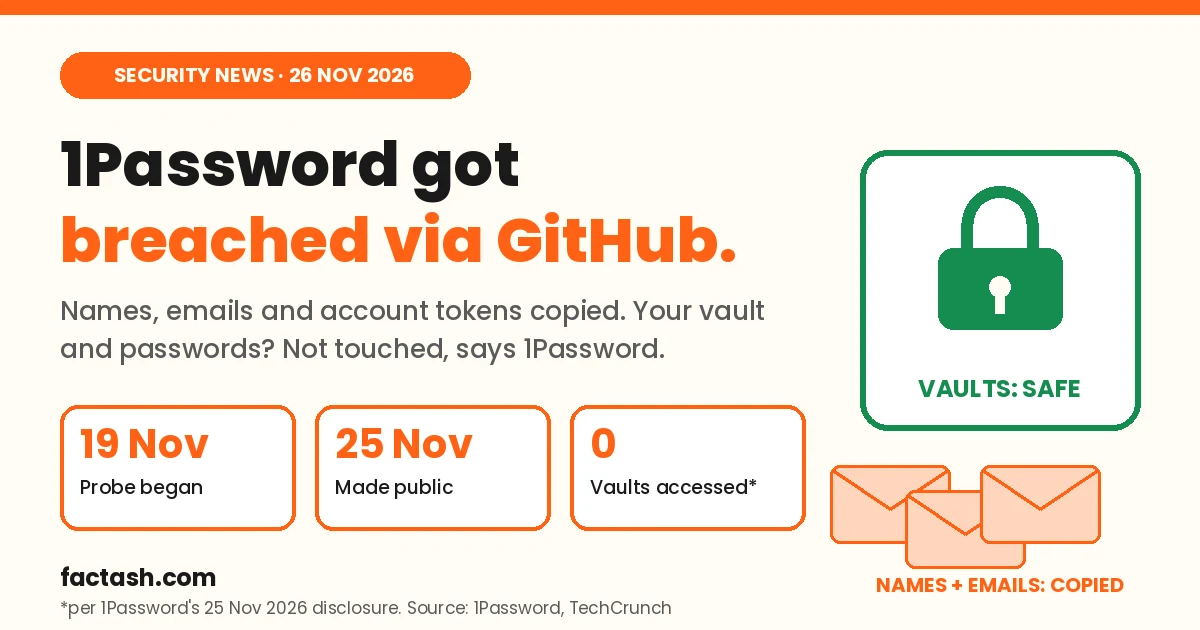
The 1Password breach is blowing up right now. On 25 November 2026, 1Password confirmed that an attacker got into some of its backend systems through one employee's corporate GitHub account, pushed malicious code, and copied customer account records, including names and email addresses. The plot twist? 1Password says your vaults, passwords and the keys that lock them were never touched. So what actually leaked, is 1Password still safe, and do you need to do anything? Let's break it down, no jargon.
TL;DR
- What happened: On 19 November, 1Password began investigating signs that an employee's corporate GitHub account had been hijacked. The attacker used it to reach source code and push malicious code to backend services, which downloaded customer account data (1Password).
- What leaked: Names, sign-in emails, account IDs, account creation and last sign-in times, public keys, login (SRP) parameters, tokens in some invite and recovery emails, plus private source code and access to its CI/CD system.
- What's safe: Your vaults and everything in them, the keys that protect them, your account password and Secret Key (1Password never stores them), recovery keys, and the apps and browser extensions.
- Do you need to change your password? 1Password says no action is required. The real risk is phishing emails that use your leaked name and email.
- How many people? Not disclosed. 1Password only says "a subset" of customers.
What happened in the 1Password breach? The 60-second version
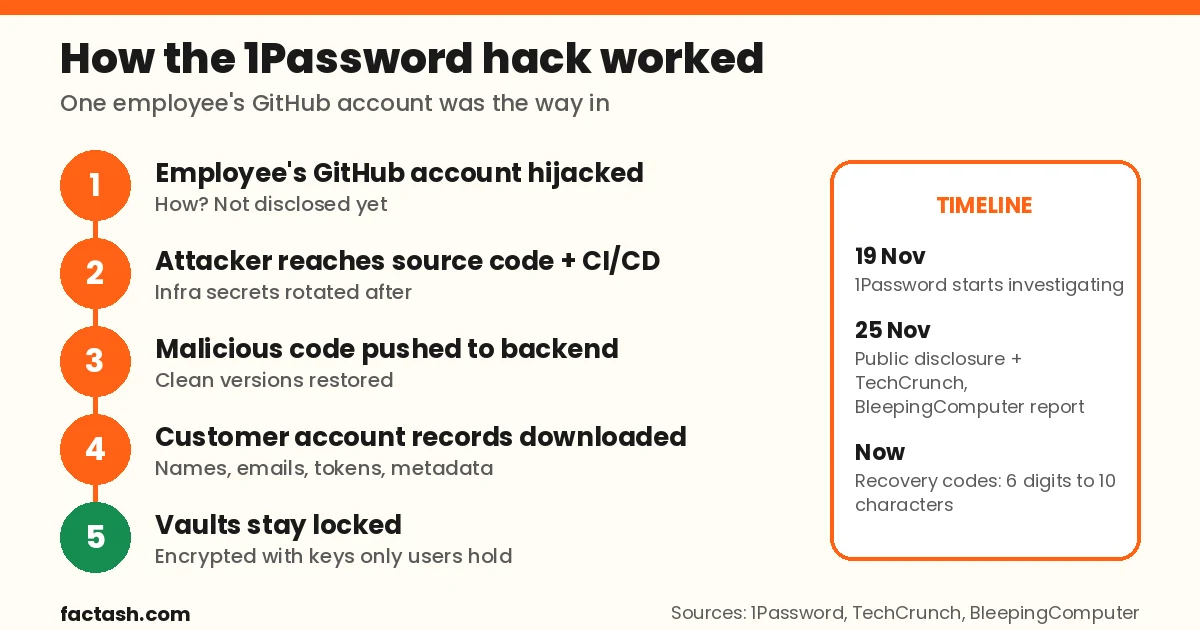
Here's the chain of events, straight from 1Password's own security incident update published on 25 November 2026:
- 19 November: 1Password started investigating "indications that an attacker gained access to an employee's corporate GitHub account."
- The attacker used that account to access source code and push malicious code to backend services.
- That code "downloaded administrative data pertaining to our customers," meaning account records for a subset of users.
- The attacker also copied source code from private repositories and got into 1Password's CI/CD system (the pipeline that builds and ships its software), which holds infrastructure secrets. 1Password says it has rotated every credential that may have been exposed.
The big line from the company: "At no time were customer vault contents accessed by, or available to, the attacker."
What we still don't know: how the employee's GitHub account was compromised, and how many customers were hit. TechCrunch and SiliconANGLE both note 1Password hasn't explained either. TechCrunch also asked whether the hackers made any demands; no answer yet.
What data was stolen in the 1Password hack?
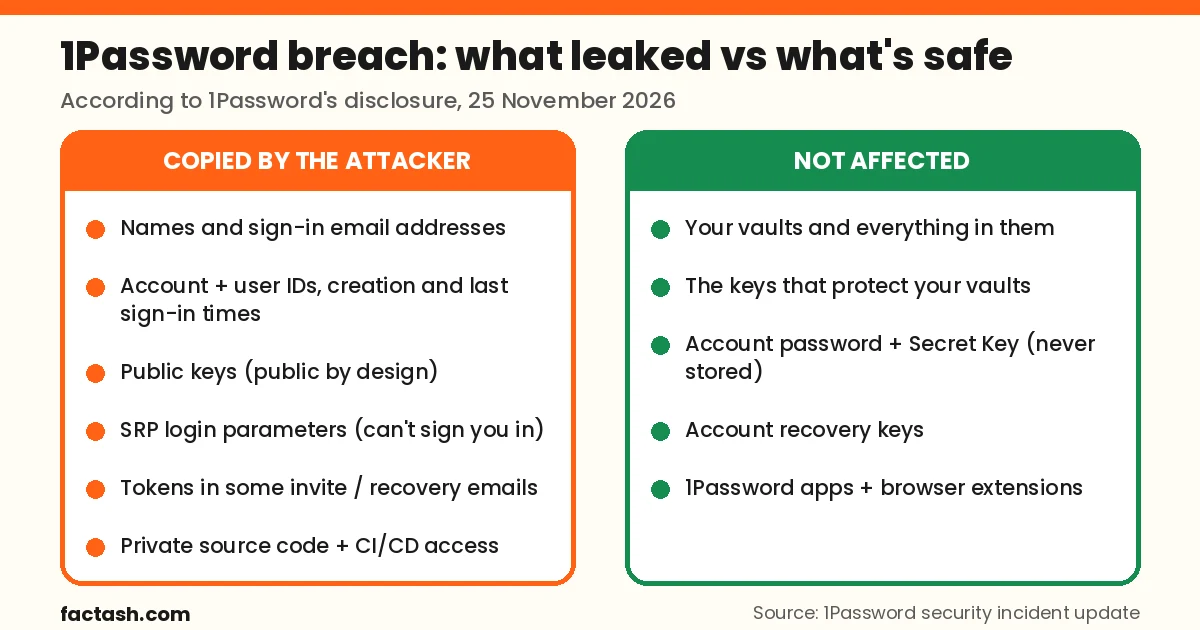
| Copied by the attacker | Not affected (per 1Password) |
|---|---|
| Names and the email addresses you sign in with | Your vaults and every item in them |
| Account and user IDs, account creation and last sign-in times | The keys that protect your vaults |
| Public keys (public by design, no security impact) | Your account password and Secret Key (never stored by 1Password) |
| Secure Remote Password (SRP) parameters | Account recovery keys |
| Tokens in some invitation, provisioning and recovery emails | 1Password apps and browser extensions |
| Other non-secret internal account metadata | 1Password services (working normally) |
| Private source code + CI/CD access |
Wait, what are "SRP parameters"? Should I worry? SRP is the protocol 1Password uses so it can check your login without ever knowing your password. On the 1Password Community forum, a 1Password community manager explained that the stolen SRP data includes a "verifier" derived from both your account password and your Secret Key, and that it "can't be reversed to reveal either one," can't be used to sign in as you, and can't be used to brute-force your password without your Secret Key, which 1Password doesn't store.
And those email tokens? When 1Password emails you an invite or an account recovery link, it contains a token. The company says a token alone can't open an account: you'd also need an SSO sign-in or a code sent to your registered email. Only "a small number of users" were in that invite or recovery state during the incident, and they were notified directly. As a precaution, 1Password lengthened those codes from six numbers to ten letters and numbers, which it says "makes brute force guessing practically impossible."
Is 1Password safe to use after the breach?
Short answer: based on everything disclosed so far, your saved passwords are not exposed. Here's why the design matters:
- Zero-knowledge encryption. 1Password says your vault is encrypted with keys only you hold, so neither 1Password nor "an attacker who gets into our servers" can read it.
- Two secrets, both on your side. Your vault is protected by your account password and a Secret Key. 1Password says it stores neither, and its community team says the backend access "didn't give them the secrets needed to decrypt your vault."
- No account takeovers found. The company says it has found no internal evidence of account takeovers using the exposed provisioning tokens, and brought in independent cybersecurity experts to check its clean-up.
But "vault safe" doesn't mean "no risk." As BleepingComputer points out, the stolen data is basically a list of confirmed 1Password users with their names and emails. That's gold for scammers.
Factash take: the encryption did its job here, and that's the whole point of a zero-knowledge password manager. The weak link was one employee's GitHub account, not the crypto. Still, 1Password owes users two answers: how many people were hit, and how that GitHub account got popped.
What should 1Password users do right now?
You don't have to change your password, according to 1Password. But do these five things anyway, because phishing season just started:
- Ignore "urgent" 1Password emails. Be suspicious of any email, text or call about invites, account recovery or "securing your account after the breach" that you didn't start. BleepingComputer warns that scammers will use exactly this breach as bait.
- Never share your password or Secret Key. 1Password says it "will never contact you to ask for your account password or Secret Key." Only type them in the official app or on the website you opened yourself.
- Go direct, don't click. Open the 1Password app or type the address yourself instead of clicking links in emails.
- Turn on two-factor authentication for your 1Password account if you haven't already, and consider passkeys for your other accounts (here's our passkeys explainer).
- Report anything weird to support@1password.com, the address 1Password listed in its update.
Need a refresher on spotting fake security emails? Our guide to the Microsoft 365 outage phishing scam walks through the same tricks scammers use.
Has 1Password been hacked before?
Kind of. In October 2023, 1Password said an attacker accessed its Okta tenant using session data stolen in a breach of Okta's support system; no user data was found to be compromised, SiliconANGLE notes. The 2026 incident is bigger because customer account records were actually copied.
People are also comparing it to rival LastPass, which revealed nearly four years ago that a hacker had copied encrypted customer vaults after an earlier break-in at its development environment (SiliconANGLE). The difference is huge: in the 1Password case, the company says vaults weren't accessed at all.
Why is everyone talking about it?
- Irony. A password manager getting breached is peak internet. The jokes write themselves.
- Scale. 1Password says it serves millions of customers and more than 200,000 businesses (TechCrunch, SiliconANGLE).
- The GitHub angle. One hijacked developer account reached source code, CI/CD and production backend services. That's a supply-chain wake-up call for every tech company. Breaches like the Cleverbridge card data hack and the Notion AI chat transcripts leak show how often third-party and developer access is the soft spot.
- Timing. It dropped right before Black Friday, when inboxes are already flooded with fake deals (here's how to spot fake online stores).
What happens next?
- More details: 1Password says it will keep its post current and update it "if we find anything that changes what we've said here."
- The numbers: watch for a count of affected customers or any regulator notices; none had been published as of this morning.
- Who did it: no group has been named, and 1Password hasn't said who was behind the attack.
- Phishing wave: expect fake "1Password security alert" emails over the next few weeks.
FAQ
What happened in the 1Password breach?
On 19 November 2026, 1Password began investigating signs that an attacker had hijacked an employee's corporate GitHub account. The attacker used it to access source code, push malicious code to backend services and download customer account records. 1Password disclosed the incident on 25 November 2026.
Were 1Password passwords or vaults stolen?
No, according to 1Password. The company says customer vaults, the items in them and the keys that protect them were not accessed, and that it never stores your account password or Secret Key.
What customer data was taken in the 1Password hack?
Names and sign-in email addresses, account and user IDs, account creation and last sign-in times, public keys, Secure Remote Password parameters, tokens in some invitation and recovery emails, and other non-secret account metadata. The attacker also copied private source code and accessed 1Password's CI/CD system.
Do I need to change my 1Password password?
1Password says you do not need to update anything in your account. It recommends watching for phishing emails, texts or calls about invites or account recovery that you did not start, and never sharing your password or Secret Key.
Is 1Password still safe to use?
Based on what 1Password has disclosed, yes for your stored data: vaults are encrypted with keys only you hold, and the company found no evidence of account takeovers. The main risk is phishing that uses the leaked names and emails.
How many 1Password users were affected?
1Password has not said. It describes the affected group only as a subset of its customers, and says a small number of users with pending invitations or recovery requests were notified directly.
Keep Reading on Factash
- What are passkeys? Passwordless login explained
- Microsoft 365 outage phishing scam: spot the fake email
- Black Friday scams 2026: how to spot AI fake online stores
- Cleverbridge data breach: card numbers and CVVs stolen
- Notion AI data breach: Fireworks hack exposed AI chats
- More Technology news
- More Cybersecurity news
Read the original disclosure: Update on a security incident involving 1Password's backend systems (1Password, 25 November 2026).
Source: main source is 1Password's official post, "Update on a security incident involving 1Password's backend systems. Customer vaults were not affected and all vault contents remain secure.", 25 November 2026 (read on 1password.com). Also: TechCrunch (Zack Whittaker, 25 November 2026), BleepingComputer (25 November 2026), SiliconANGLE (Duncan Riley, 25 November 2026) and the 1Password Community announcement thread. This is a developing story; affected-customer numbers and the attack's entry point had not been disclosed as of 26 November 2026, 9:25 AM IST.
Image credits
- Featured graphic: Factash original graphic (facts from the 1Password security incident update and TechCrunch).
- How the 1Password hack worked: Factash original graphic (from 1Password, TechCrunch and BleepingComputer).
- What leaked vs what's safe: Factash original graphic (from the 1Password security incident update).