Last updated: 23 Nov 2026, 2:15 PM IST · Last checked: Cleverbridge incident page, BleepingComputer, Neowin, PCI SSC, CFPB and Report Fraud pages, 23 Nov 2026
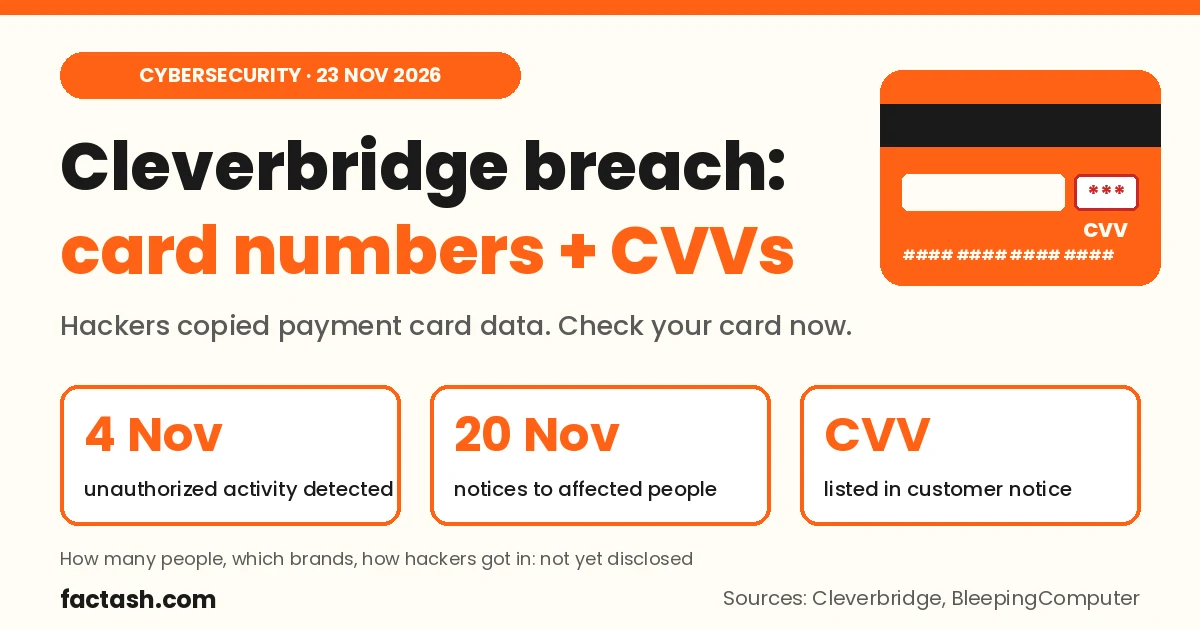
Ever bought software online and seen "Cleverbridge" on your card statement instead of the app's name? Cleverbridge, the company that often appears on those statements, says a third party copied payment card data stored on its platform. A customer notice seen by BleepingComputer says the copied data includes the CVV/CVC security code.
In the Cleverbridge data breach, Cleverbridge, the "merchant of record" that runs checkout, payments and subscriptions for lots of software and SaaS brands, says a third party copied payment card data stored on its platform. BleepingComputer's Lawrence Abrams reported on Sunday (22 November, US time) that a customer notice lists card numbers, expiry dates and CVV/CVC security codes. Below: what has been confirmed, what is still unknown, and steps to protect your card.
TL;DR
- Cleverbridge detected unauthorized activity on 4 November 2026 and later found a third party copied payment card data stored on its platform.
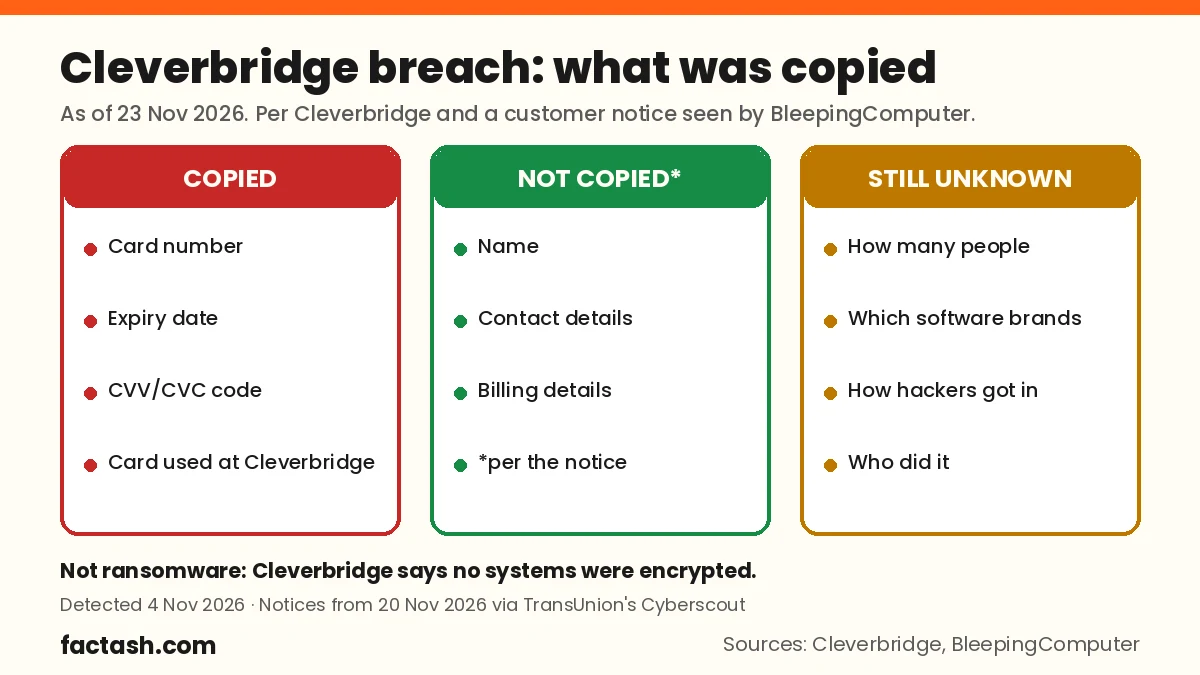
- A notice seen by BleepingComputer says the data includes card number, expiry date and CVV/CVC. It says name, contact and billing details were not copied.
- Cleverbridge started notifying affected people on 20 November. It hasn't said how many people are hit, which software brands' customers, or how hackers got in.
- Not ransomware, per Cleverbridge. No systems were encrypted.
- Factash guidance: if you got a notice, call your card issuer and ask for a new card. Everyone else: check statements for unfamiliar charges, and ignore "Cleverbridge refund" texts.
What happened?
Per Cleverbridge's own incident update page, the company "detected unauthorised activity in our platform" on 4 November 2026, took affected systems offline, and had everything back online the same day. But the investigation "subsequently determined that a third party copied payment card data stored on our platform."
Cleverbridge says it began notifying affected individuals on 20 November. Its public page only says the data "may include payment card details used to make a purchase through Cleverbridge" and tells people to check their own notification for specifics.
That's where BleepingComputer comes in. A breach notification shared with the outlet says: "the information involved includes the payment card details you used to make a purchase through Cleverbridge, notably your card number, expiry date, card security code (CVV/CVC)." The same notice says "no other personal data (for example your name, contact or billing details) were copied," and tells each person the last four digits of the affected card.
Other details confirmed so far:
- It wasn't ransomware. Cleverbridge says none of its systems were encrypted.
- Authorities are in the loop. BleepingComputer says Cleverbridge notified data protection authorities, law enforcement, payment card networks and payment partners.
- The notices are legitimate, per Cleverbridge. Cleverbridge is using TransUnion's Cyberscout to send notifications and says affected cardholders have been offered credit or identity monitoring "where available."
What is Cleverbridge, and why is it on my statement?
Cleverbridge is a merchant of record (MoR). Translation: when you buy or renew certain software online, Cleverbridge is technically the seller handling the payment, tax and subscription, so your bank statement may say "Cleverbridge" rather than the app's name. Its help page says a Cleverbridge charge is most likely a new software purchase or a subscription renewal.
Cleverbridge's homepage says it handles 1.5+ million transactions a month, has processed $10+ billion in revenue and sells in 240+ markets. BleepingComputer notes the company lists brands like Red Hat, SUSE, Tenable, Veeam, Jamf, Sony and Parallels as customers.
Big caveat: Cleverbridge has not said which brands' customers were affected. Being a customer of one of those brands does not mean your card was stolen. The notice is what tells you.
Why the CVV detail matters
The CVV/CVC is that 3 or 4-digit code on your card. Online shops ask for it to check you actually have the card. With number + expiry + CVV, someone has most of what's needed to try card-not-present shopping online. (Many banks add extra checks like one-time codes, but that is not guaranteed.)
Card industry rules say that code shouldn't be sitting around at all. The PCI Security Standards Council says PCI DSS Requirement 3.3.1.2 "strictly prohibits storing them after authorization, even if encrypted." BleepingComputer asked Cleverbridge why CVV codes were accessible and whether the card data was encrypted. As of its report, the company hadn't answered. So we don't know yet why or how those codes were stored, and Factash isn't claiming any rule was broken.
What we still don't know
As of Monday 23 November, 2:15 PM IST:
- How many people are affected. No number has been shared.
- Which software brands' customers were hit.
- How hackers got in and how long they had access.
- Who did it. No group has been publicly linked to the attack.
We'll update this post if Cleverbridge shares more.
Am I affected?
Only Cleverbridge's notice can tell you for sure. Factash's read on the signals:
- You got an email or letter from Cleverbridge or TransUnion/Cyberscout naming a card ending in your digits? Treat that card as compromised.
- You've seen "Cleverbridge" on your statement in the past (software or a subscription)? You might be affected. Watch that card closely and look out for a notice.
- Never bought software or subscriptions through it? You're very likely not in this one, but the scam texts below can still hit you.
Factash guidance: what to do right now
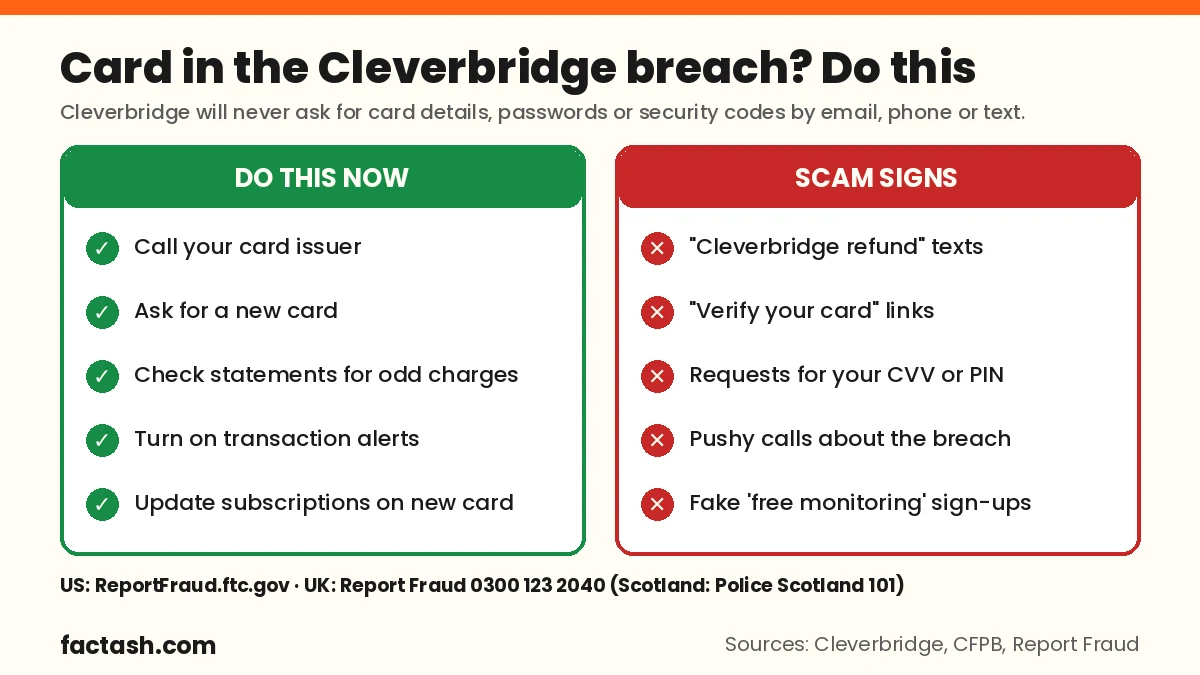
- Call your card issuer using the number on the back of your card or the bank's app, mention the Cleverbridge breach and ask for a replacement card. Cleverbridge itself says banks "may decide to replace your card."
- Scan your statements for charges you don't recognize, especially small "test" charges. Report anything unfamiliar promptly.
- Update your subscriptions after you get a new card, so your software doesn't quietly fail to renew.
- Turn on transaction alerts in your banking app so you see every charge in real time.
- Use the monitoring offer if your notice includes one. Enroll using the details in the notice itself, not a link from an unsolicited message.
- Ignore "Cleverbridge" refund or verification messages. Cleverbridge says it "will never ask you for your card details, passwords, or security codes by email, phone, or text message."
US readers: per the CFPB, if someone steals and uses your credit card number (but you still have the card), you generally have no liability for the unauthorized use. Debit cards have different rules, so move fast. Report fraud to the FTC at ReportFraud.ftc.gov.
UK readers: tell your bank or card provider straight away. If you've been scammed, report it to Report Fraud (the service that replaced Action Fraud) on 0300 123 2040 in England, Wales and Northern Ireland, or to Police Scotland on 101.
Watch for follow-up scams
Factash's take: expect fake "Cleverbridge refund", "your card has been suspended" or "claim your free credit monitoring" emails and texts. With Black Friday on 27 November, fake order confirmations will be everywhere too. Never click the link; go to your bank's app or the official site yourself. Our Black Friday scams 2026 guide has the full checklist.
It's also the latest in a run of third-party breaches. Hackers recently hit the Optimizely platform and planted a card skimmer on 178 websites, and a vendor attack exposed Chase, Visa and Mastercard customer info. The pattern is the same: third-party providers you've never heard of are holding your data.
The bigger picture
You can't stop a company you've never heard of from getting hacked. You can make stolen card data less useful. Factash guidance: use virtual or single-use card numbers where your bank offers them, keep alerts on, and switch on passkeys for your accounts so a leaked detail isn't enough to get in.
FAQ
What is the Cleverbridge data breach?
Cleverbridge, an e-commerce company that processes software and subscription payments, says it detected unauthorized activity on 4 November 2026 and later found that a third party copied payment card data stored on its platform. It began notifying affected people on 20 November 2026.
What data was stolen in the Cleverbridge breach?
A customer notice reported by BleepingComputer says the data includes card numbers, expiry dates and CVV/CVC security codes. The notice says names, contact details and billing details were not copied.
Why is Cleverbridge on my bank statement?
Cleverbridge is a merchant of record for many software and SaaS companies, so it can appear on statements instead of the product name. Its help page says a Cleverbridge charge is most likely a software purchase or a subscription renewal.
How do I know if I was affected by the Cleverbridge breach?
Cleverbridge is notifying affected individuals directly, with help from TransUnion's Cyberscout, and the notice names the last four digits of the affected card. If you have not received a notice but have paid through Cleverbridge, watch that card closely.
Should I cancel my card after the Cleverbridge breach?
If you received a notice, contact your card issuer using the number on your card and ask about a replacement. Cleverbridge itself says card issuers may decide to replace affected cards.
Was the Cleverbridge breach ransomware?
No. Cleverbridge says it was not a ransomware attack and none of its systems were encrypted.
Keep Reading on Factash
- Optimizely hack: card skimmer on 178 websites
- Chase, Visa, Mastercard data breach: what n0n leaked
- Black Friday scams 2026: fake online stores
- FBI hacked again: NCIC crime database breach
- Passkeys explained
- More Technology news
Source: main source is BleepingComputer's original reporting, "Cleverbridge warns hackers stole credit card numbers, CVVs in data breach" by Lawrence Abrams, 22 November 2026. Also: Cleverbridge, "Incident Update & FAQs", Neowin, "Cleverbridge confirms data breach that exposed customers' payment card data" by Justin Luna, 23 November 2026, Cleverbridge Help, "What is this charge from Cleverbridge on my card?", Cleverbridge homepage, PCI Security Standards Council FAQ on card verification codes, CFPB, unauthorized credit card charges and Report Fraud FAQs. Sources checked 23 November 2026, 2:15 PM IST.
Image credits
- Featured graphic: original Factash design (facts from BleepingComputer and Cleverbridge).
- "Cleverbridge breach: what was copied" infographic: original Factash design (facts from Cleverbridge and BleepingComputer).
- "What to do now" checklist graphic: original Factash design (facts from Cleverbridge, the CFPB and Report Fraud).