Last updated: 18 Nov 2026, 2:20 PM IST
For several hours on Monday, 16 November 2026, visitors to some of the world's best-known websites could have received malicious code without clicking anything, according to security researchers at Report URI.
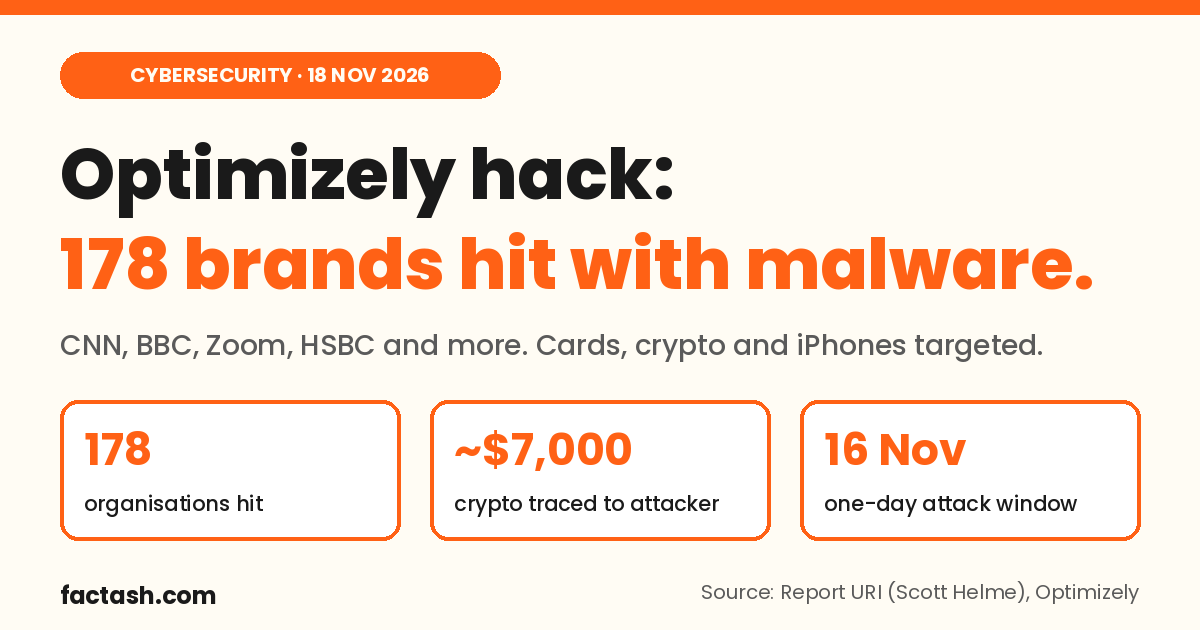
In the Optimizely hack, an attacker inserted malicious JavaScript into Optimizely, a website testing tool used by large companies. Report URI says the code was served to visitors of 178 organisations, including CNN, the BBC, Zoom, HSBC, Equifax, IKEA and Salesforce. According to Report URI, it could steal card details, swap crypto wallet addresses and target older iPhones. This explainer covers what happened, who was affected and what visitors can do, based mainly on Report URI's investigation by Scott Helme (main source), plus Optimizely's own incident report, Malwarebytes and Newsweek.
TL;DR
- On 16 November 2026, malicious code was injected into Optimizely Web Experimentation snippets and served to visitors of 178 organisations (188 infected snippets), per Report URI.
- According to Report URI, the code skimmed payment cards typed into a site's own forms, swapped crypto wallet addresses, stole some cookies and screenshots, and pushed iOS exploit kits at older iPhones and iPads.
- Optimizely says a flaw in its account signup flow let the attacker act as admin users. It was closed at 16:10 UTC and all injected code was removed by 22:24 UTC the same day.
- Report URI traced about $7,000 in crypto to the attacker's wallets. It says it cannot see how many cards were skimmed.
- Report URI and Malwarebytes advise anyone who visited an affected site on 16 November to update their iPhone/iPad, check card statements and double-check any crypto transfers.
What is Optimizely and what got hacked?
Optimizely makes software that lets companies run A/B tests and personalise their websites. To use it, a site loads a small piece of JavaScript called a "snippet" from Optimizely's servers. Every visitor's browser runs that snippet. Malwarebytes notes that BuiltWith detects Optimizely on roughly 190,000 live websites overall (that's total usage, not the number hit here).
According to Report URI, the attacker wrote their own code into the "Project JavaScript" field of customer projects. The rest of each file was untouched and was still served from Optimizely's own domain, with Optimizely's certificate, from a host the affected sites already trusted, Report URI says. Helme told Newsweek this makes it a supply-chain attack: "Compromise one trusted vendor, and its code runs on every customer's website at once."
See Report URI's screenshot of zoom.com loading the malicious script, and the injected code, in its write-up: Report URI, Scott Helme, 16 November 2026.
How did the attacker get in?
In its 17 November security incident report, Optimizely says an unauthorised third party "exploited a vulnerability in the Optimizely Web Experimentation account signup flow" to impersonate users and insert malicious JavaScript into some customer projects. Key points from the report:
- It was not a credentials breach. Optimizely says no customer passwords were stolen or used, and it has no evidence any were exposed.
- The attacker created accounts starting at 00:37 UTC on 16 November, from IP addresses that included commercial VPN (ExpressVPN) addresses.
- Only Web Experimentation was involved. Feature Experimentation, the SDKs and legacy Full Stack were not affected, Optimizely says.
- Optimizely brought in Mandiant to investigate. The root cause and final indicator list are still to be confirmed.
Read Optimizely's full incident report (PDF): Optimizely, Security Incident Initial Report for Customers, 17 November 2026.
Timeline of the Optimizely hack (16 November 2026)
| Time (UTC) | What happened | Source |
|---|---|---|
| 00:37 | First impersonated user account created by the attacker | Optimizely |
| 04:21 | First injected Optimizely snippet seen (the BBC's) | Report URI |
| 07:51 | First malicious code written to a customer project, per Optimizely's investigation | Optimizely |
| 08:28 | Main payload (track.js) first seen on bbc.com | Report URI |
| 13:34 | Optimizely detects the malicious activity | Optimizely |
| 13:43 | Card skimmer added to the payload | Report URI |
| 16:10 | Vulnerability closed | Optimizely |
| 22:24 | Injected code removed from all affected projects | Optimizely |
Note the two companies give different start times: Report URI saw an injected BBC snippet at 04:21 UTC, while Optimizely's investigation puts the first malicious code at 07:51 UTC. The 07:51 to 22:24 UTC window Optimizely gives is 1:21 PM on 16 November to 3:54 AM on 17 November in India (IST), and about 2:51 AM to 5:24 PM Eastern on Monday 16 November in the US. In the UK it is the same as UTC.
What did the malware actually do?
Report URI says every visitor got the same script, and all of its features were live at once:
- Crypto address swapping. It found wallet addresses (Bitcoin, Ethereum and other EVM chains, TRON, Solana, TON, Litecoin, Bitcoin Cash, Dogecoin) on the page and in your clipboard and replaced them with the attacker's. Copy an address while the tab was open and you might paste theirs.
- Card skimming. Added at 13:43 UTC, it grabbed card number, expiry date and CVV when all three were submitted. Cards entered in hosted payment iframes like Stripe or Adyen were out of reach, according to both Report URI and Optimizely. Cards typed into a site's own form fields were not.
- Cookie and screenshot theft. Next to wallet or payment wording, it sent the page URL, readable cookies (those not marked HttpOnly) and a screenshot to the attacker's server.
- iPhone and iPad exploits. On iOS it loaded the Coruna and DarkSword exploit kits. Report URI says the kit's own comments list iOS 18.7.3 and later, and 26.3 and later, as patched. Optimizely says the iOS stage targeted iOS/iPadOS 18.6 and lower.
Report URI says that, as of 19:25 UTC on 16 November, the attacker's wallets had received about $7,040, all within roughly nine hours that day. It also says, "We have no way to see how many credit cards were skimmed, how many cookies or screenshots were stolen, or how many iOS devices were infected." Scott Helme told Newsweek the code may have been served during roughly 34 million page visits (possible range 6 million to 150 million), adding: "That counts visits that loaded the code, not people who lost money or data. The actual harm is far smaller."
Which websites were affected?
Report URI checked 1,611 Optimizely snippets and found 188 infected snippets belonging to 178 organisations. It says the real number is likely higher. Banking and finance was the biggest group with 32 organisations. Names on its published list include:
| Sector | Examples from Report URI's list |
|---|---|
| Banking & finance | HSBC (US and several other countries), Equifax, Equifax UK, Paychex, TaxAct, Funding Circle |
| News & media | CNN, BBC, Fox News, NPR, Top Gear |
| Tech & SaaS | Zoom, Salesforce, GitLab, Bitly |
| Retail | IKEA, ASOS, Mattel, American Eagle |
| Streaming | Peacock, NOW TV |
| Telecoms | Virgin Media O2, O2, TalkTalk |
| Travel | Alaska Airlines / Hawaiian Airlines, Air France-KLM |
| Crypto & trading | Ledger, IG, interactive investor |
See Report URI's full list to check a site you used. Report URI notes that a website can be compromised through a third-party script "without its own code or infrastructure ever being breached." Being on the list means the site loaded an infected snippet. Report URI also found that at HSBC, the site's Content Security Policy blocked the main script and the data theft, but an inline copy of the code still ran. As Malwarebytes puts it, the BBC timeline "does not establish that the BBC's own servers were breached, or that every BBC visitor was infected."
Some companies have responded. Equifax told Newsweek it "ceased our use of Optimizely" and has "not identified evidence of any compromise to our systems or impact to our data." IKEA told Newsweek it is investigating. Salesforce said in a security advisory that it has disabled Optimizely scripts while it investigates.
Is it still happening?
According to Report URI, all infected Optimizely files it was tracking were clean from 23:11 UTC on 16 November and have stayed clean. The attacker's main server domain, 1688360.cc, was put on hold at 00:37 UTC on 17 November and no longer resolves. Optimizely says delivery of the malicious code is blocked and none remains in its systems.
What should you do if you visited an affected site?
You can't inspect every script a website loads, so these are the practical steps, based on advice from Report URI and Malwarebytes:
- Update your iPhone or iPad now. Report URI says to get to iOS 18.7.3 or later, or iOS 26.3 or later. Malwarebytes advises installing the latest version available for your device.
- Check your card statements if you paid by card on an affected site on 16 November, and call your card issuer about anything you don't recognise. Turn on transaction alerts.
- Double-check crypto transfers made that day. If the address you pasted doesn't match the one you meant to pay, it may have been swapped.
- Watch for unusual account activity, like new sessions or changed settings, on services you used that day. Malwarebytes notes the code could steal some cookies, which can keep you signed in. Signing out of other sessions and turning on two-step verification or passkeys can also help (how passkeys work).
- Watch for phishing. Scammers often use breach news as a lure. Don't trust "your card was compromised" emails or texts with links; contact your bank using the number on your card. Our guides on Microsoft 365 outage phishing and Black Friday fake stores show how these lures work.
The bigger picture
In this case the code reached visitors through a trusted third party, not the brands' own systems, according to Report URI. Factash has covered other third-party and AI-era security risks, including the Uber driver data breach via Fireworks AI and the FBI's warning about the Artex AI hacking tool. Report URI evaluated the Content Security Policy (CSP) of affected organisations' sites and found it fully blocked the payload for only 24 of them (15%). Helme told Newsweek researchers saw "no evidence of AI involvement" in this attack.
FAQ
What is the Optimizely hack?
On 16 November 2026, attackers injected malicious JavaScript into Optimizely Web Experimentation snippets, and the code ran in visitors' browsers on the websites of 178 organisations, according to Report URI. Report URI says it could skim cards, swap crypto addresses and target older iPhones.
Which websites were affected by the Optimizely hack?
Report URI found 188 infected snippets across 178 organisations, including CNN, the BBC, Zoom, HSBC, Equifax, IKEA, Salesforce, GitLab, ASOS, Peacock and Alaska Airlines. Its full list is on the Report URI blog.
How did hackers get into Optimizely?
Optimizely says an unauthorised party exploited a flaw in the Web Experimentation account signup flow to impersonate administrator users and edit Project JavaScript. It says this was not a credentials breach and no customer passwords were exposed.
Was my credit card stolen?
According to Report URI and Optimizely, the skimmer targeted card details typed into a site's own payment form on an affected page while the code was live on 16 November. Cards entered in hosted payment frames like Stripe or Adyen were out of reach. Check your statements and contact your card issuer about anything unusual.
Do I need to update my iPhone?
Yes, if you can. Report URI says the malware loaded exploit kits aimed at older iOS versions, and it advises iOS 18.7.3 or later, or iOS 26.3 or later.
Is the Optimizely malware still active?
No. Optimizely says it closed the flaw at 16:10 UTC and removed all injected code by 22:24 UTC on 16 November, and Report URI found every infected file clean from 23:11 UTC that day.
Keep Reading on Factash
- Artex AI hacking tool: FBI warning
- Uber data breach via Fireworks AI
- Microsoft 365 outage phishing scam
- More Technology news
Source: main source is Report URI, "World's Largest Brands Infected With Malware Via Optimizely" by Scott Helme, published 16 November 2026 and updated 17 November 2026 (read it). Also: Optimizely, Security Incident Initial Report for Customers, 17 November 2026 (PDF), Malwarebytes, "CNN, BBC, Zoom, and other sites served malicious code in supply-chain attack" by Pieter Arntz, 17 November 2026 and Newsweek, "Cyber attack hits 178 major websites" by Chris Matthews and Hollie Silverman, 17 November 2026. Sources checked 18 November 2026, 2:20 PM IST.
Image credits
- Featured graphic: original Factash design (facts from Report URI and Optimizely).