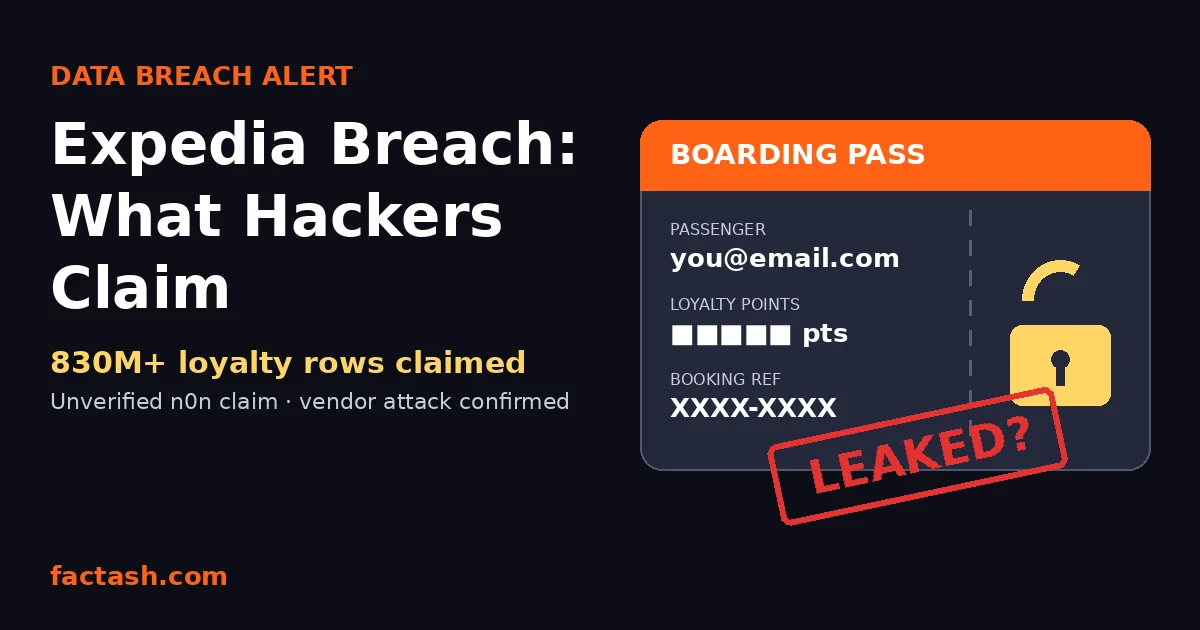
You booked one hotel in 2019 and now your email might be sitting in a hacker's spreadsheet. Fun. The Expedia data breach is the cyber story everyone's googling this week: Expedia Group has confirmed attackers got into its systems through a hacked vendor, while an extortion crew called n0n is bragging about "nearly a billion" traveler records. Here's what's actually confirmed, what's just hacker hype (for now), and the 10-minute checklist to protect your travel accounts.
TL;DR
- On 12 November 2026 Expedia Group confirmed to Skift that attackers compromised a third-party data platform provider and used its trusted access to reach systems at multiple companies, including Expedia Group.
- Expedia says it contained the issue, is investigating with outside security experts, and that its platforms "remain safe to use."
- Extortion group n0n claims it stole 830 million+ loyalty program rows, 58 million traveler profiles and 333 million account records. None of this has been independently verified.
- Expedia hasn't said what data was taken, which brands (Expedia, Hotels.com, Vrbo, Orbitz, Travelocity, Hotwire...) or how many people are affected.
- Biggest real risk right now: super-convincing booking and "points expiring" phishing. Change reused passwords, turn on 2FA and only sign in through the official app.
What happened in the Expedia data breach?
Short version: a vendor got hacked, and the hackers used that vendor's keys to walk into its customers' systems.
In a statement to travel industry outlet Skift on Thursday, 12 November 2026, Expedia Group said: "We are aware of a supply chain attack, reported by security researchers, in which attackers compromised a third-party data platform provider and used its trusted access to reach systems at multiple companies, including Expedia Group."
In the version shared with Forbes, the company added: "We take our travelers' privacy extremely seriously. As soon as we became aware, we took action to contain the issue and began investigating alongside leading third-party security experts. Our platforms remain safe to use for both travelers and partners."
What Expedia has not said yet (as of 14 November 2026):
- Which vendor was hacked.
- What customer data, if any, was taken.
- Which brands or countries are affected.
- Whether customers will be notified.
BreachNews also notes that, as of 13 November, Expedia had not filed a material cybersecurity incident report (Form 8-K Item 1.05) with the US Securities and Exchange Commission.
What n0n claims it stole (big numbers, zero proof... so far)
The confirmation came days after cybersecurity sites reported that a new extortion group called n0n had listed Expedia Group on its dark-web leak site and threatened to publish the data unless the company reached a settlement. According to Cybernews, the group claims its haul includes:
- 830 million rows of loyalty program data across 800 files, covering 35 named programs: email addresses, member IDs, points balances in 21 currencies, membership tiers and booking values.
- 58.3 million traveler profiles with email addresses, account dates and home airports.
- 333.3 million consumer account records pairing account IDs and emails with what the group calls "password-like tokens".
- Nearly 23 million trip journey records and more than 221 GB of booking event files.
- 2.4 million card network spending records keyed by hashed customer email addresses.
- 72.2 million consumer matching records and nearly 500,000 guest communication records with accommodation details.
- Claimed live credentials for Expedia's big data platform, source code access and a production cloud environment.
Reality check, bestie: every one of those figures comes from the hackers. Expedia hasn't confirmed them, and "rows" are not "people". One traveler can show up in hundreds of rows, so "nearly a billion records" does not mean a billion humans got leaked. SECNEWS reports n0n has since published a sample of data it says came from Expedia, and that date ranges in several files suggest the material is at least partly historical. Still unverified.
Who is n0n?
Per Forbes, threat intel firm SOCRadar describes n0n as a group "focusing on data theft and extortion without relying on traditional ransomware" that emerged in mid-September 2026. In other words: no locked screens, just "pay us or we post your data."
The Qubole connection (aka why your old apps matter)
Here's the nerdy-but-important part. On 9 November 2026, cloud security firm Wiz, working with Sentra and Google's Mandiant, published research on an attack involving Qubole, a big-data platform. Between 14 and 26 October 2026, an attacker used IAM credentials from an AWS account associated with Qubole to assume access roles that Qubole's customers had set up in their own Amazon Web Services accounts.
Once inside, Wiz says the attacker listed resources, harvested stored secrets and downloaded data from storage buckets, "in some cases downloading entire buckets in a single session." The wild part? Wiz found most of the roles the attacker used "were not otherwise in use". Companies had stopped using the vendor but never removed its access. The doors were just... left open.
Skift describes Qubole as a onetime Expedia vendor, and Expedia's wording closely matches the Qubole campaign. Wiz added an update on 11 November saying an actor calling itself "n0n" had claimed responsibility for the Qubole intrusions. But: Expedia has not named Qubole, and neither Wiz nor Sentra has publicly named Expedia as a victim. So it's a strong pattern, not a confirmed link.
Should you panic? Nah. Should you act? Yes.
There's no confirmed evidence that payment card numbers were exposed, so you don't need to rage-cancel your cards. The real risk is phishing that actually sounds legit. A scam email that knows your home airport, your loyalty tier or your last hotel stay hits way harder than a random "Dear Customer" message. And it's not a hypothetical: Cybernews notes that after Booking.com disclosed a breach involving booking data in April 2026, customers reported phishing emails, calls and WhatsApp messages that referenced their bookings.
Timing makes it worse. Lots of people in the US and UK are booking Thanksgiving, Christmas and New Year trips right now, and scammers know it.
What to do now: your 10-minute Expedia breach checklist
If you've ever had an account with Expedia, Hotels.com, Vrbo, Orbitz, Travelocity, Hotwire or (UK) ebookers, do this:
- Change reused passwords. If your Expedia Group password is also your Netflix, email or bank password, change it everywhere. Use a unique password for each account (a password manager makes this painless).
- Turn on two-factor authentication for your travel accounts and, most importantly, your email. Even better, switch to passkeys wherever they're offered.
- Sign in only through the official app or by typing the website address. Never through links in emails or texts about refunds, booking problems or points.
- Check your loyalty points and bookings for changes you didn't make, plus your card statements for anything weird.
- Know Expedia's own rules. On its official contact page, Expedia says it will never ask for your password or one-time passcode, never ask for a wire transfer, only asks for card details at checkout and will never ask you to pay with a gift card. Anyone doing that is a scammer.
- Watch out for fake support numbers. Expedia warns that fake Expedia phone numbers are circulating, often through misleading search ads. Use the contact options inside the app or official site.
- Check if your email is in known breaches at Have I Been Pwned.
- Report scams. In the US, use ReportFraud.ftc.gov (or IdentityTheft.gov if your identity was misused). In the UK, report to Action Fraud and forward scam texts to 7726.
Red flags in "Expedia" messages
- "Your booking will be cancelled unless you re-confirm your card in 24 hours."
- "Your points expire tonight, click to redeem."
- A "hotel" calling or messaging to "verify" your card for a stay.
- Any request for a one-time code, a gift card or a bank transfer.
The bigger lesson: supply chain attacks are the new normal
Expedia didn't need to be "hacked" in the classic sense. A trusted vendor did. We've seen the same pattern this year in the Amadeus data breach hitting travel, and in the Notion AI data breach, where trouble at a third-party provider spilled onto its customers. For you, that means one thing: you can't control a company's vendors, but you can control your passwords, 2FA and how fast you spot a fake message.
Keep your scam radar sharp
- Amadeus data breach: what to do
- FBI FaceStealer scam: how fake Zoom calls stole $400M
- Black Friday scams 2026: fake online stores to avoid
- Fake FBI and FTC agent scam calls: how to spot them
- DreamHost data breach explained
- More Technology stories on Factash
FAQ
Did Expedia have a data breach in 2026?
Expedia Group confirmed on 12 November 2026 that attackers compromised a third-party data platform provider and used its trusted access to reach systems at multiple companies, including Expedia Group. It has not said what data was taken or how many people are affected.
What data was stolen in the Expedia breach?
Expedia hasn't said. The extortion group n0n claims it took more than 830 million loyalty program rows, 58 million traveler profiles and 333 million account records, including emails, loyalty IDs, points balances and "password-like tokens". These claims have not been independently verified.
Is it safe to use Expedia, Hotels.com and Vrbo right now?
Expedia says its platforms "remain safe to use for both travelers and partners" and that it contained the issue. To be extra safe, use a unique password, turn on two-factor authentication and only sign in through the official app or website.
Was my credit card exposed in the Expedia breach?
There is no confirmed evidence that full card numbers were exposed. n0n claims to have 2.4 million card network spending records keyed by hashed email addresses, which is unverified. Keep an eye on your statements and report anything unusual to your bank.
Is the Expedia breach linked to Qubole?
Possibly, but it is not confirmed. Wiz documented an attack through Qubole's AWS access between 14 and 26 October 2026, and Skift describes Qubole as a onetime Expedia vendor. Expedia hasn't named the vendor, and researchers haven't publicly named Expedia as a victim.
What should I do if I get an Expedia email about my booking or points?
Don't click links or call numbers in the message. Open the official Expedia, Hotels.com or Vrbo app or type the website address yourself. Expedia says it will never ask for your password, one-time passcode, a wire transfer or gift card payment.
Main source: Skift, "Expedia Confirms Cyberattack Through Third-Party Vendor" (12 November 2026), which carries Expedia Group's statement. Also referenced: Forbes (Suzanne Rowan Kelleher, 13 November 2026), Cybernews, Wiz Research (9 November 2026), BreachNews, SECNEWS and Expedia's fraud guidance. Facts as reported up to 14 November 2026.
Image credits
- Featured graphic: Factash original.