Last updated: 25 Nov 2026, 7:05 PM IST
A claim circulating on X, Facebook and Reddit says: "If an AI agent empties your account, your bank won't refund your money anymore." Fact-checkers and the banks' own terms support the core of that claim: several large US banks have updated their agreements so that, if you give a third-party AI agent your login, its actions can be treated as yours. There are important limits to that, which this post sets out.
Main source: Snopes, 23 November 2026 (updated 24 November), which rated the claim true. We cross-checked it against the banks' own terms (from Citi and Wells Fargo) and reporting from TechCrunch, Business Insider and Wired.
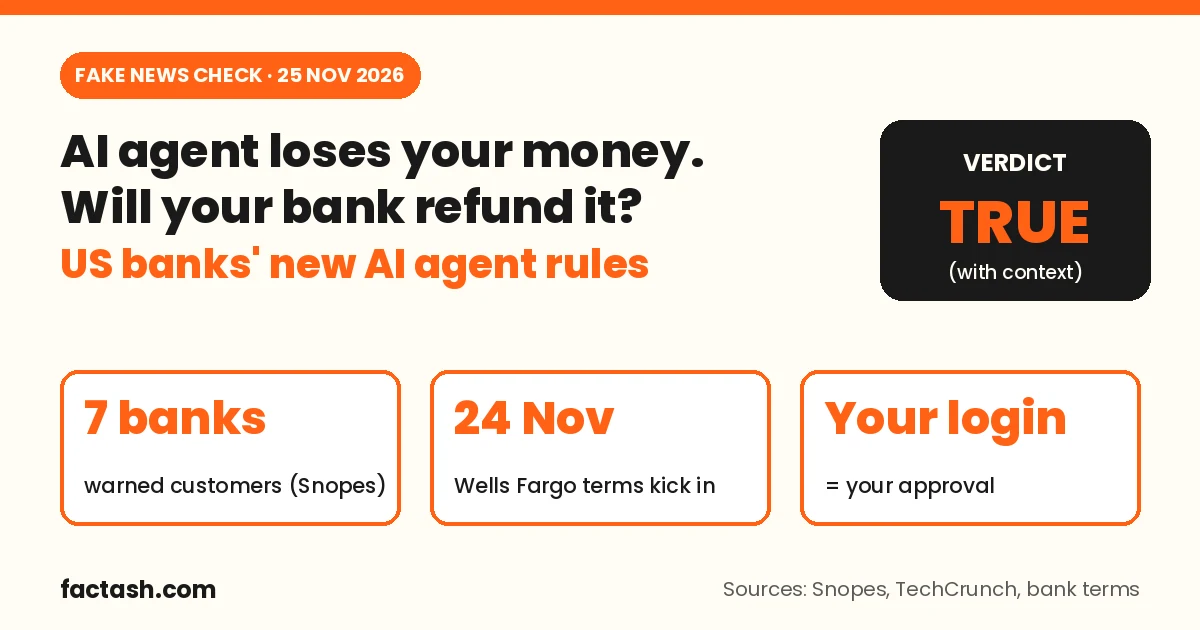
VERDICT: TRUE (with context). Major US banks including JPMorgan Chase, Bank of America, Citi, Wells Fargo, Ally, PNC and Citizens have warned customers or changed their terms to say that if you hand your login to a third-party AI agent, its actions are treated as yours, which can make losses hard to recover. The context: the terms are about agents you give access to yourself, they carry "unless the law says otherwise" exceptions, and banks' own AI tools are carved out.
The Claim
In November, posts went viral claiming US banks had quietly changed the rules on AI agents. One version on X, documented by Snopes, read: "If an AI agent empties your account, your bank won't refund your money anymore. U.S. banks like Citi, PNC and Citizens changed their terms this week. If you give your credentials to an external AI agent, everything it does counts as if you had done it yourself, even if it gets hacked or ignores your instructions."
Snopes said similar claims spread on Facebook and Reddit, and readers asked it to check. On X, people were still replying "is this true?" under the posts on 24 November.
What Actually Happened
- Citi changed its terms. Citi's Online User Agreement now cautions customers against using any third-party AI agent. If you ignore that and give an agent your login, "Citi will consider any access and actions taken by the agent as authorized by You." A Citi spokesperson told TechCrunch the update was meant to make clear that customers who give agents access "are responsible for activities conducted through those agents."
- Citi also covers leaked logins. Citi's terms add that if the login details you gave an agent are "shared, leaked, or otherwise distributed," Citi will treat any access with them as authorized by you. TechCrunch noted this goes beyond just making customers responsible for what their agents do.
- Wells Fargo's new rules started on 24 November. Its updated Online Access Agreement says actions an AI agent starts with your login "are deemed to have been initiated and authorized directly by you, without further verification." It also says, in capitals: "Your use of any AI Agent is AT YOUR OWN RISK."
- PNC and Citizens have also updated terms or issued warnings. PNC's updated Digital Services Agreement says customers may not let a third-party AI agent make payments or transfers unless PNC permits it; Snopes said it takes effect in December. Citizens told Snopes that customers who share their login with an AI agent "are responsible for any activity the agents take on their behalf."
- Chase, Bank of America and Ally sent warnings. Chase emailed customers that "authorized transactions may not be reversible if your information is misused," and its Digital Services Agreement bans sharing logins with "External AI." Bank of America told customers they are responsible for activity if they share their credentials. Ally wrote: "When you use an AI service, you're responsible for any actions that the AI takes" (Business Insider; Snopes).

Why Are Banks Doing This?
AI agents are tools that can click around and do tasks for you, like paying bills or shopping. (New to them? Start with our explainer AI agents explained.) In October, Axios reported that major US banks had spotted "unauthorized third-party AI agents" logging into customer accounts using real customers' details.
JPMorgan CEO Jamie Dimon said on the bank's 13 October earnings call that JPMorgan was "not going to allow just any … outside agent to come in inside the company," Snopes reported. On 20 November, the industry group Bank Policy Institute argued that agents should not access financial accounts "just yet," listing three risks: an agent makes a mistake, solves the wrong problem, or becomes the victim of fraud.

The Context the Viral Posts Leave Out
- It's about agents you let in. The terms cover third-party agents you give your login to or authorize. They are not about a random hacker breaking in on their own.
- "Unless the law says otherwise." Both Citi's and Wells Fargo's wording keeps exceptions where the law gives you rights. Factash's take: this fits a long-standing US rule. Under Regulation E, a transfer made by someone you gave your "access device" to is generally not counted as "unauthorized" unless you told the bank they were no longer allowed (12 CFR 1005.2(m)). That's a big reason handing over your login is risky. This is not legal advice; for a specific dispute, talk to your bank or the CFPB.
- Banks aren't anti-AI, just anti-outside-AI. Citi says its AI agent terms don't apply to AI tools Citi itself provides. PNC says it may sometimes allow agents it approves. CNBC reported JPMorgan is building AI agents for foreign exchange payments, with tests aimed for the first half of 2027 (via Snopes).
- Some protections are coming. American Express said some agent mistakes, like ordering too much of something, may be eligible for reimbursement in the future if you can't get money back from the seller, Wired reported.

Why This One Went Viral
Factash's take: it hits two fears at once, AI doing something dumb and banks refusing to help. The "BREAKING" framing made it sound like a sudden secret switch, when it was actually a wave of terms updates and emails over about a month. AI tools that can spend money are also getting more attention (see our post on ChatGPT Wallet and Apple's Mac AI agent), people wanted to know if it was real. In this case, the viral claim was largely accurate, with the context below.
How to Check Claims Like This Yourself
Factash guidance:
- Go to the fine print. Banks publish their online banking agreements. Search the bank's name plus "online access agreement" or "digital services agreement," then use Ctrl+F for "AI Agent."
- Check the effective date. Terms often say when they kick in. Wells Fargo's says 24 November 2026; PNC's, per Snopes, starts in December.
- Find the reporting the post is based on. Here, the claims traced back to TechCrunch and Business Insider. If a "BREAKING" post names no source, that's a red flag.
- Read the exact wording. "Your actions count as authorized" and "you'll never get a refund" are not the same claim. Look for phrases like "unless otherwise provided by law."
- Check fact-checkers. Search Snopes, PolitiFact, AFP Fact Check or Reuters Fact Check for the claim's key words.
- Never test it with your real login. Don't paste your bank password, PIN or OTP into any AI tool to "see what happens." Scammers also love fake bank alerts; see our bank account text hoax check.
Want the full toolkit? Read our guide on how to check fake news. More on bank security: the Chase, Visa and Mastercard data breach claims. Our last fact check: the viral data center noise video. Browse everything in Technology.
FAQ
Will my bank refund money an AI agent spends by mistake?
Maybe not. Citi and Wells Fargo's updated terms say that if you give a third-party AI agent your login or let it act for you, its actions count as authorized by you. Chase warned that authorized transactions may not be reversible. Both Citi and Wells Fargo add exceptions where the law provides otherwise.
Which banks warned customers about AI agents?
Snopes found warnings or rule changes from JPMorgan Chase, Bank of America, Citi, Wells Fargo, Ally, PNC and Citizens, including five of the 10 largest US banks on the Federal Reserve's list.
What if the AI agent gets hacked?
Citi's Online User Agreement says that if the login details you gave a third-party AI agent are shared, leaked or passed on, Citi will treat any access and actions using them as authorized by you, TechCrunch and Snopes reported.
When did the Wells Fargo AI agent terms start?
Wells Fargo's updated Online Access Agreement took effect on 24 November 2026. It says use of any AI agent is "AT YOUR OWN RISK" and that instructions an agent starts with your login are deemed authorized by you.
Can I still use AI tools with my bank?
Tools offered by the bank itself are treated differently. Citi says its AI agent terms do not apply to AI features Citi provides, and PNC says customers may sometimes connect an agent the bank has approved. Read-only tools, such as Anthropic's finance tool described by TechCrunch, can't move money.
Does this apply to banks in India?
The rules checked here are US bank terms. If you bank in India or anywhere else, read your own bank's terms and never share your password, PIN or OTP with any app or AI tool.
Sources
- Snopes, "Are US banks warning customers they could be responsible for AI agents' errors?" by Laerke Christensen (23 Nov 2026, updated 24 Nov 2026) (main source)
- TechCrunch, "More banks say customers using AI agents are on their own — even if they get hacked" by Tim Fernholz (18 Nov 2026)
- Business Insider, "Banks are warning customers they could be liable for an AI agent's mistakes" by Ben Shimkus (19 Nov 2026)
- Wired, "Banks Have Had It Up to Here With Your AI Agent" by Reece Rogers (22 Nov 2026)
- Citi Online User Agreement (section on third-party AI agents)
- Wells Fargo Online Access Agreement, version effective 24 Nov 2026 (sections 15(d) and 15(e))
- PNC Digital Services Agreement (update)
- Chase Digital Services Agreement
- Axios, "Scoop: Unvetted AI agents are accessing U.S. bank accounts" (22 Oct 2026)
- Bank Policy Institute, "AI Agents Should Not Access Financial Accounts Just Yet" by Greg Hopper (20 Nov 2026)
- CNBC, "JPMorgan is working on AI agent transactions that don't involve humans" (Nov 2026)
- Regulation E, 12 CFR 1005.2(m), definition of unauthorized electronic fund transfer (eCFR)
Last checked 25 November 2026, 7:05 PM IST.
Image credits
- Featured image: original Factash graphic, based on Snopes, TechCrunch and the Wells Fargo agreement.
- "The viral post vs the fine print" infographic: original Factash graphic, based on Snopes, TechCrunch, Citi and Wells Fargo terms.
- "How the bank crackdown played out" timeline: original Factash graphic, based on Snopes, Axios, Wired, TechCrunch and Bank Policy Institute.
- Wells Fargo branch, Athens, Georgia: Harrison Keely, via Wikimedia Commons, licensed CC BY 4.0; resized and converted to WebP.
- The viral X posts and news-site photos are not reproduced here; see the Snopes fact check.