Last updated: 27 Nov 2026, 7:05 PM IST
"IOWA LAND GRAB." If your feed has been serving you "the Army blew up toxic lead so an AI data center could take the land," you're not alone. The posts are still spreading two days after the blast. Real talk: we checked the timeline, the land records and what everyone involved actually said, and the data center link falls apart. Let's break it down.
Main source: PolitiFact's fact check of the data center claims (24 November 2026), cross-checked with the U.S. Army's official announcement, the EPA's 26 November sampling update and Lead Stories' check of the viral "fallout map".
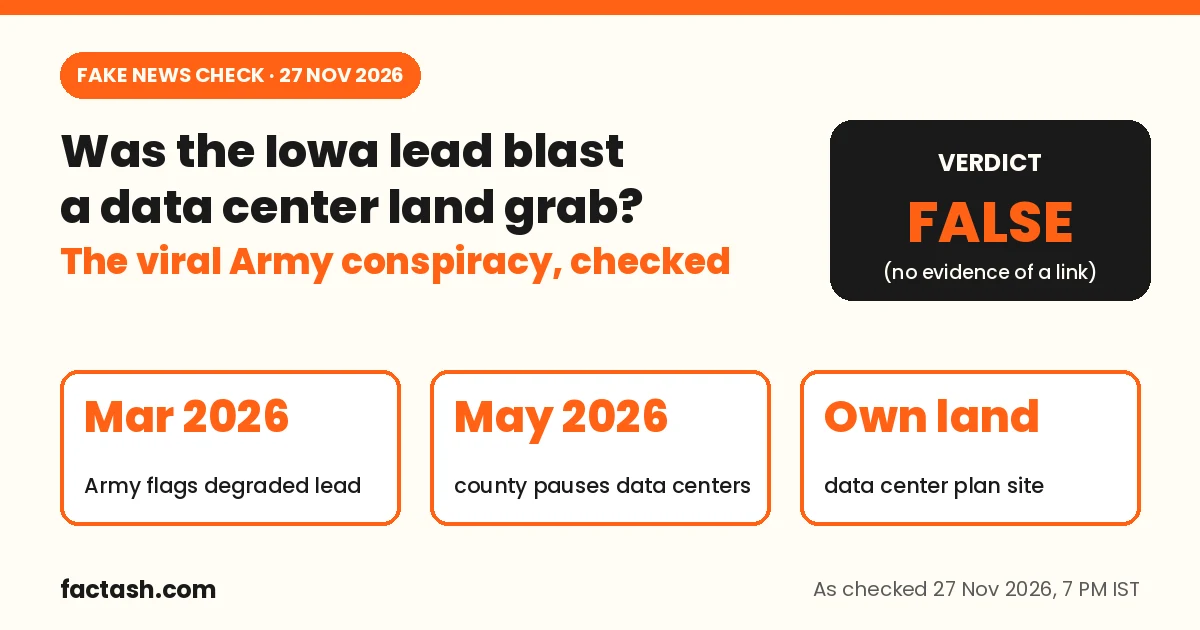
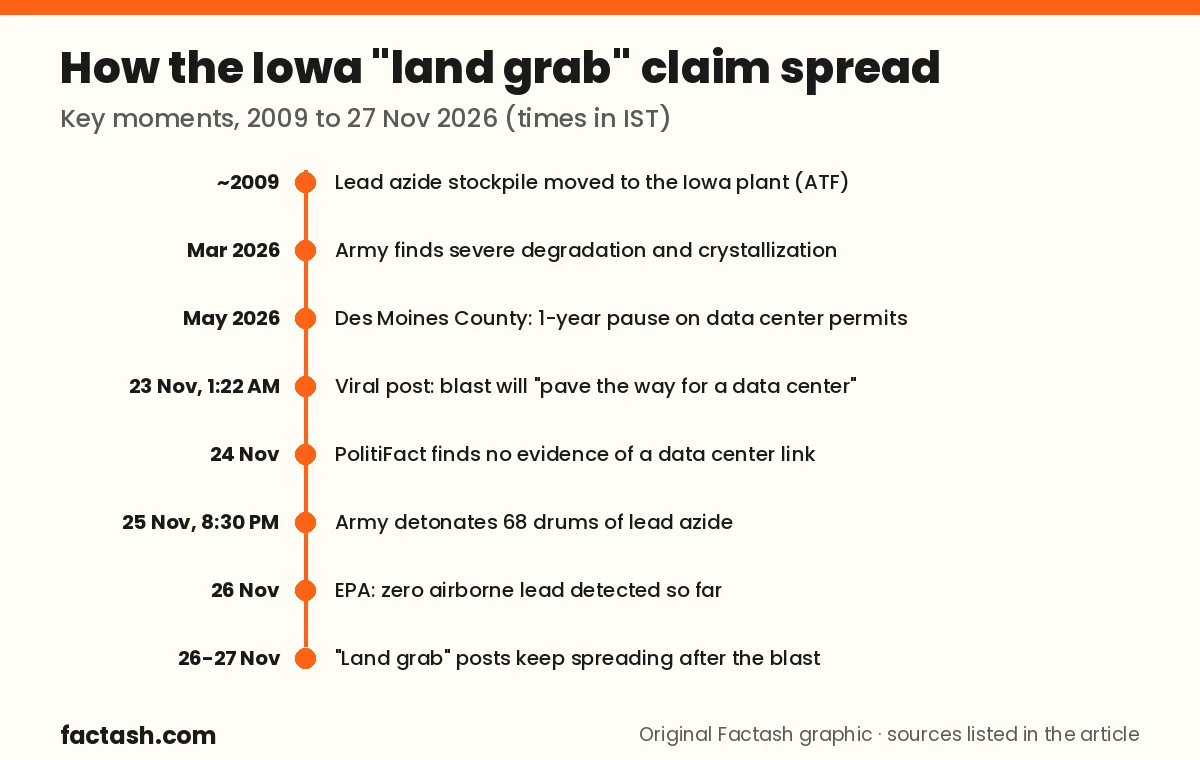
VERDICT: FALSE. There is no evidence that the Army's 25 November detonation of lead azide at the Iowa Army Ammunition Plant was a plan to free up land for a data center. The Army says it was the only safe way to destroy degraded explosives, and its documents mention no other land use. The nearby AI data center proposal is a planned expansion of a bitcoin mine on land the company already owns, and the company says it had no role in the blast. The viral timeline is also backwards: the Army flagged the degraded lead in March 2026, before the county paused data center permits in May 2026.
The Claim
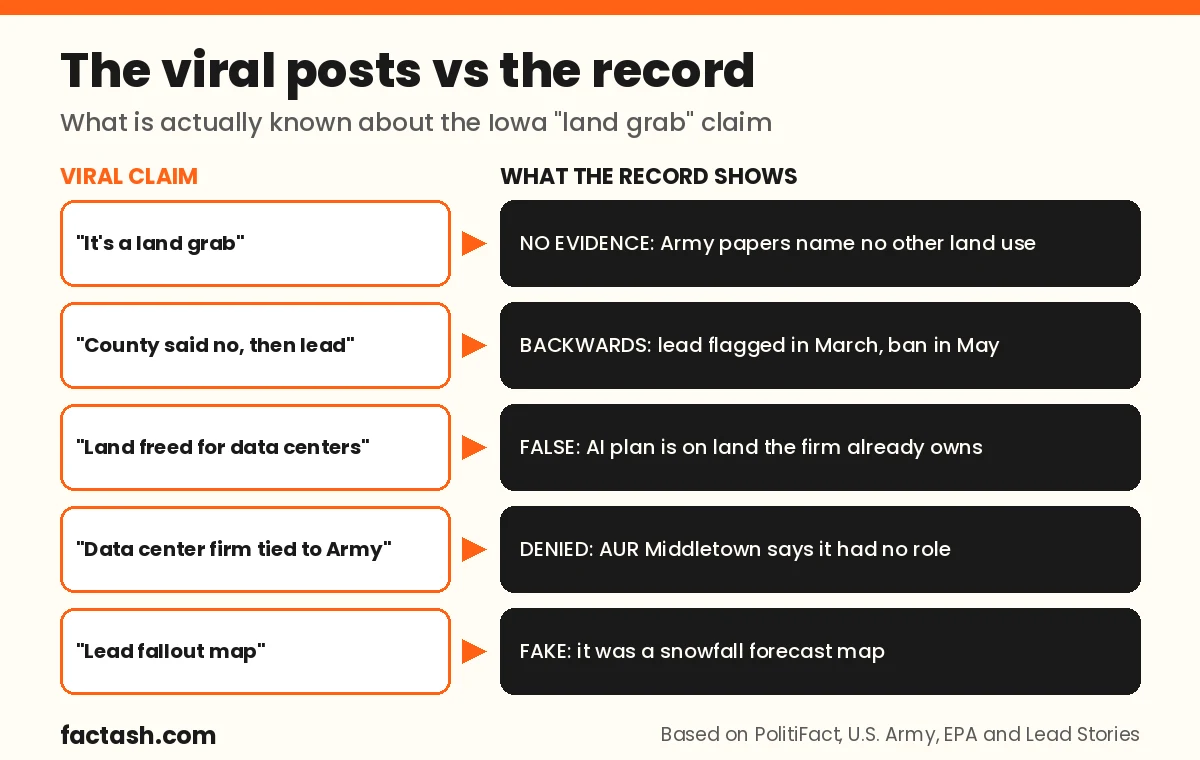
The Army's plan to blow up about 5 tons of degraded lead azide in Middletown, Iowa, was already huge news. Then the conspiracy version took off. A 22 November X post quoted by PolitiFact said: "They want the land – county said no and then they magically they found the lead which needed to be disposed of…" and claimed that after the blast "the land is usable for data centers but not 'safe' for civilian use."
One of the most-viewed versions, a post from @GoUncensored (about 54,000 views when we checked), said the detonation would "pave the way for a data center two miles away." After the blast on 25 November, posts kept coming: one X account called it an "IOWA LAND GRAB" and said it "appears to be about much more than disposing lead azide," another called the timing "super sus," and another posted that "this explosion is all about a land grab!"
What Actually Happened
- The Army says this was about one thing: unstable explosives. According to the Army's 24 November announcement, a routine safety inspection found "severe material degradation and crystallization" in about 68 drums holding more than 9,700 pounds of lead azide. In that state it becomes "an ultra-sensitive primary explosive," so moving it, chemically neutralizing it or trucking it away was judged too risky. A multi-agency review approved a controlled, in-place detonation as "the only viable method to permanently eliminate the hazard."
- No data center in the Army's plans. PolitiFact reported that the Army's documents do not mention using the affected land for other purposes, such as data centers, and concluded that "available information does not support a link" between the detonation and any data center motive.
- The nearby AI project is on land the company already owns. AUR Middletown built a bitcoin mine in 2025 on a 7-acre former farm parcel between West Burlington and Middletown. Its president, JohnPaul Baric, told PolitiFact that a proposed AI data center expansion would be on that same land. A senior planner at the Southeast Iowa Regional Planning Commission told PolitiFact he wasn't aware of any plans that would need more land.
- The company denies any role. "We had no role in the Army's planned lead azide detonation or in any lead contamination from the ammunition plant," Baric told PolitiFact, adding that AUR Middletown has no relationship with the Army.
- The timeline in the viral posts is backwards. The posts say the county said no to data centers and then the lead "magically" appeared. But the Army said it determined in March 2026 that the stockpile had severely degraded, while Des Moines County's one-year moratorium on data center permits came in May 2026, PolitiFact reported. And the stockpile itself wasn't new: ATF Director Robert Cekada said it was moved to the plant around 2009.
Why People Believed It
Context matters here, because this one mixes real facts with a big leap. It's true that there's a bitcoin mine a few miles from the plant, true that its owner wants to turn it into an AI data center, and true that the county paused data center permits this year. Data centers are also a hot-button issue across the US right now (we fact-checked another one recently: the viral "data center noise" moose video). Add a scary, rescheduled Army blast and a lot of public anger, and "connect the dots" posts write themselves.
Factash's take: two things happening near each other isn't proof they're connected. And the "land grab" framing leaves out the key detail: the data center plan sits on private land the company already owns, not on Army land.
The Context the Viral Posts Leave Out
- Why not neutralize it instead? Some posts say the Army ditched a safer chemical option. Col. Aaron Teller of the 71st Explosive Ordnance Disposal Group said in the Army's announcement that crystallized lead azide had built up on the barrels and their lids, so they couldn't be moved or opened to apply a neutralizing agent, and "that proved to be an unsafe method."
- What happened after the blast? The detonation went ahead on 25 November at about 9 a.m. Central time (8:30 PM IST). The White House quoted Maj. Gen. Eric Shirley saying all the lead azide barrels were "definitively removed," with no secondary explosions and no infrastructure damage.
- What about the lead? The EPA said on 26 November that all real-time air monitors had shown zero airborne lead since the detonation, and that more than 1,000 post-detonation samples were collected. Lab results were expected to start arriving from 27 November (US time), and anyone can follow the data on the EPA's Iowa data page. The Army has said properties testing above the approved standard will be cleaned up at government expense.
- That "lead fallout map" is a snow map. A viral map called a "lead fallout map from North American Military model" was actually a snowfall forecast from a weather model, Lead Stories found. NAM means North American Mesoscale.
So, What's Still Worth Watching?
Being sceptical of a land grab story doesn't mean the worries about lead are silly. Lead exposure is a real health risk, and the lab results for soil, water and dust are what people near Middletown actually need. Factash guidance: watch the official numbers on the EPA's data page, and treat any post that pairs a scary event with "it's really about data centers" as a theory until someone shows documents.
How to Check Claims Like This Yourself
Factash guidance:
- Check the timeline. Put the dates in order yourself. Here, the degraded lead was flagged in March, and the data center pause came in May. The viral story needs it the other way round.
- Look at who owns the land. County property records and planning minutes are public. The AI data center proposal is on land its owner already bought, not on the Army plant.
- Read the official documents. The Army's announcement and environmental assessment say why it acted. If a post claims a hidden motive, ask what document shows it.
- Read the labels on maps and charts. The "fallout map" literally said "snowfall accumulation." Zoom in before you share.
- Separate "near" from "connected." Two projects a few miles apart isn't evidence of a plot. Look for contracts, emails or statements that tie them together.
- Find a fact-checker's write-up. PolitiFact and Lead Stories both checked this story. A quick search for the claim plus "fact check" can save you from sharing a rumour.
Want the full toolkit? Read our guide on how to check fake news. More from our fact-check desk: did DOGE fire 400 FAA technicians before the ground stop?, the fake Trump "90-day blackout" video, and yesterday's check: did OpenAI or Anthropic break RSA encryption? Browse everything in Technology.
FAQ
Was the Iowa lead detonation done to make room for a data center?
There is no evidence of that. The Army says the 25 November detonation was the only safe way to destroy degraded, crystallized lead azide, and its documents mention no other use for the land. PolitiFact found no link between the blast and any data center plan, and the company behind the nearby proposal told PolitiFact it had no role in the detonation.
Is there a data center near the Iowa Army Ammunition Plant?
There is a bitcoin mine nearby. AUR Middletown built it in 2025 on a 7-acre former farm parcel between West Burlington and Middletown and has proposed expanding it into an AI data center. Its president told PolitiFact the expansion would be on land the company already owns. Des Moines County's one-year moratorium on data center permits, issued in May 2026, covers that proposal.
Why didn't the Army just neutralize the lead azide with chemicals?
The Army said the crystallized lead azide had become extremely sensitive to friction, vibration, heat and shock. Col. Aaron Teller of the 71st Explosive Ordnance Disposal Group said crystals had built up on the barrels and lids, so the barrels could not be moved or opened to apply a chemical neutralizing agent, and that method proved unsafe.
Did the blast release lead into the air?
As of the EPA's 26 November update, all real-time air monitors had reported zero detection of airborne lead since the detonation. More than 1,000 post-detonation air, water, soil and dust samples had been collected, and the EPA said lab results could start arriving as early as 27 November (US time). Those results are the next thing to watch.
Is the viral "lead fallout map" real?
No. Lead Stories found that a map shared on X as a "lead fallout map" was actually labelled as a snowfall accumulation forecast from the College of DuPage weather model. "NAM" stands for the North American Mesoscale weather model, not a "North American Military model."
How long was the lead azide stored in Iowa?
ATF Director Robert Cekada said the US stockpile of lead azide was moved to the Iowa Army Ammunition Plant around 2009, and some of it was already more than 60 years old then. The Army said it determined in March 2026 that the material had severely degraded and crystallized.
Sources
- PolitiFact, "Iowa lead azide blasts a ploy to build data centers? Fact-checking claims about the Army's plan" by Maria Briceño (24 Nov 2026) (main source)
- U.S. Army, "Army announces controlled detonation of degraded explosive material at Iowa Army Ammunition Plant" (24 Nov 2026)
- U.S. EPA, "EPA Provides Update on Sampling Following Yesterday's Controlled Detonation at Iowa Army Ammunition Plant" (26 Nov 2026)
- The White House, release on the Iowa controlled detonation (25 Nov 2026)
- Lead Stories, "Map Does NOT Show Projected Lead Fallout from Iowa Army Ammunition Plant Explosion" by Alexis Tereszcuk (24 Nov 2026)
- PolitiFact, "The Army is going to detonate toxic lead azide in Iowa. Here's what we know about safety concerns." (19 Nov 2026)
- Viral posts on X: @GoUncensored (22 Nov, US time), "IOWA LAND GRAB" post (25 Nov), @PioneerMama (26 Nov), @Dede_Watson (26 Nov)
Last checked 27 November 2026, 7:05 PM IST. View counts are as seen on X when we checked. We'll update this post if new evidence or the EPA lab results change the picture.
Image credits
- Featured image: original Factash graphic, based on PolitiFact's fact check and the U.S. Army's announcement.
- "The viral posts vs the record" infographic: original Factash graphic, based on PolitiFact, the U.S. Army, the EPA and Lead Stories.
- "How the Iowa land grab claim spread" timeline: original Factash graphic, based on the official statements, fact checks and X posts listed in Sources.
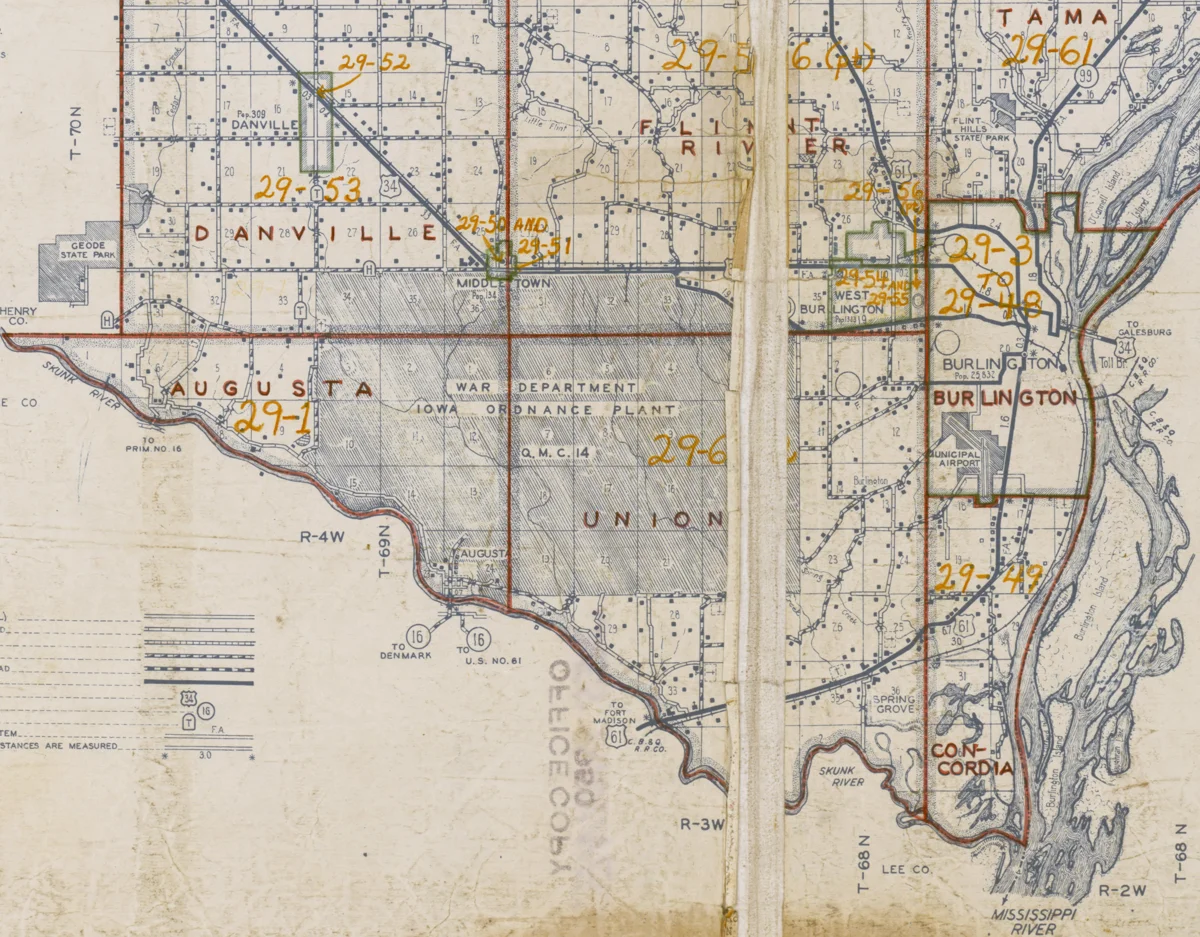
- 1950 War Department map of the Iowa Ordnance Plant: U.S. National Archives and Records Administration, via Wikimedia Commons, public domain; resized and converted to WebP.
- The viral X posts and news-site photos are not reproduced here; see the linked posts and fact checks.