Last updated: 26 Nov 2026, 7:10 PM IST
"BREAKING: Fears grow that OpenAI or Anthropic may have broken Bitcoin's cryptography." If your timeline went full doom mode in the last 24 hours, this is why. Posts with millions of views say the big AI labs have quietly cracked RSA, the maths that protects a huge chunk of the internet. Real talk: it's a rumour about a rumour, and nobody has shown any proof. Let's break it down.
Main source: Scott Aaronson's own words on his blog Shtetl-Optimized (comment #23, 24 November 2026, US time) and his 25 November post, where the rumour started. We cross-checked it against the papers Google Research actually published, posts from Ledger CTO Charles Guillemet, and Cointelegraph's report.
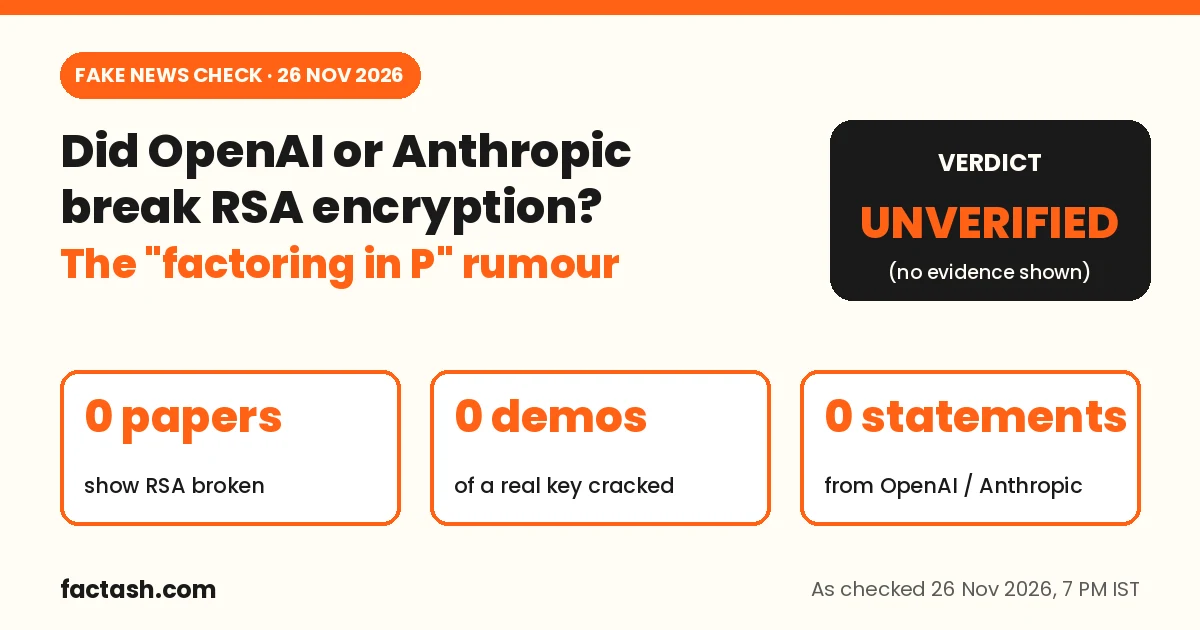
VERDICT: UNVERIFIED. It is true that rumours exist: Scott Aaronson said he has heard "many, many rumors" that OpenAI, Anthropic or both have a fast factoring method, and he is "virtually certain" the labs have some cryptography "bombshells." But he also said he doesn't know how much to credit the factoring rumour. As of 26 November 2026, 7 PM IST, there is no paper, no code, no demo of a real RSA key being cracked, and no statement from either lab. Claims that RSA or Bitcoin "has been broken" go beyond any evidence.
The Claim
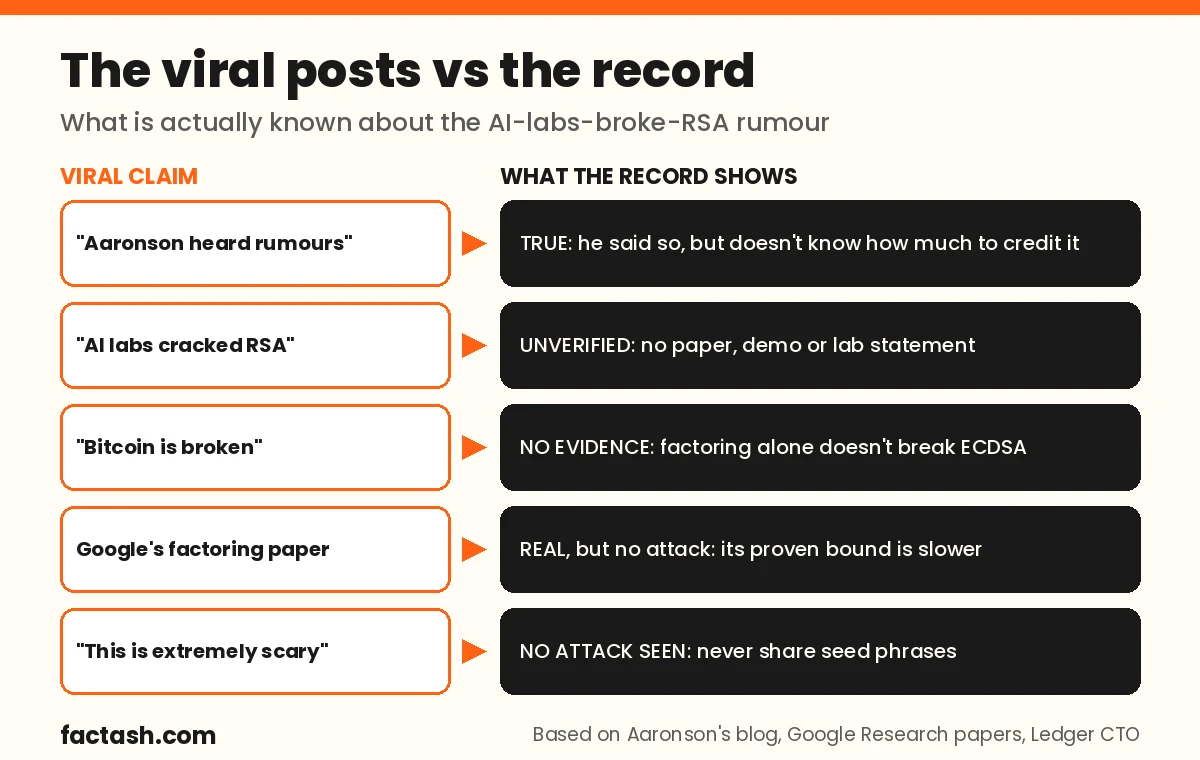
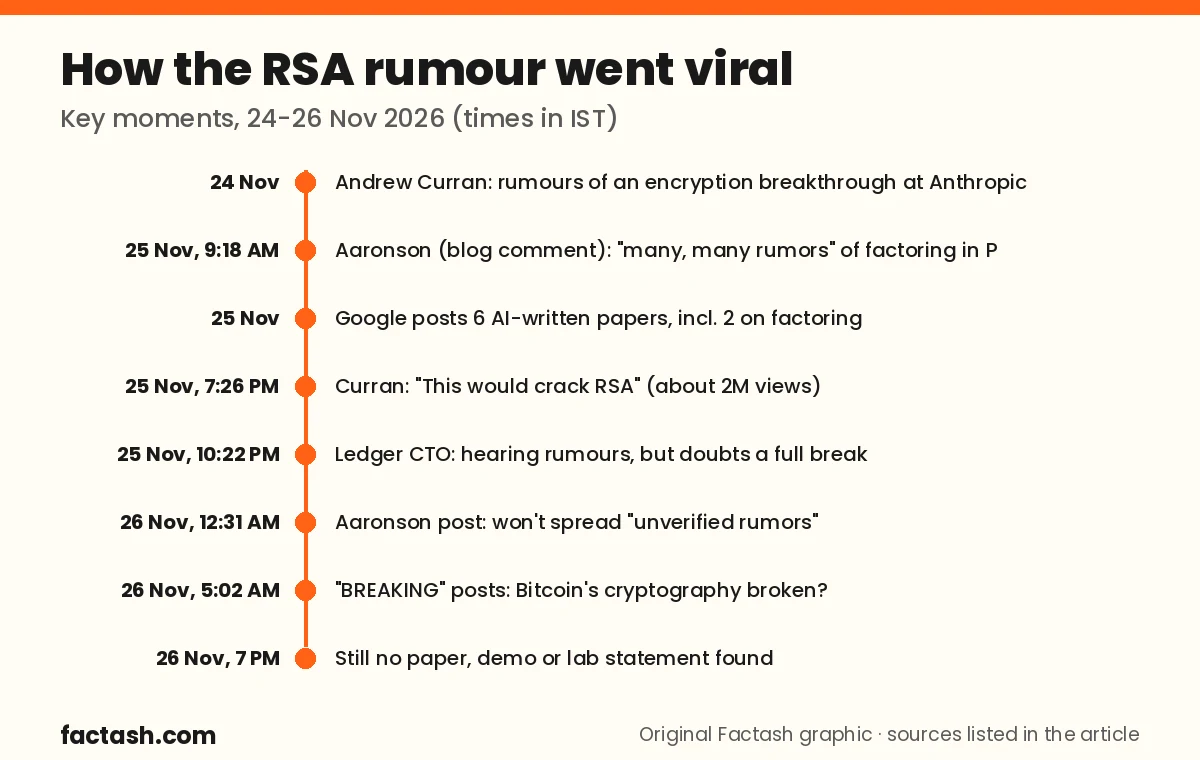
From 25 November, posts on X claimed AI labs had cracked modern encryption. AI commentator Andrew Curran wrote that he had also heard the rumour "about both Anthropic and OpenAI" and added: "This would crack RSA." That post had about 2 million views when we checked. Another account, @kimmonismus, said that if the rumours were true, "it would explain why OpenAI and Anthropic are holding back their latest models" (about 2.7 million views).
Then the crypto accounts took over. AlphaWire posted: "BREAKING: FEARS GROW THAT OPENAI OR ANTHROPIC MAY HAVE BROKEN BITCOIN'S CRYPTOGRAPHY." Crypto Rover posted: "BREAKING: This is extremely scary. Rumors suggest OpenAI, Anthropic, or both may have CRACKED the math behind modern encryption." Each got more than 200,000 views, and the replies are full of people asking "is this real?"
What Actually Happened
- It started in a blog comment. On his blog, a reader asked Aaronson the odds that factoring is "in P." He replied: "I've now heard many, many rumors that one or both labs are sitting on Factoring in P. I don't know how much to credit this." He added that he was "virtually certain" the labs had "one or more bombshells for cryptography," but that "the exact nature of those bombshells has gotten distorted via a game of Telephone."
- Aaronson then hit the brakes. In his 25 November post he wrote that "until I either see details or hear directly from someone at a lab, I feel much, much less confident about the specific nature of those bombshells," and: "I do not wish to be responsible for spreading unverified rumors." On Bitcoin he was blunt: if your main worry is your wallet, "go somewhere else for rumors about whether or not ECDSA is broken or whatever. I don't have what you're looking for here."
- The crypto expert is sceptical. Ledger CTO Charles Guillemet posted that he was also hearing rumours that labs had broken factoring, elliptic-curve crypto and Ring-LWE (a post-quantum building block). But he wrote: "I'd be very surprised to see any of them fall apart completely."
- Google's real papers don't break RSA. On 25 November Google Research posted six papers written by its Cogentic AI agent on Gemini 4, two on factoring. The main factoring paper proves an expected running time of LN[1/3, 105] with no unproven assumptions. That matches the "1/3" shape of the number field sieve used in practice, but with a much bigger constant, so it's a theory win, not a faster attack. Guillemet's take: "None of them breaks anything," and "RSA key sizes don't move."
- No confirmation from the labs. We found no statement from OpenAI or Anthropic confirming or denying the rumour, and no published factoring algorithm from either company, as of 26 November, 7 PM IST.
Why People Believed It
Context matters here, because this rumour didn't come from nowhere. The last few weeks have been wild for AI and maths: an Anthropic mathematician posted an AI-assisted proof of the Riemann Hypothesis (we covered it in Riemann Hypothesis solved? Claude AI proof explained), and OpenAI and Anthropic both posted proofs of the VP vs VNP conjecture, Cointelegraph reported. On 24 November, Curran had already written that "there have been rumors of an encryption breakthrough at Anthropic." So when a respected scientist said he'd heard about factoring too, people connected the dots fast.
Factash's take: "a famous expert heard a rumour" became "AI broke encryption" in about a day, and then "Bitcoin is broken" by the next morning. Every repost dropped a bit more of Aaronson's "I don't know how much to credit this."
The Context the Viral Posts Leave Out
- RSA and Bitcoin are different locks. RSA relies on factoring being hard. Bitcoin signatures use elliptic-curve cryptography (ECDSA and Schnorr on the secp256k1 curve). A factoring breakthrough alone would not break Bitcoin. The ECC rumours are a separate claim, and just as unproven.
- "In P" doesn't automatically mean "practical." A polynomial-time algorithm with a huge exponent or constant could still be useless against real 2048-bit keys. Without a paper, nobody outside the labs can judge.
- Responsible disclosure would be messy. Guillemet noted that if a lab did find something like this, a clean disclosure that avoids mass exploitation "would be very hard to pull off," which is also why rumours spread instead of facts.
- The world was already moving on from RSA. Because of the quantum computing threat, NIST finalised its first post-quantum encryption standards in August 2024, and organisations are already migrating.
So, Should You Panic?
Nope. Factash guidance: nothing in this story needs you to change anything tonight. Keep using strong, unique passwords and two-factor authentication, and keep your phone and apps updated. The bigger real-world risk right now is scammers using "your crypto is at risk" panic to push fake wallet "migrations." Never share a wallet recovery phrase with anyone, for any reason.
How to Check Claims Like This Yourself
Factash guidance:
- Find patient zero. Viral posts said "Scott Aaronson says." Go to his blog and read the exact words. Here, the original said "I don't know how much to credit this."
- Spot the rumour chain. "I heard," "rumours suggest" and "fears grow" are not evidence. Count how many sources actually saw something versus repeating each other.
- Ask for the receipts. A real crypto break comes with a paper, code, or a demo of a real key being factored. No receipts means unverified.
- Read the paper's abstract, not the hype. Google's factoring paper is public. Its abstract says what it proves, and it is not "RSA is broken."
- Check what security experts say. Look for cryptographers and security teams (like Ledger's CTO here) rather than "BREAKING" accounts that post about everything.
- Watch for panic sales pitches. If a post pushes you to move funds, buy a coin or click a link because "encryption is broken," treat it as a red flag.
Want the full toolkit? Read our guide on how to check fake news. More AI context: why OpenAI wants AI limits. Our last fact check: will banks refund money your AI agent loses? And for a real security bug you should patch: the WhatsApp Android flaw. Browse everything in Technology.
FAQ
Has RSA encryption been broken by AI?
There is no public evidence of that. As of 26 November 2026, 7 PM IST, no paper, code or demonstration showing RSA broken has been published, and we found no statement from OpenAI or Anthropic confirming it. The claim comes from rumours that computer scientist Scott Aaronson said he had heard, while adding he didn't know how much to credit them.
What does "factoring in P" mean?
It means an algorithm that can split any large number into its prime factors in polynomial time, so the work grows slowly as numbers get bigger. RSA's security depends on factoring very large numbers being impractically hard, so a fast, practical version would break RSA. Even a polynomial-time algorithm could still be too slow to use if its exponent or constants are huge.
Did Google's new AI papers break RSA?
No. On 25 November Google Research posted six papers written by its Cogentic AI agent on Gemini 4. The factoring paper proves, without unproven assumptions, an expected running time of L_N[1/3, 105]. That is a theory milestone, but the constant 105 makes it a far slower bound than the number field sieve used in practice. Ledger's CTO wrote that none of the papers "breaks anything."
Is Bitcoin at risk from the RSA rumour?
Bitcoin signatures use elliptic-curve cryptography, not RSA, so a factoring breakthrough on its own would not break them. Separate rumours say elliptic-curve crypto was broken, but those are also unverified; Aaronson explicitly declined to comment on whether ECDSA is broken.
Who is Scott Aaronson?
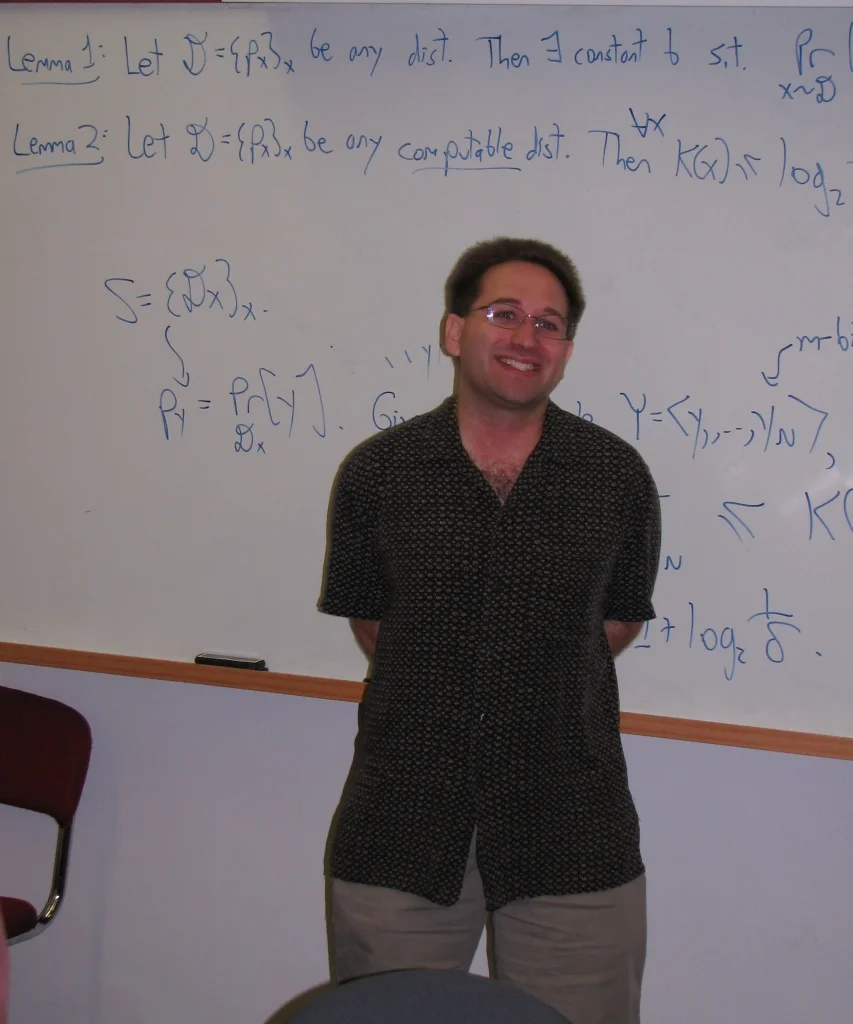
He is a theoretical computer scientist at the University of Texas at Austin who worked at OpenAI from 2022 to 2024. He writes the blog Shtetl-Optimized, where the rumour comments appeared.
Should I change my passwords or move my crypto?
Nothing in this rumour requires you to act right now. Factash guidance: keep using strong, unique passwords and two-factor authentication, keep apps updated, and never share a crypto wallet recovery phrase with anyone, especially people using "your crypto is at risk" panic to pressure you.
Sources
- Scott Aaronson, Shtetl-Optimized, comment #23 on "I've been drinking wine in my kitchen" (24 Nov 2026, US time) (main source)
- Scott Aaronson, Shtetl-Optimized, "HOLY SHIT HOLY SHIT HOLY SHIT HOLY SHIT" (25 Nov 2026)
- Google Research, Cogentic research papers on GitHub (papers dated 25 Nov 2026)
- "Unconditional Integer Factorization in Time L_N[1/3, O(1)]" (Cogentic / Gemini 4, Google Research)
- Charles Guillemet (Ledger CTO) on X, rumours post (25 Nov 2026) and update on Google's papers (25 Nov 2026)
- Cointelegraph, "AI labs likely sitting on cryptography 'bombshells,' computer scientist says" by Felix Ng (26 Nov 2026)
- Viral posts on X: Andrew Curran (25 Nov), Andrew Curran (24 Nov), @kimmonismus (25 Nov), AlphaWire (25 Nov, US time), Crypto Rover (26 Nov)
- NIST, "NIST Releases First 3 Finalized Post-Quantum Encryption Standards" (13 Aug 2024)
Last checked 26 November 2026, 7:10 PM IST. View counts are as seen on X when we checked. We'll update this post if OpenAI, Anthropic or anyone publishes evidence.
Image credits
- Featured image: original Factash graphic, based on Scott Aaronson's blog and Google Research's papers.
- "The viral posts vs the record" infographic: original Factash graphic, based on Aaronson's blog, Google's factoring paper and Charles Guillemet's posts.
- "How the RSA rumour went viral" timeline: original Factash graphic, based on the X posts and blog entries listed in Sources.
- Scott Aaronson lecturing in Jerusalem (2010): Easy n, via Wikimedia Commons, released into the public domain by the author; converted to WebP.
- The viral X posts and news-site photos are not reproduced here; see the linked posts and the Cointelegraph report.