Last updated: 16 Nov 2026, 2:20 PM IST
Uber has started sending letters about a "security incident" to drivers whose information was exposed. The Uber data breach, first detailed by TechCrunch on 13 November 2026, involved drivers' license images and details stored with a third-party vendor, which TechCrunch identified as the AI platform Fireworks AI. Below: what was taken, who is affected and what drivers can do, based on Uber's state filings and TechCrunch's reporting.
TL;DR
- Uber is notifying drivers that their driver's license images and details were stolen in an October 2026 breach at a vendor, TechCrunch reported on 13 November 2026.
- TechCrunch identified the vendor as Fireworks AI, an AI platform whose breach also exposed Notion data (see our Notion AI data breach explainer).
- Stolen data: license images plus name, address, date of birth and license number, per Uber's filing with the Iowa Attorney General.
- State filings so far cover about 10,869 people in Iowa, Massachusetts, South Carolina and Rhode Island, with California and Illinois numbers not yet published.
- Uber is offering free credit monitoring through Cyberscout (TransUnion). You must enroll within 90 days of your letter.
What happened in the Uber data breach?
According to Uber's notice to the Iowa Attorney General, dated 10 November 2026:
- On 7 October 2026, an unauthorized party used the service provider's compromised internal credentials to access Uber data connected to that provider (Uber's investigation established this date on 13 October).
- On 9 October, the provider told Uber. Uber says it "immediately severed data connections" and started investigating.
- On 13 October, Uber's investigation confirmed personal information had been accessed.
- Letters to affected people started going out on 10 November 2026.
TechCrunch identified the provider as Fireworks AI, a platform that lets developers run open AI models. An Uber spokesperson told TechCrunch the notices relate to "a security incident impacting one of our third-party vendors, Fireworks.ai, which had access to some Uber data."
Read Uber's full notice: Uber's security incident notification to the Iowa Attorney General (PDF, 10 November 2026).
What data was stolen?
Uber's filing says the exposed information included:
| Data type | Included? |
|---|---|
| Images of driver's licenses | Yes |
| Full name | Yes |
| Home address | Yes |
| Date of birth | Yes |
| Driver's license number | Yes |
| Access to other Uber systems | No, per Uber |
According to the Iowa filing, the data sat in a cloud storage environment Uber created specifically for the service provider's work. Uber says alerts were switched on, but "because the unauthorized third party used valid credentials... no alerts were triggered." Uber says the stolen credentials did not give access to any other Uber systems, and that it has deleted or rotated all credentials tied to the vendor.
The Iowa filing does not list passwords, bank details or payment cards among the exposed data. A license image combined with a name, address and date of birth can still be misused for identity fraud, which is why Uber's letter recommends the precautions below.
How many people are affected?
Uber hasn't published a total. Here's what the public filings show so far:
| State | People affected | Source |
|---|---|---|
| Iowa | ~2,999 | Iowa AG filing |
| South Carolina | 3,430 | TechCrunch |
| Massachusetts | 2,567 | TechCrunch |
| Rhode Island | 1,873 | TechCrunch |
| Illinois | Pending | TechCrunch |
| California | Not disclosed | TechCrunch |
That adds up to about 10,869 people in four states (the Iowa figure is approximate). TechCrunch reports the number is expected to rise as more notifications are filed.
Who hacked Fireworks AI?
Per TechCrunch, Fireworks blamed a financially motivated cybercriminal group that wants to sell stolen tokens for accessing large language models (LLMs). No known group has claimed the theft. TechCrunch reports that Fireworks disclosed the breach in October, that it exposed customer information including billing data and some private AI datasets, and that Notion confirmed its data was also stolen in the Fireworks hack (more in our Notion AI data breach explainer).
TechCrunch also notes this is Uber's second known breach this year, after an incident at its Uber Freight trucking unit.
What should Uber drivers do now?
Drivers who received a letter, or who drive in the states above, can take these steps. Most come from the precautions listed in Uber's letter:
- Read your letter carefully. It contains your personal activation code for the free monitoring. Only use the enrollment steps printed in the letter, never a link from a random text or email.
- Enroll in the free credit monitoring. Uber's consumer letter template (filed with the California AG) says it's run by Cyberscout, a TransUnion company, and you must enroll within 90 days of the letter date.
- Consider a credit freeze. Uber's letter notes that a security freeze restricts creditor access to your file (it can also delay your own new-account requests). Freezes with Equifax, Experian and TransUnion are free in the US.
- Or add a fraud alert. Uber's letter notes that contacting one bureau places an alert at all three.
- Check your credit reports. Get them free at AnnualCreditReport.com and look for accounts you don't recognise.
- Watch for Uber-themed phishing. Breach news is often followed by phishing attempts. Treat unexpected "verify your account" texts or emails with caution and log in only through the official Uber app. Our fake FBI and FTC agent scam guide covers the phone version of this trick.
- Secure your Uber account. Turn on two-step verification and, where you can, switch to passkeys (here's how passkeys work).
- If someone uses your identity, report it at IdentityTheft.gov for a recovery plan.
Are Uber riders affected?
The filings and reporting so far describe drivers whose license information was stored with the vendor. Uber hasn't said riders' data was involved. If you did not get a letter, Uber has not notified you that you are affected; a strong password and two-step verification are still sensible.
The bigger picture: breaches through vendors
In this case the attackers did not break into Uber's own systems. They used the vendor's valid credentials, and Uber says that is why its alerting did not fire. Factash has also covered the Expedia and Amadeus data breaches.
FAQ
Is the Uber data breach letter real?
Uber has filed breach notices with several US state attorneys general, and letters to affected people began on 10 November 2026. Still, check that any letter matches Uber's official filings, and enroll only through the steps printed in the letter itself.
What information was stolen in the Uber breach?
Images of driver's licenses plus extracted text: name, address, date of birth and driver's license number, according to Uber's filing with the Iowa Attorney General.
How did hackers get Uber data?
According to Uber's Iowa filing, an unauthorized party compromised a service provider's internal credentials and used them on 7 October 2026 to access a cloud storage area Uber had set up for that provider. TechCrunch identified the provider as Fireworks AI.
How many Uber drivers were affected?
Uber hasn't given a total. Public filings show about 2,999 in Iowa, 3,430 in South Carolina, 2,567 in Massachusetts and 1,873 in Rhode Island, with more states pending.
Is Uber offering free credit monitoring?
Yes. Affected people get free credit monitoring and fraud assistance from Cyberscout, a TransUnion company, and must enroll within 90 days of the letter date.
Were Uber riders' details exposed?
The filings and reporting so far describe drivers' license data. Uber has not said rider data was involved.
Main source: TechCrunch, "Uber confirms hackers stole thousands of drivers' license information in data breach" by Zack Whittaker, 13 November 2026. Also referenced: Uber's notification to the Iowa Attorney General (10 November 2026) and Uber's consumer letter template filed with the California Attorney General. Facts as reported up to 16 November 2026, 2:20 PM IST.
Image credits
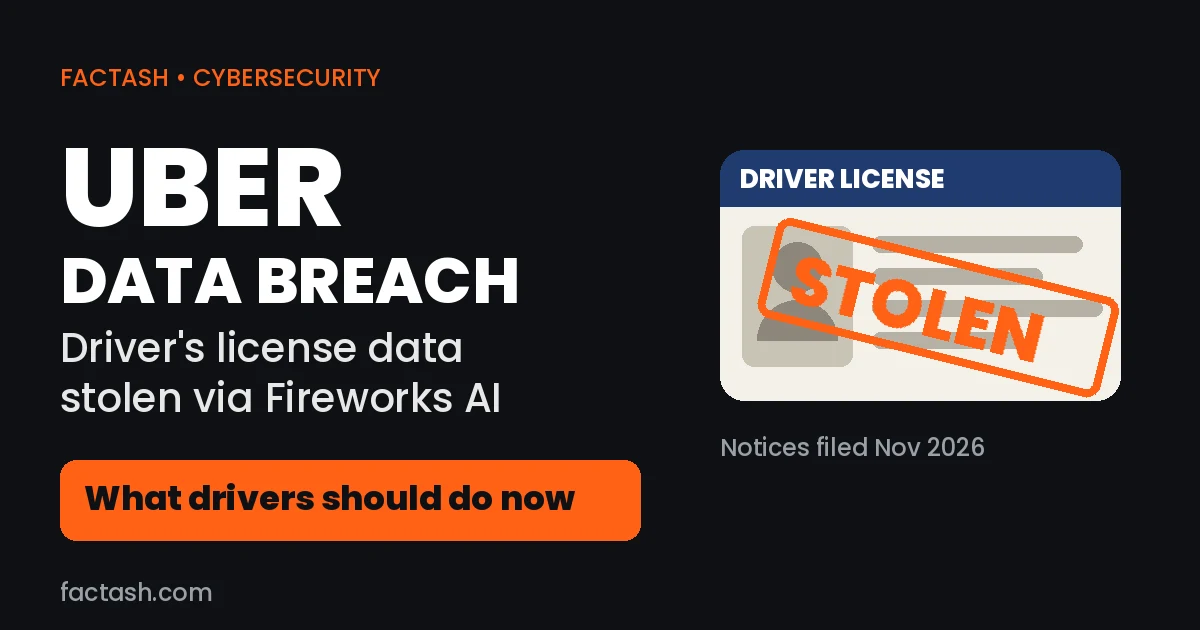
- Featured graphic: original Factash design.