Last updated: 18 Nov 2026, 7:05 PM IST
The Kerch Strait Bridge was damaged in Ukrainian strikes on 16 and 17 November 2026, according to Ukrainian officials and news outlets including Reuters and the BBC. But a widely shared "collapse" video carrying the "Sueta" logo is not real footage of that damage, according to the fact-checking site Lead Stories, which found it was made with AI.
Main source: Lead Stories fact check by Uliana Malashenko, 17 November 2026. We checked the viral Kerch Bridge collapse video against Lead Stories' AI-detection findings, the official statement from Ukraine's Security Service (SBU), and reporting from Reuters, the BBC and The Guardian.
VERDICT: FALSE. The viral video carrying the "Sueta" logo does not show real damage to the Kerch Strait Bridge. Lead Stories found that Hive Moderation rated it 98.6% likely to contain AI-generated or deepfake content, and Google's SynthID check found an invisible watermark saying it "was made or edited with Google AI". The attack itself was real: the SBU says a metal arch and the road span beneath it were completely destroyed.
The Claim
On 17 November 2026, the X account @Sueta_inc posted a video with a Ukrainian caption. As shown in X's automatic translation quoted by Lead Stories, it read:
"THE KERCH BRIDGE WAS ATTACKED AGAIN IN THE NIGHT OF NOVEMBER 17: FOUR FP-5 HITS RECORDED The load-bearing arch of the road section, along with the roadway span, collapsed into the Kerch Strait. The released footage shows massive sections of the bridge that fell into the water. Reports indicate that the debris blocked the shipping channel."
The clip was shared as if it were real footage of the bridge, which links Russia to Crimea, collapsing. Lead Stories lists archived copies of the post in its fact check.
What Lead Stories Found
1. An AI detector flagged it. Hive Moderation said the video was 98.6% likely "to contain AI-generated or deepfake content".
2. Google's own watermark was inside. SynthID, Google's tool for spotting invisible watermarks that its AI models embed, found one in the clip and said it "was made or edited with Google AI".
3. It wasn't the first one. Lead Stories says that on 16 November it found another video with the "Sueta" logo presented as damage to the same bridge, and that one was also AI-generated.
What Actually Happened to the Kerch Bridge
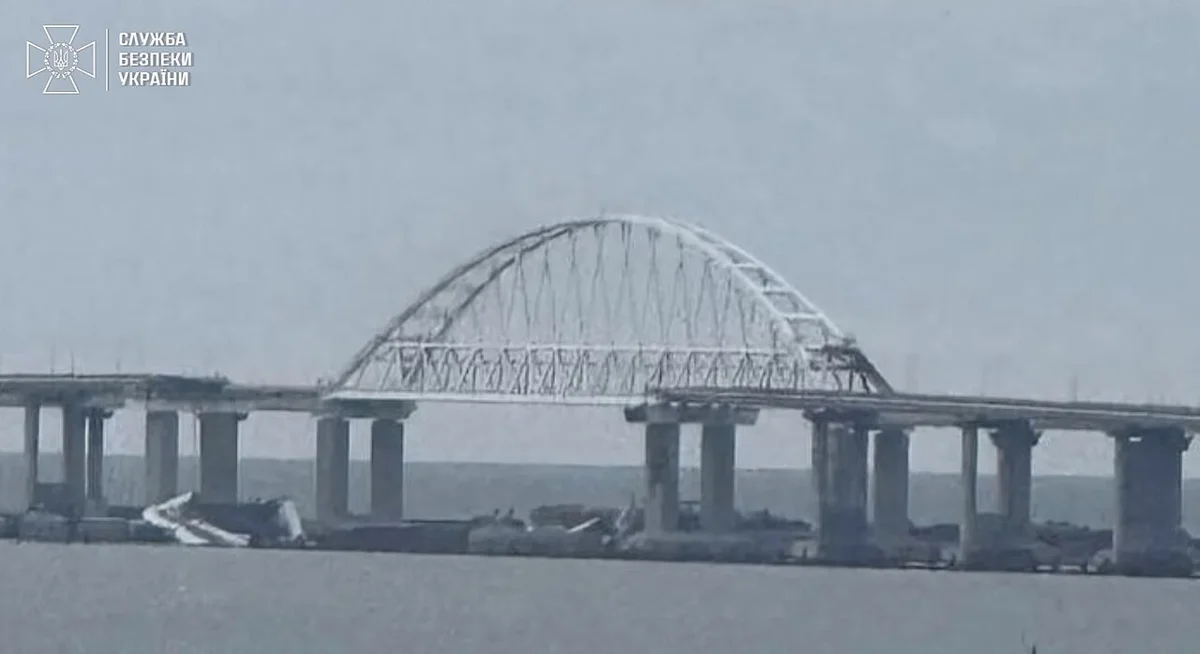
The strike shown in the claim did happen. This is what officials on both sides and news outlets have said:
- Two strikes in two days. The BBC reports drones hit the bridge on the night of 16 November, damaging the road arch, and final strikes in the early hours of 17 November brought it down.
- Official damage report. The SBU said one of the bridge's metal arches and the road span under it were completely destroyed and that the railway part was also damaged, after a roughly month-long, seven-stage operation (as reported by Interfax-Ukraine).
- Verified footage exists. Reuters says it verified videos and images posted by President Volodymyr Zelenskyy showing the bridge's main road arch had crumbled into the sea. BBC Verify also verified a clip filmed from a camera on a Ukrainian Flamingo missile approaching the span.
- Size of the damage. The BBC says the road arch was about 227 metres long and weighed thousands of tonnes. The railway arch stayed standing, and trains were later allowed to run again.
- Russia's response. Kremlin spokesperson Dmitry Peskov said the bridge would be repaired and would be "even better than before" (Reuters, The Guardian). Sergei Aksyonov, Crimea's Russian-installed governor, said two people were killed and road traffic was suspended (Reuters).
The bridge was damaged, but according to Lead Stories, the Sueta clip does not show that damage. Footage verified by Reuters and BBC Verify is available from those outlets.
Why Fakes Like This Spread
These are general patterns Factash has seen in AI-made videos tied to real news, not findings specific to this clip:
- Real events create demand for footage. When a major event is in the news, people look for video of it, and fabricated clips can circulate alongside real ones.
- The caption matched the headlines. It described an arch and road span collapsing, which is close to what officials later confirmed. Accurate-sounding text can make fabricated visuals more convincing.
- AI video tools are widely available. Factash has fact-checked similar AI-made clips and images, including the AI airport ground stop video, the Kraków shooter AI photo and the pterodactyl over Mexico clip.
- Logos look official. A channel watermark makes a clip feel like news. It isn't proof of anything.
How to Check Claims Like This Yourself
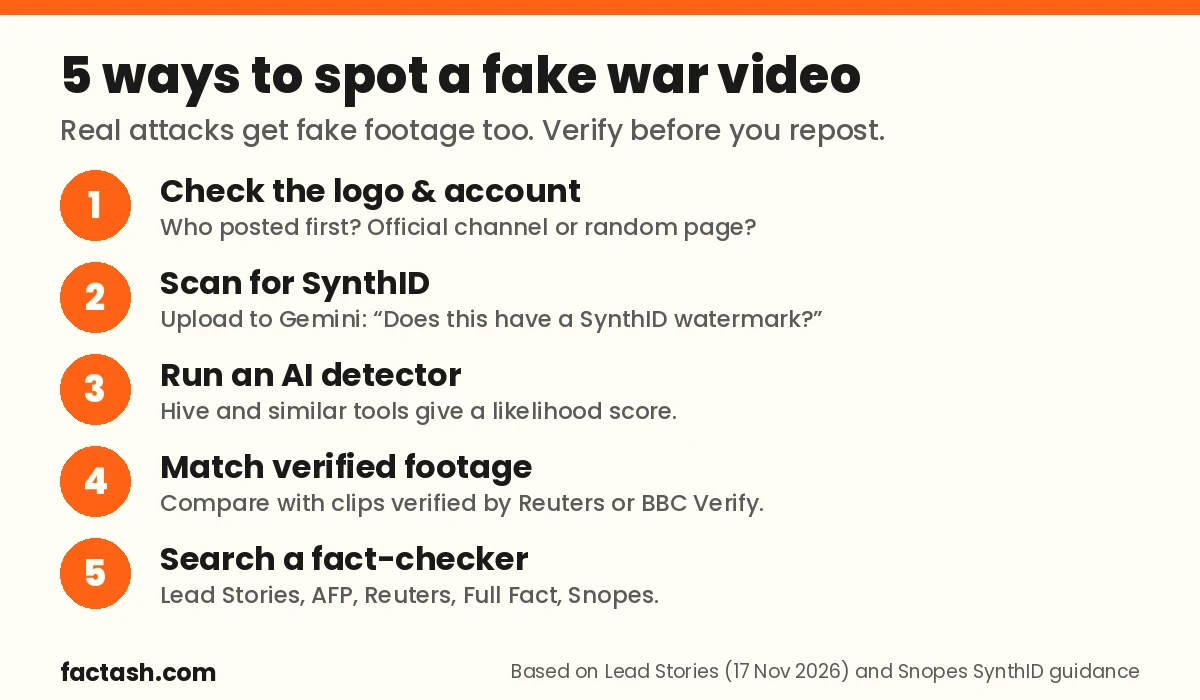
- Check who posted first. Is it an official channel (a government, a military, a verified newsroom) or an unverified page with a logo?
- Scan for SynthID. As Snopes explains, you can upload an image to Google Gemini and ask, "Does this image have a SynthID watermark?" Lead Stories used SynthID on this video. No watermark doesn't mean it's real, since other AI tools don't add one.
- Run an AI detector. Tools like Hive Moderation give a likelihood score. Treat it as a clue, not a verdict.
- Match it to verified footage. Reuters and BBC Verify publish what they've checked. If your clip doesn't match any verified angle, be suspicious.
- Search a fact-checker. Type the claim plus "fact check" and look for Lead Stories, AFP Fact Check, Reuters Fact Check, Full Fact or Snopes.
- Remember that a real event can have fake footage. "It really happened" doesn't make every video of it real.
Want the full toolkit? Read our guide on how to check fake news. More fact checks: the Trump 90-day blackout video, the Gaza flooded tents image and the "Trump was arrested" text hoax. Browse everything in Technology.
FAQ
Is the viral 'Sueta' Kerch Bridge collapse video real? No, according to Lead Stories, which rated it fake on 17 November 2026. Hive Moderation scored the clip 98.6% likely to contain AI-generated or deepfake content, and Google's SynthID check found a watermark showing it was made or edited with Google AI.
Was the Kerch Bridge actually hit on 17 November 2026? Yes. According to the BBC and Lead Stories, Ukraine struck the bridge on 16 November and again overnight into 17 November. Ukraine's SBU said one of the metal arches and the road span under it were completely destroyed, and Reuters verified videos posted by President Zelenskyy showing the road arch had fallen into the sea. The Kremlin said the bridge would be repaired.
So if the bridge really collapsed, why is the video rated False? Because a fact check rates the specific content, not the general event. Lead Stories found this clip does not show real footage of the damage and was generated with AI, so sharing it as evidence spreads fake footage even though the attack itself happened.
Who posted the fake Kerch Bridge video? Lead Stories traced it to a post by the X account @Sueta_inc on 17 November 2026, with a Ukrainian caption claiming four FP-5 hits. Lead Stories says it found another AI-generated 'Sueta' video of the same bridge on 16 November.
How can I check if a war video is AI-generated? Find who posted it first, upload it or a frame to Google Gemini and ask whether it has a SynthID watermark, try an AI detector such as Hive, compare it with footage verified by outlets like Reuters or BBC Verify, and search the claim plus 'fact check'. No watermark does not prove a clip is real.
Sources
- Lead Stories, "Fact Check: FAKE AI-Generated 'Sueta' Video Shows Damage To Kerch Strait Bridge After Ukrainian Attack" by Uliana Malashenko (17 Nov 2026) (main source)
- Security Service of Ukraine (SBU), official statement on the Crimean Bridge operation (17 Nov 2026, Ukrainian)
- BBC News, "How the attack on Putin's prized Crimean Bridge unfolded"
- Reuters, "Ukraine cripples Crimean road bridge in blow to Putin before meeting with Xi and Trump" (17 Nov 2026)
- The Guardian, "Ukraine critically damages Kerch bridge linking occupied Crimea with Russia" (17 Nov 2026)
- Interfax-Ukraine, "Kerch Strait Bridge road section destroyed, railway section damaged – General Staff"
- Snopes, guidance on checking SynthID watermarks (Nov 2026)
Sources last checked 18 November 2026, 7:05 PM IST.
Image credits
- Featured image: original Factash graphic.
- Kerch Bridge damage photo: author Security Service of Ukraine (attribution: ssu.gov.ua, archived copy), file page "File:KerchBridgeCollapse.jpg" on Wikimedia Commons, licensed Creative Commons Attribution 4.0 International (CC BY 4.0). Changes: resized from 2,914 × 1,588 to 1,200 × 654 pixels and converted to WebP. No endorsement by the SBU is implied.
- "5 ways to spot a fake war video" infographic: original Factash graphic, based on Lead Stories and Snopes.
- The fake viral clip itself is not reproduced here; archived copies are linked in Lead Stories' fact check.