Last updated: 27 Nov 2026, 9:30 AM IST
The organisation that runs the World Cup just admitted it got hacked. And no, nobody "brute-forced" anything. The hackers reportedly just pretended to be FIFA staff.
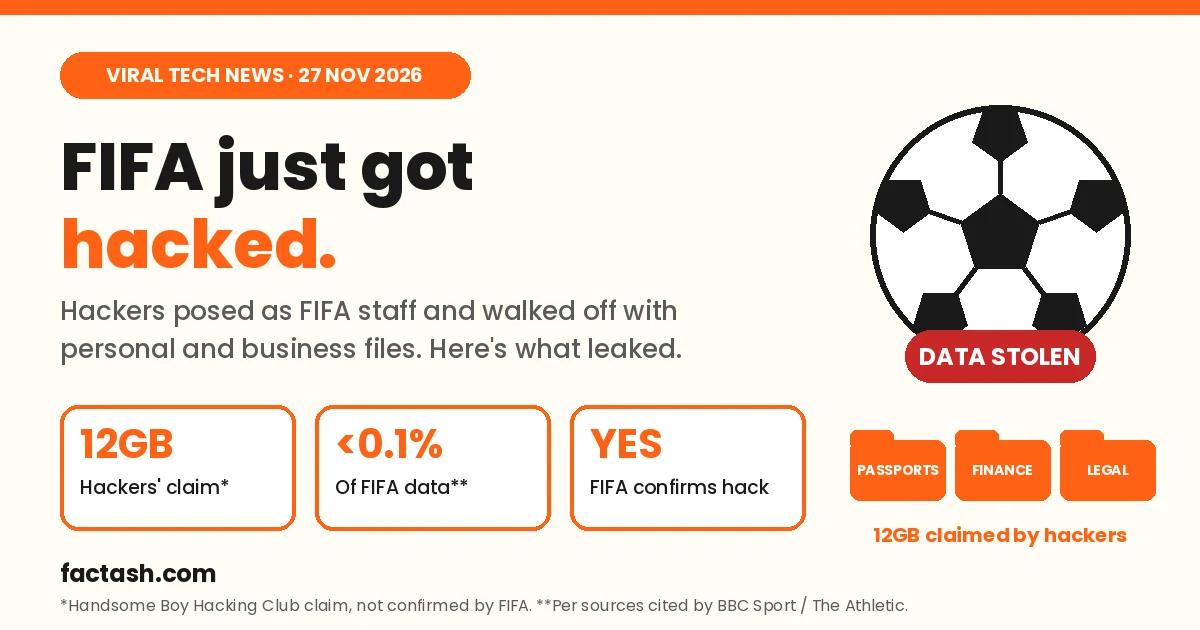
FIFA hacked is one of the biggest tech stories on the internet right now. FIFA has confirmed it was hit by a "criminal cyber-attack" that gave hackers "unauthorised access to a limited set of personal and business information" (BBC Sport). A brand-new crew calling itself the Handsome Boy Hacking Club (HBHC) says it walked away with more than 12GB of files, including passports, immigration papers, financial and legal records. So what's confirmed, what's just hacker hype, and should you, a regular football fan, be worried? Let's break it down.
TL;DR
- What happened: FIFA confirmed a criminal cyberattack that exposed a "limited set of personal and business information." It is working with law enforcement (BBC Sport).
- Who did it: A group called the Handsome Boy Hacking Club claimed responsibility. It first posted a screenshot of FIFA files on X on 19 November (Anadolu Agency).
- How: Not a tech failure, according to sources. The attackers got in by impersonating FIFA staff, which is classic social engineering.
- What they claim they took: 12GB+ of identity and immigration documents, executive info, financial records, legal documents and internal governance files. FIFA has not confirmed the volume or full contents.
- Are fans affected? There is no report that fan accounts, ticket data or payment cards were part of this. FIFA has not said who was affected.
What happened in the FIFA hack? The 60-second version
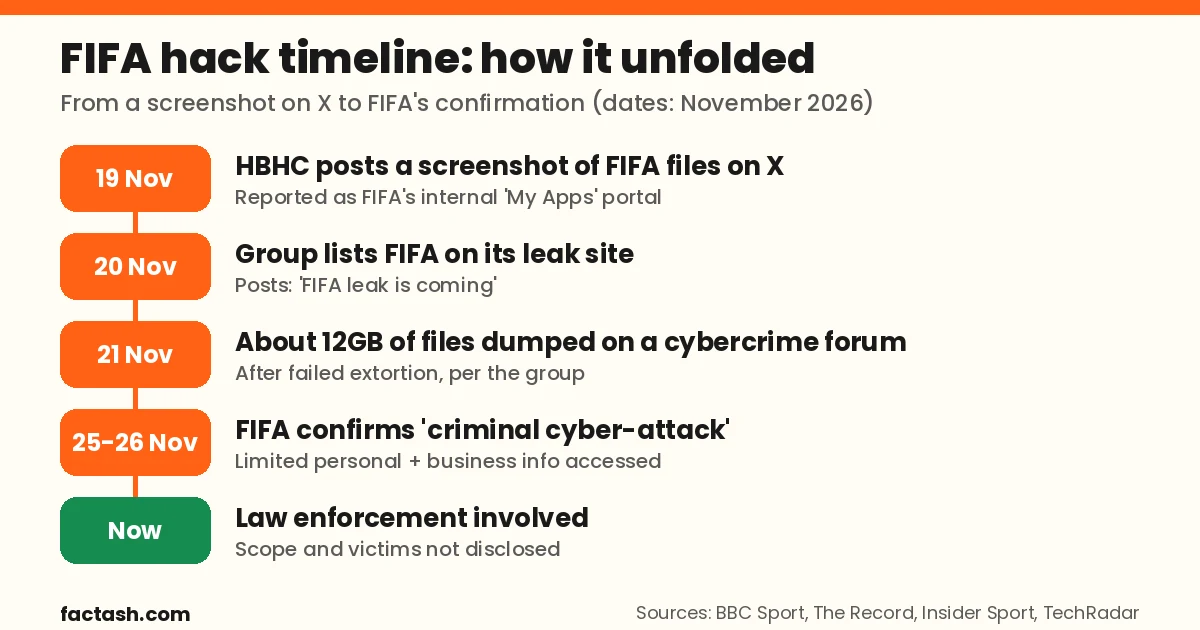
Here's how it played out, pieced together from BBC Sport, The Record, Insider Sport and TechRadar:
- 19 November: HBHC posted an image on X that appeared to show FIFA's internal "My Apps" portal, a Microsoft dashboard employees use to open work apps (Insider Sport).
- 20 November: The group posted "FIFA leak is coming," and attack-tracking account Hackmanac flagged the breach claim on the dark web (TechRadar).
- 21 November: Analysts said about 12.2GB of internal documents had been taken. The group says it tried to extort FIFA, failed, and then dumped the files on a cybercrime forum (The Record, TechRadar).
- 25-26 November: FIFA confirmed the attack to The Athletic, The Record, BBC Sport and others.
FIFA's full statement is short and spicy: "FIFA can confirm that it has been the victim of a criminal cyber-attack resulting in unauthorised access to a limited set of personal and business information. FIFA is working closely with the relevant authorities, including law enforcement. FIFA condemns in the strongest possible terms the unlawful acquisition and publication of information, particularly personal data."
What data was stolen in the FIFA data breach?
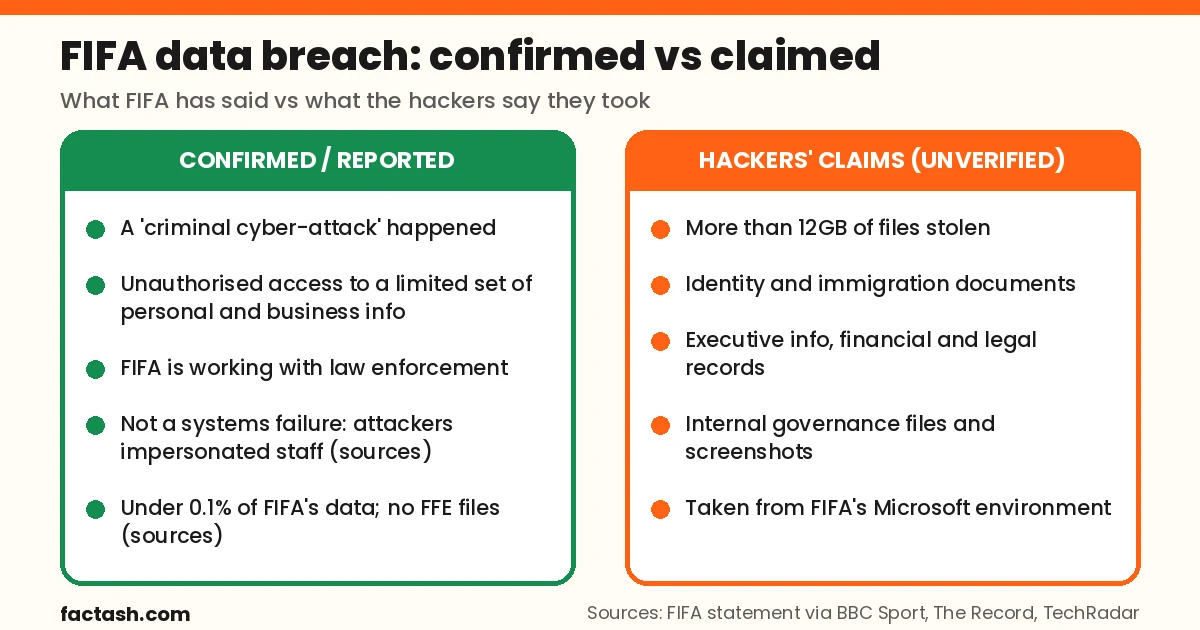
This is where you need to separate facts from flexing.
| Status | |
|---|---|
| A criminal cyberattack happened | Confirmed by FIFA |
| "Limited set of personal and business information" accessed | Confirmed by FIFA |
| Less than 0.1% of all FIFA data affected | Reported by sources (The Athletic, BBC Sport) |
| Attackers impersonated staff, no systems failure | Reported by sources |
| No Fifa Forward Enterprise (FFE) documents in the leak | Reported by BBC Sport |
| 12GB+ of files stolen | Hackers' claim |
| Identity and immigration documents, executive info, financial, legal and governance files | Hackers' claim |
| Files came from FIFA's Microsoft environment | Hackers' claim |
One security site, Secure.com, says a review of the leaked copy by DarknetSearch counted 2,460 files, including 169 labelled as passports and 116 as visas. That's a single third-party analysis, not something FIFA has confirmed, so treat it as "reported," not gospel.
Translation: even if it's "only 0.1%," passport and visa scans are the kind of data that fuels identity fraud for years. As Huntress's Dray Agha told TechRadar, criminals can reuse those personal details for targeted fraud "long after an extortion demand fails."
Who is the Handsome Boy Hacking Club?
Honestly? Nobody really knows yet. The Record says the group "emerged last week and little is known about its members or associations," and TechRadar calls it an entirely new crew with no track record.
What we do know:
- Trackers first logged HBHC around 19 November (Secure.com).
- It also claims hits on other organisations, but researchers say those listings are unverified.
- Its latest post promises "more leaks soon."
- FIFA itself has not named who was behind the attack.
The name sounds like a meme. The data dump is not.
How did hackers get into FIFA? (Spoiler: people, not code)
According to sources who spoke to The Athletic and BBC Sport, this was not a systems or technology failure. The attackers got access "by impersonating and taking advantage of staff."
That's social engineering: pretending to be a colleague, IT support or a boss to trick someone into handing over a login, approving a sign-in, or sharing files. It's the same playbook behind a lot of 2026's biggest hacks, including the 1Password breach, which started with a single employee's GitHub account.
Factash take: you can have the fanciest firewall on Earth, but if someone can phone your help desk and sound convincing, they can walk right in. Tight access controls and strong sign-in checks on every account are the fix experts keep repeating, and it's why passkeys are becoming such a big deal.
Is my FIFA account or World Cup ticket data safe?
Based on everything reported so far, there is no sign that fan accounts, ticket purchases or payment card data were part of this breach. Reports describe the stolen material as internal FIFA staff and business files, and FIFA sources said the attack targeted the organisation, not individuals.
But FIFA hasn't published a full list of who was affected, so play it safe:
- Ignore "FIFA security alert" emails, texts or WhatsApps asking you to log in, "verify" your account or pay a fee. Scammers love riding a headline.
- Go to FIFA's website or app directly, never through a link in a message.
- Use a unique password for your FIFA account and turn on two-step verification wherever you can.
- Watch for refund or ticket scams. It's Black Friday today, and fake deal sites are everywhere. Here's how to spot AI fake online stores.
- If you ever sent FIFA a passport or visa copy (for example, as staff, media or travelling with officials), watch for identity-fraud attempts and keep an eye on any notification from FIFA.
Why is everyone talking about the FIFA hack?
- It's FIFA. Football's global governing body, the organiser of the World Cup that wrapped up this summer, with 211 member associations.
- The timing is messy. BBC Sport notes the hack lands amid controversy over President Gianni Infantino's abandoned Fifa Forward Enterprise proposal. BBC Sport understands those documents were not in the breach.
- Football is getting hammered. Days earlier, Spain's LaLiga confirmed that hackers stole fans' personal data from a fan-services platform between 14 and 16 November (BleepingComputer). CyberSmart's Jamie Akhtar told TechRadar the sporting industry is "becoming an increasingly attractive target for cybercriminals."
- India is watching too. Coverage has spread across Indian outlets like India Today and Mint.
On X, posts about the FIFA hack jumped from a handful a day to over 3,600 on 26 November (UTC), by Factash's count of X posts.
What happens next?
- Law enforcement investigation: FIFA says it's working with the relevant authorities. No arrests have been announced.
- More details? FIFA hasn't said exactly when the breach happened, how many people were affected or which systems were involved. Expect pressure for answers, especially from people whose identity documents may be in the dump.
- More leaks: HBHC is promising more. Whether it delivers, or whether its other claims hold up, is still unknown.
Stay tuned. We'll update this post if FIFA shares more.
FAQ
Was FIFA really hacked?
Yes. FIFA confirmed it was the victim of a criminal cyberattack that gave hackers unauthorised access to a limited set of personal and business information, and said it is working with law enforcement.
Who hacked FIFA?
A previously unknown group calling itself the Handsome Boy Hacking Club (HBHC) claimed responsibility and posted screenshots of FIFA files on X on 19 November 2026. FIFA has not publicly named the attackers.
What data was stolen in the FIFA data breach?
The hackers claim they took more than 12GB of files, including identity and immigration documents, executive information, financial records, legal documents and internal governance files. FIFA has only confirmed that a limited set of personal and business information was accessed, and sources say it was less than 0.1% of FIFA's data.
How did hackers get into FIFA?
According to sources cited by The Athletic and BBC Sport, the attackers impersonated FIFA staff to gain access. It was described as not being a systems or technology failure.
Are FIFA fan accounts or World Cup tickets affected?
There is no report that fan accounts, ticket data or payment cards were part of the breach. FIFA has not said who was affected, so fans should still ignore unexpected messages asking them to log in or pay, and use a unique password.
Were Gianni Infantino's FIFA Forward Enterprise documents leaked?
BBC Sport understands that the stolen data did not include documents relating to the abandoned Fifa Forward Enterprise proposal.
Keep Reading on Factash
- 1Password breach: hacked via GitHub. Is 1Password safe?
- Black Friday scams 2026: how to spot AI fake online stores
- What are passkeys? Passwordless login explained
- FBI hacked: NCIC crime database breach explained
- TfL Oyster photocard data breach: what leaked
- Microsoft 365 outage phishing scam: spot the fake email
- More Technology news
- More Cybersecurity news
Read the original report: Fifa confirms internal data stolen in cyber attack (BBC Sport, Dale Johnson, 26 November 2026).
Source: main source is BBC Sport, "Fifa confirms internal data stolen in cyber attack", Dale Johnson, 26 November 2026 (read on bbc.com), which carries FIFA's statement. Also: The Record by Recorded Future News (Jonathan Greig), TechRadar (Sead Fadilpašić, 26 November 2026), Insider Sport (Kieran O'Connor, 26 November 2026), Anadolu Agency (26 November 2026), Secure.com, India Today, Mint and, for LaLiga, BleepingComputer. FIFA's original statement was given to The Athletic. This is a developing story; the number of affected people, the breach date and the systems involved had not been disclosed as of 27 November 2026, 9:30 AM IST.
Image credits
- Featured graphic: Factash original graphic (facts from BBC Sport and The Record). No FIFA logo or news-site photos used.
- FIFA hack timeline: Factash original graphic (from BBC Sport, The Record, Insider Sport and TechRadar).
- Confirmed vs claimed: Factash original graphic (from FIFA's statement via BBC Sport, The Record and TechRadar).